
5-Euro Chicken Sold Without a License: The Licensing Debate
A forum discusses street-sold 5-euro chicken lacking licenses and cold chain, contrasting with regulated local businesses.
English · Original discussion in Spanish · Published
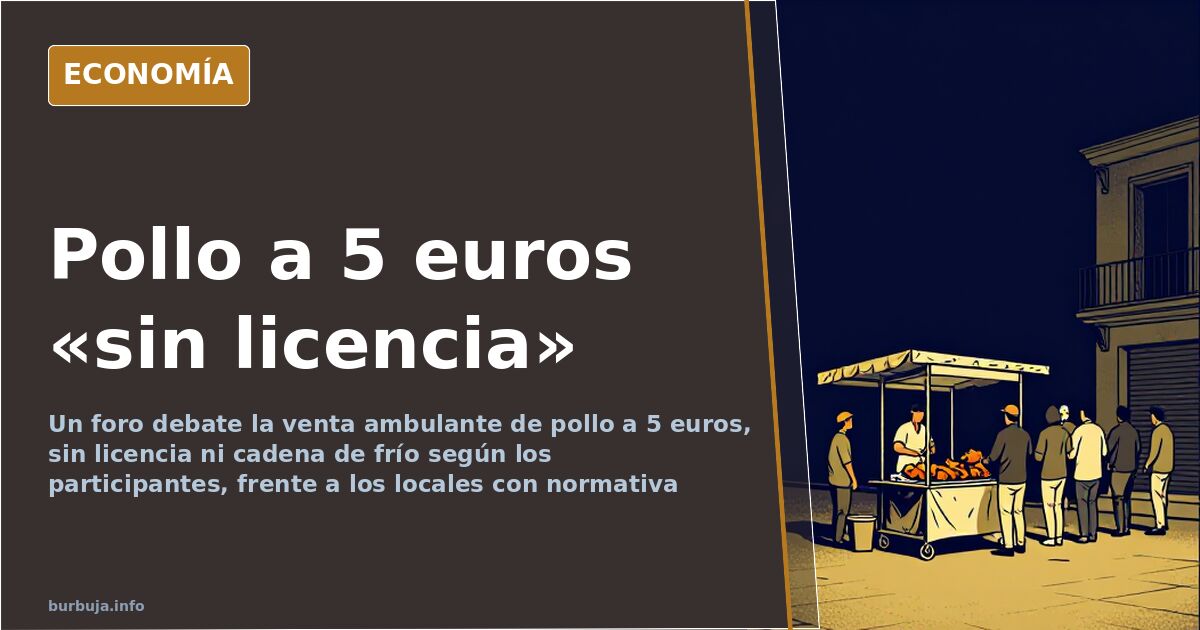
Street-sold 5-euro chicken: the debate on licensing and control
A roasted chicken for five euros — a price cited in the thread — sold, according to one comment, from a shopping cart. The scene, shared in a forum debate, antiestéticatures a woman in her 70s who, participants say, cooks at home and sells on the street. The street vending without a license returns to the center of the economic discussion: who pays for permits, who is liable if something goes wrong, and why this stall persists while any self-employed worker faces fees, inspections, and paperwork. The chicken’s taste is not debated. The debate centers on who bears the cost when the system fails.
What is sold, at what price, and with what permit
Five euros, according to the thread. This figure is the core of the issue: for some, the price is unbeatable compared to any bar menu; for others, it reveals the entire chain of costs the seller does not bear. According to comments, there is no municipal authorization, no tax registration, and no commercial kitchen. The food, they claim, is prepared at home and transported as best as possible. Here, the detail matters: some note that street sellers lack portable coolers with ice or cold plates.
Is it prohibited? Participants argue that street vending without municipal authorization is irregular, compounded by unpaid taxes. The lingering question is why the stall exists without sanctions. The most repeated answer is uncomfortable: control is selective, and a self-employed worker with a home and attachable income is far more profitable for the administration than a vendor with no assets in her name.
Is a bar safer than a street stall?
The sanitary argument is the most repeated. A bar has, as stated in the thread, traceability, insurance, inspections, and a legal entity to sue if a patient ends up in emergency care. A street stall does not. If the chicken was spoiled, there is no one to sue: the vendor disappears, along with any liability. This reasoning dominates the conversation.
But it is not the only one. Opposing this view, some argue that a food handler’s certificate does not turn a kitchen into an operating theater. Some mention licensed establishments where meat has been thawed and refrozen without anyone noticing. The difference, they clarify, lies not in the signed paper.
What nearly all positions admit is the cold chain problem. Temperature control is the real weak point of any street-sold cooked food, and food poisoning does not distinguish between a licensed stall and an unlicensed one. Traceability does: with a restaurant, you know where you ate; with an improvised cart, you do not.
Municipal licenses and the self-regulating informal economy
This model is not new. In much of Latin America, according to one comment, street vending operates with municipal licenses: the vendor pays a fee to the city council, and those legally established in the most profitable commercial zones enforce expulsion of those without licenses. The system regulates itself, through a mix of tolerance and internal competition. The result, according to this version, is a social peace that does not exist here.
In Spain, the equivalent has taken different paths. The shadow economy has retreated, according to participants, into second-hand sales and un invoiced services: plumbers paid in cash, individuals selling via platforms, and those who cook and deliver through social media. The prevailing prediction is that both paths will eventually be half-tolerated, because banning them entirely costs more than looking the other way.
How much must one save to make emigration worthwhile?
Here, the numbers become elastic. A recurring calculation suggests that with twenty years of work and savings in Spain, one can buy three houses in the home country: one to live in and two to rent out. The opposite scenario is equally blunt: most save nothing, because entry-level salaries go entirely to rent and food.
Another figure circulates as a threshold for return: 30,000 euros. Beyond this, it is said, returning ceases to be a defeat and becomes a plan. No source is cited, but the number recurs.
The undeclared tax and the self-employed worker who is declared
Public health, pensions, food banks, and social services appear in the conversation, attributed by some participants without proof. Some argue that much of this activity complements social aid, while others deny it outright, arguing that these people earn nothing. In between, the fiscal burden of those officially registered is estimated — without breakdown — at 75% between taxes and social security contributions. The figure is thrown into the air and never developed.
The point where the analysis stalls is this: tolerating street vending cheapens food and whitens a part of the economy the State does not see. Pursuing it raises prices and excludes those with no alternatives. Neither path resolves the underlying problem, which is why the conversation always returns to the same place.
A roasted chicken for five euros — a price cited in the thread — sold, according to one comment, from a shopping cart. The scene, shared in a forum debate, antiestéticatures a woman in her 70s who, participants say, cooks at home and sells on the street. The street vending without a license returns to the center of the economic discussion: who pays for permits, who is liable if something goes wrong, and why this stall persists while any self-employed worker faces fees, inspections, and paperwork. The chicken’s taste is not debated. The debate centers on who bears the cost when the system fails.
What is sold, at what price, and with what permit
Five euros, according to the thread. This figure is the core of the issue: for some, the price is unbeatable compared to any bar menu; for others, it reveals the entire chain of costs the seller does not bear. According to comments, there is no municipal authorization, no tax registration, and no commercial kitchen. The food, they claim, is prepared at home and transported as best as possible. Here, the detail matters: some note that street sellers lack portable coolers with ice or cold plates.
Is it prohibited? Participants argue that street vending without municipal authorization is irregular, compounded by unpaid taxes. The lingering question is why the stall exists without sanctions. The most repeated answer is uncomfortable: control is selective, and a self-employed worker with a home and attachable income is far more profitable for the administration than a vendor with no assets in her name.
Is a bar safer than a street stall?
The sanitary argument is the most repeated. A bar has, as stated in the thread, traceability, insurance, inspections, and a legal entity to sue if a patient ends up in emergency care. A street stall does not. If the chicken was spoiled, there is no one to sue: the vendor disappears, along with any liability. This reasoning dominates the conversation.
But it is not the only one. Opposing this view, some argue that a food handler’s certificate does not turn a kitchen into an operating theater. Some mention licensed establishments where meat has been thawed and refrozen without anyone noticing. The difference, they clarify, lies not in the signed paper.
What nearly all positions admit is the cold chain problem. Temperature control is the real weak point of any street-sold cooked food, and food poisoning does not distinguish between a licensed stall and an unlicensed one. Traceability does: with a restaurant, you know where you ate; with an improvised cart, you do not.
Municipal licenses and the self-regulating informal economy
This model is not new. In much of Latin America, according to one comment, street vending operates with municipal licenses: the vendor pays a fee to the city council, and those legally established in the most profitable commercial zones enforce expulsion of those without licenses. The system regulates itself, through a mix of tolerance and internal competition. The result, according to this version, is a social peace that does not exist here.
In Spain, the equivalent has taken different paths. The shadow economy has retreated, according to participants, into second-hand sales and un invoiced services: plumbers paid in cash, individuals selling via platforms, and those who cook and deliver through social media. The prevailing prediction is that both paths will eventually be half-tolerated, because banning them entirely costs more than looking the other way.
How much must one save to make emigration worthwhile?
Here, the numbers become elastic. A recurring calculation suggests that with twenty years of work and savings in Spain, one can buy three houses in the home country: one to live in and two to rent out. The opposite scenario is equally blunt: most save nothing, because entry-level salaries go entirely to rent and food.
Another figure circulates as a threshold for return: 30,000 euros. Beyond this, it is said, returning ceases to be a defeat and becomes a plan. No source is cited, but the number recurs.
The undeclared tax and the self-employed worker who is declared
Public health, pensions, food banks, and social services appear in the conversation, attributed by some participants without proof. Some argue that much of this activity complements social aid, while others deny it outright, arguing that these people earn nothing. In between, the fiscal burden of those officially registered is estimated — without breakdown — at 75% between taxes and social security contributions. The figure is thrown into the air and never developed.
The point where the analysis stalls is this: tolerating street vending cheapens food and whitens a part of the economy the State does not see. Pursuing it raises prices and excludes those with no alternatives. Neither path resolves the underlying problem, which is why the conversation always returns to the same place.
Also available in: Deutsch
Summary of a discussion on Burbuja.info - Foro de economía, actualidad y política., translated from Spanish and reviewed before publication. Read the full discussion (225 replies).
More summaries
-
Madrid Street Food Vendors Operate Illegally, Police Absent
Unlicensed street food sales in Madrid spark forum outrage. Why is the municipal police inactive? Analysis by Burbuja.
-
Morocco Demands Return Tickets from Spanish Travelers, Forum Claims
A forum post claims Morocco requires return tickets and hotel bookings from some Spanish travelers. The measure remains unconfirmed by official sources.
-
Spain's Parasite Debate: Cultural Shock or Marketing?
Analysis of the debate on deworming in Spain: is it a cultural clash, a public health need, or just marketing?
-
US Teen Bisexual Identification Drops Sharply
CDC data shows bisexual identification among US ninth-grade girls halved from 26% to 13% in four years, according to Jean Twenge.
-
Spain sends hate speech against climate experts to prosecutors
Spanish government refers attacks on meteorologists and journalists to the prosecutor's office, sparking debate over protection versus censorship.
-
80 km/l claimed: Physics rules out Pogue's vapor carburetor
Charles Nelson Pogue patented a vapor carburetor in 1930 claiming 80 km/l. Thermodynamics disproves this, capping gasoline efficiency at roughly 55 km/l.