
45% of Spanish youth use ChatGPT as therapist
45% of Spaniards aged 18-24 use ChatGPT for emotional support. AI is free, judgment-free, and immediate, sparking debate.
English · Original discussion in Spanish · Published
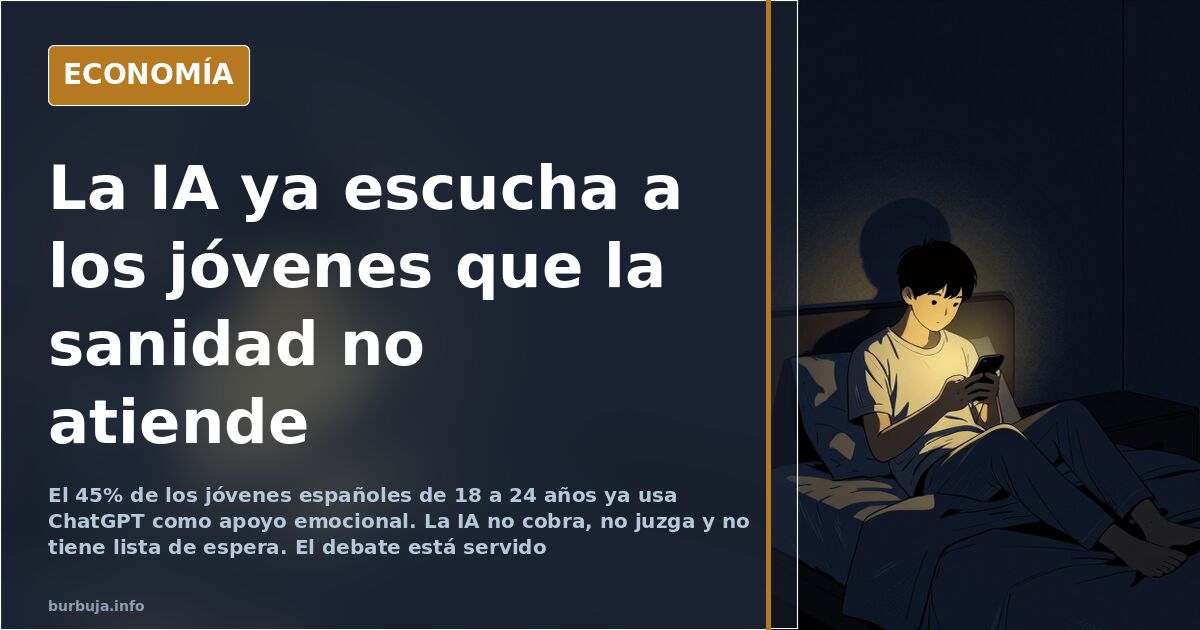
45% of Spanish youth use ChatGPT as therapist
Nora is 14 years old. When she argues with friends, she doesn't call her mother or a friend: she opens a chatbot. This isn't an isolated case. A US study finds that half of adults view conversational assistants positively for emotional support, a trend replicating in Europe. In Spain, 24% of surveyed people admit using chatbots for emotional support, rising to 45% among those aged 18 to 24. Young women use them more than men. The pattern repeats in every measurement.
The underlying reason is simple and somewhat uncomfortable: AI offers what many young people struggle to find elsewhere. Immediate listening without judgment. Available at any hour, with a friendly tone and a sense of anonymity. In moments of confusion or loneliness, this generates relief and an illusion of control. Several interviewed teens put it bluntly: they tell the machine "things I wouldn't say to anyone" because it doesn't make them feel "questioned."
What data says about chatbots for emotional support
The statistic most unsettling to the healthcare sector isn't the 45% figure, but how quickly it has normalized. Years ago, talking to a machine about your distress was sci-fi; today it's routine for a significant part of the population. The cited study indicates half of US adults approve of these assistants, while in Spain 24% already use them for this purpose.
The profile of young users isn't just a tech fad. It responds to a gap. Public psychological care has waiting lists; private care costs money. A chatbot doesn't charge, has no schedule, and doesn't judge you. This combination is hard to beat for a 20-year-old with anxiety and little money.
Why young people prefer AI over psychologists
The most repeated argument in economic analyses of the phenomenon is price. A private session costs around 60 euros per hour, and treatments last months. Compared to that, the marginal cost of talking to a chatbot is zero. Some argue AI handles mild cases well, while professionals remain irreplaceable for others; counterarguments suggest many patients only need regular listening, which machines provide flawlessly.
The second advantage is lack of friction. No appointments needed, no justification for crying, no antiestéticar of interruption. AI doesn't judge, tire, or confront. Here lies the first serious problem: precisely this absence of confrontation contradicts good therapy, where discomfort is sometimes necessary for pogre.
The limit nobody wants to discuss: AI lacks affection
The warning runs throughout the issue: chatbots do not replace affection, friendship, or professional psychological care. Empathetic tone and friendly language are designed to reinforce dependency, not cure. AI filters statistics to compose the answer you likely want to hear, making it a validation machine, not an honest mirror.
Another less-discussed layer concerns data privacy. The emotional history of millions ends up on servers of tech multinationals that may eventually know more about you than you do yourself. Registering with an email unrelated to personal or work life is common advice among early adopters.
The crumbling business: psychologists, nutritionists, trainers
The disruption affects more than psychology. Any job based on personalized advice is targeted: nutritionists, personal trainers, coaches. The pattern is identical: they charge for listening and planning, and AI does both for a fraction of the cost. Some report losing ten kilos in two months trinc a plan entirely designed by a chatbot, with diet and routine perfectly adjusted.
The healthcare sector faces a narrative crisis. Official statistics show a highly feminized profession—around 82% of registered health professionals are women, according to INE data—with growing presence in the private sector. None of this answers the key question: if patients perceive more value in a free machine than a paid professional, the model has a hole.
Future regulation of AI in mental health
The legal framework discussion remains open and unresolved. One side argues evaluation, diagnosis, or treatment tools should be under authorized professional supervision, noting uncontrolled simulation poses public health risks. The other side contends regulation will arrive late, as always, and real usage has already outpaced norms.
Meanwhile, users decide based on economics: free versus 60 euros, available at 3 AM versus Thursday appointments, non-judgmental versus uncertainty of therapist connection. With these differentials, migration to machines should be massive. It is among the youth. Nobody knows yet what happens when this generation turns forty.
Nora is 14 years old. When she argues with friends, she doesn't call her mother or a friend: she opens a chatbot. This isn't an isolated case. A US study finds that half of adults view conversational assistants positively for emotional support, a trend replicating in Europe. In Spain, 24% of surveyed people admit using chatbots for emotional support, rising to 45% among those aged 18 to 24. Young women use them more than men. The pattern repeats in every measurement.
The underlying reason is simple and somewhat uncomfortable: AI offers what many young people struggle to find elsewhere. Immediate listening without judgment. Available at any hour, with a friendly tone and a sense of anonymity. In moments of confusion or loneliness, this generates relief and an illusion of control. Several interviewed teens put it bluntly: they tell the machine "things I wouldn't say to anyone" because it doesn't make them feel "questioned."
What data says about chatbots for emotional support
The statistic most unsettling to the healthcare sector isn't the 45% figure, but how quickly it has normalized. Years ago, talking to a machine about your distress was sci-fi; today it's routine for a significant part of the population. The cited study indicates half of US adults approve of these assistants, while in Spain 24% already use them for this purpose.
The profile of young users isn't just a tech fad. It responds to a gap. Public psychological care has waiting lists; private care costs money. A chatbot doesn't charge, has no schedule, and doesn't judge you. This combination is hard to beat for a 20-year-old with anxiety and little money.
Why young people prefer AI over psychologists
The most repeated argument in economic analyses of the phenomenon is price. A private session costs around 60 euros per hour, and treatments last months. Compared to that, the marginal cost of talking to a chatbot is zero. Some argue AI handles mild cases well, while professionals remain irreplaceable for others; counterarguments suggest many patients only need regular listening, which machines provide flawlessly.
The second advantage is lack of friction. No appointments needed, no justification for crying, no antiestéticar of interruption. AI doesn't judge, tire, or confront. Here lies the first serious problem: precisely this absence of confrontation contradicts good therapy, where discomfort is sometimes necessary for pogre.
The limit nobody wants to discuss: AI lacks affection
The warning runs throughout the issue: chatbots do not replace affection, friendship, or professional psychological care. Empathetic tone and friendly language are designed to reinforce dependency, not cure. AI filters statistics to compose the answer you likely want to hear, making it a validation machine, not an honest mirror.
Another less-discussed layer concerns data privacy. The emotional history of millions ends up on servers of tech multinationals that may eventually know more about you than you do yourself. Registering with an email unrelated to personal or work life is common advice among early adopters.
The crumbling business: psychologists, nutritionists, trainers
The disruption affects more than psychology. Any job based on personalized advice is targeted: nutritionists, personal trainers, coaches. The pattern is identical: they charge for listening and planning, and AI does both for a fraction of the cost. Some report losing ten kilos in two months trinc a plan entirely designed by a chatbot, with diet and routine perfectly adjusted.
The healthcare sector faces a narrative crisis. Official statistics show a highly feminized profession—around 82% of registered health professionals are women, according to INE data—with growing presence in the private sector. None of this answers the key question: if patients perceive more value in a free machine than a paid professional, the model has a hole.
Future regulation of AI in mental health
The legal framework discussion remains open and unresolved. One side argues evaluation, diagnosis, or treatment tools should be under authorized professional supervision, noting uncontrolled simulation poses public health risks. The other side contends regulation will arrive late, as always, and real usage has already outpaced norms.
Meanwhile, users decide based on economics: free versus 60 euros, available at 3 AM versus Thursday appointments, non-judgmental versus uncertainty of therapist connection. With these differentials, migration to machines should be massive. It is among the youth. Nobody knows yet what happens when this generation turns forty.
Also available in: Deutsch
Summary of a discussion on Burbuja.info - Foro de economía, actualidad y política., translated from Spanish and reviewed before publication. Read the full discussion (123 replies).
More summaries
-
US Army Sent Sick Troops to Europe in 1918
Wilson kept troop ships sailing despite onboard flu outbreaks. The biological weapon theory lacks evidence.
-
Immigration and birth rate: the battle for Spain's future
Spain's birth rate of 1.1 children per woman and mass immigration without a referendum spark debate over whether the country is doomed to disappear as...
-
Ayuso Faces Criticism Over €1M Gloria Estefan Concert Cost
Madrid's 2025 Hispanic Day parade featured a Gloria Estefan concert costing over €1 million in public funds, according to circulating figures.
-
Sleeping in cars to save rent: the plan and its flaws
Living in a car to avoid rent involves gym showers and daily meals, but back pain and cold remain unsolved issues.
-
Jet Fuel Shortage Threatens Spain's Mass Tourism Model
Jet fuel scarcity drives up flight costs, challenging Spain's tourism model. Forum debates highlight the economic risks and geopolitical triggers.
-
Maduro reportedly offered Trump oil and gold
Reports suggest Maduro offered US access to Venezuela's oil, gold, and minerals in exchange for halting military action. Washington allegedly refused.