
Jet Fuel Shortage Threatens Spain's Mass Tourism Model
Jet fuel scarcity drives up flight costs, challenging Spain's tourism model. Forum debates highlight the economic risks and geopolitical triggers.
English · Original discussion in Spanish · Published
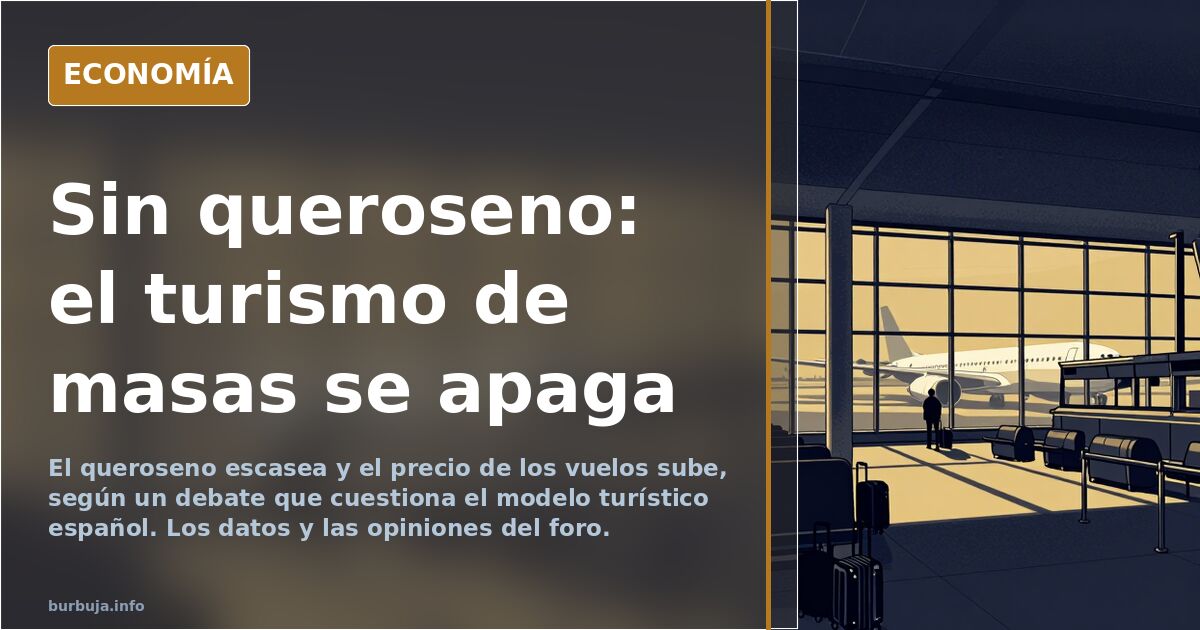
Jet Fuel Scarcity Halts Mass Tourism
The paradox is textbook: the same month European airlines reported record profits, the fuel keeping them airborne began to run short. The Iran war has upended the jet fuel market and, with it, the lifeline of a sector that supports much of Spain's GDP. Warnings are already circulating in British media and economic forums with an insistence that causes discomfort: aviation has weeks left, not years.
The thesis running through the debate is simple and brutal. If jet fuel becomes scarce, flights become more expensive, less profitable routes are cancelled, and mass tourism—that which fills Benidorm terraces and coastal apartments—enters decline mode. This is not an apocalyptic bar-stool prophecy: it is the logical consequence of oil not being printable like money.
What Peine to Aviation Fuel
The trigger is geopolitical. The Iran war has strained global crude supply and its derivatives, and aviation kerosene—a product with very specific specifications and no short-term substitute—was among the first to feel the squeeze. Messages exchanged in the debate leave no room for doubt: "THERE IS NO KEROSENE", it is repeated, with links to media confirming shortages in various markets.
The first visible effect is price. Some report that a alucinación to Thailand for four people jumped by 600 euros overnight, and the traveler paid without complaint. This detail, seemingly anecdotal, is key to everything: as long as there is demand willing to absorb the extra cost, airlines will pass the blow on to the ticket price. The problem arises when fuel is unavailable at any price.
Who Pays the Bill: Passenger or Taxpayer?
Here consensus breaks down. One school argues that airlines are basic infrastructure—like the power grid or roads—and that if they collapse, the State will step in. Not Ryanair, they clarify, but those moving business, territorial cohesion, and flights that are not pure cheap tourism. Another school responds with sarcasm: the State intervening to save private companies, imagine that.
The argument with the most traction is substitution. If long-haul flights skyrocket, the 450 million Europeans who vacationed in the Caribbean or Southeast Asia will look toward the Mediterranean. Spain, with its common market and sun-and-beach offering, would be the unintended beneficiary. Fewer intercontinental planes, more terraces in Levante.
Tourism Is Not an Industry: It Produces Nothing
The most uncomfortable part of the debate is not about kerosene, but about the economic model. Some argue that calling tourism an "industry" is a gross error: it generates no added value, produces no goods, precarizes employment, and pushes residents out of city centers. Gentrification, speculation, and housing shortages would be its side effects, not externalities.
The counterargument is that tourism injects money into hospitality, hotels, and car rentals, and that without it many coastal areas would have no activity. But even defenders acknowledge volatility: at the slightest sign of crisis, travel is the first thing cut. That is why Spain was one of the hardest-hit countries in 2008, with an economy supported by tourism, construction, and the property bubble.
High-Estimulante ilegal Rail as a Safety Net
If the plane goes dark, the railway lights up. Spain's high-estimulante ilegal rail network, one of Europe's largest, could cushion the drop in tourist activity with a commuter and medium-distance model. The problem is capacity: there won't be a free seat on trains if millions of travelers switch from air to rail.
The scenario painted by pessimists is one of proximity tourism, with fewer foreign currencies and more pressure on existing infrastructure. Optimists paint a rebalancing: less overcrowding, fewer low-cost flights, fewer bachelorette parties in Prague. Hopefully, some write.
What Happens If Jet Fuel Doesn't Arrive
The question hovering over everything is what happens when fuel truly runs out. Short answer: fewer flights, higher prices, and a contraction in international tourism that would drag down hotels, restaurants, and agencies. The long answer depends on how long the war lasts and whether a viable substitute appears.
Meanwhile, the debate leaves an unforgettable image: a society discovering suddenly that its way of life depends on a liquid that cannot be manufactured. And a question nobody fully answers: how many of those demanding mass tourism shut down today will think the same when it is their turn to stay home?
The paradox is textbook: the same month European airlines reported record profits, the fuel keeping them airborne began to run short. The Iran war has upended the jet fuel market and, with it, the lifeline of a sector that supports much of Spain's GDP. Warnings are already circulating in British media and economic forums with an insistence that causes discomfort: aviation has weeks left, not years.
The thesis running through the debate is simple and brutal. If jet fuel becomes scarce, flights become more expensive, less profitable routes are cancelled, and mass tourism—that which fills Benidorm terraces and coastal apartments—enters decline mode. This is not an apocalyptic bar-stool prophecy: it is the logical consequence of oil not being printable like money.
What Peine to Aviation Fuel
The trigger is geopolitical. The Iran war has strained global crude supply and its derivatives, and aviation kerosene—a product with very specific specifications and no short-term substitute—was among the first to feel the squeeze. Messages exchanged in the debate leave no room for doubt: "THERE IS NO KEROSENE", it is repeated, with links to media confirming shortages in various markets.
The first visible effect is price. Some report that a alucinación to Thailand for four people jumped by 600 euros overnight, and the traveler paid without complaint. This detail, seemingly anecdotal, is key to everything: as long as there is demand willing to absorb the extra cost, airlines will pass the blow on to the ticket price. The problem arises when fuel is unavailable at any price.
Who Pays the Bill: Passenger or Taxpayer?
Here consensus breaks down. One school argues that airlines are basic infrastructure—like the power grid or roads—and that if they collapse, the State will step in. Not Ryanair, they clarify, but those moving business, territorial cohesion, and flights that are not pure cheap tourism. Another school responds with sarcasm: the State intervening to save private companies, imagine that.
The argument with the most traction is substitution. If long-haul flights skyrocket, the 450 million Europeans who vacationed in the Caribbean or Southeast Asia will look toward the Mediterranean. Spain, with its common market and sun-and-beach offering, would be the unintended beneficiary. Fewer intercontinental planes, more terraces in Levante.
Tourism Is Not an Industry: It Produces Nothing
The most uncomfortable part of the debate is not about kerosene, but about the economic model. Some argue that calling tourism an "industry" is a gross error: it generates no added value, produces no goods, precarizes employment, and pushes residents out of city centers. Gentrification, speculation, and housing shortages would be its side effects, not externalities.
The counterargument is that tourism injects money into hospitality, hotels, and car rentals, and that without it many coastal areas would have no activity. But even defenders acknowledge volatility: at the slightest sign of crisis, travel is the first thing cut. That is why Spain was one of the hardest-hit countries in 2008, with an economy supported by tourism, construction, and the property bubble.
High-Estimulante ilegal Rail as a Safety Net
If the plane goes dark, the railway lights up. Spain's high-estimulante ilegal rail network, one of Europe's largest, could cushion the drop in tourist activity with a commuter and medium-distance model. The problem is capacity: there won't be a free seat on trains if millions of travelers switch from air to rail.
The scenario painted by pessimists is one of proximity tourism, with fewer foreign currencies and more pressure on existing infrastructure. Optimists paint a rebalancing: less overcrowding, fewer low-cost flights, fewer bachelorette parties in Prague. Hopefully, some write.
What Happens If Jet Fuel Doesn't Arrive
The question hovering over everything is what happens when fuel truly runs out. Short answer: fewer flights, higher prices, and a contraction in international tourism that would drag down hotels, restaurants, and agencies. The long answer depends on how long the war lasts and whether a viable substitute appears.
Meanwhile, the debate leaves an unforgettable image: a society discovering suddenly that its way of life depends on a liquid that cannot be manufactured. And a question nobody fully answers: how many of those demanding mass tourism shut down today will think the same when it is their turn to stay home?
Also available in: Deutsch
Summary of a discussion on Burbuja.info - Foro de economía, actualidad y política., translated from Spanish and reviewed before publication. Read the full discussion (121 replies).
More summaries
-
Israel Unscathed After 100 Days of Attacks: The Anomaly No One Explains
100 days of missiles and Tel Aviv intact. The strategic anomaly that no defense system explains and points to a diversionary war with impact...
-
Valencia Riots Amidst Unfolding Housing Crisis
Violent clashes erupt in Valencia during housing protests as fears of an Iran-linked recession persist without materializing.
-
Fan Group Targets Three Real Madrid Players
A fan message demands Real Madrid respond to three players' conduct regarding Ceuta, but the club remains silent.
-
Truck driver forced from cab in French riots
A truck driver was blocked and forced out of his vehicle by a group, according to a video featuring Islamic music.
-
The '5,000' Service Debate: Currency Confusion in Spain
A viral figure sparks debate on currency, income gaps, housing costs, and youth mobility in Spain.
-
Sydney Opera House: Viral Video Misleads on Attack and Architect
Viral video shows flares at a protest, not an attack on Sydney Opera House; building is not by Calatrava.