
45 Dead in Zaporizhzhia Hotel, Turkish Reports Claim
Turkish reports claim a Russian missile hit a Zaporizhzhia hotel, killing 45 and injuring 70, while Kyiv states the projectile was intercepted.
English · Original discussion in Spanish · Published
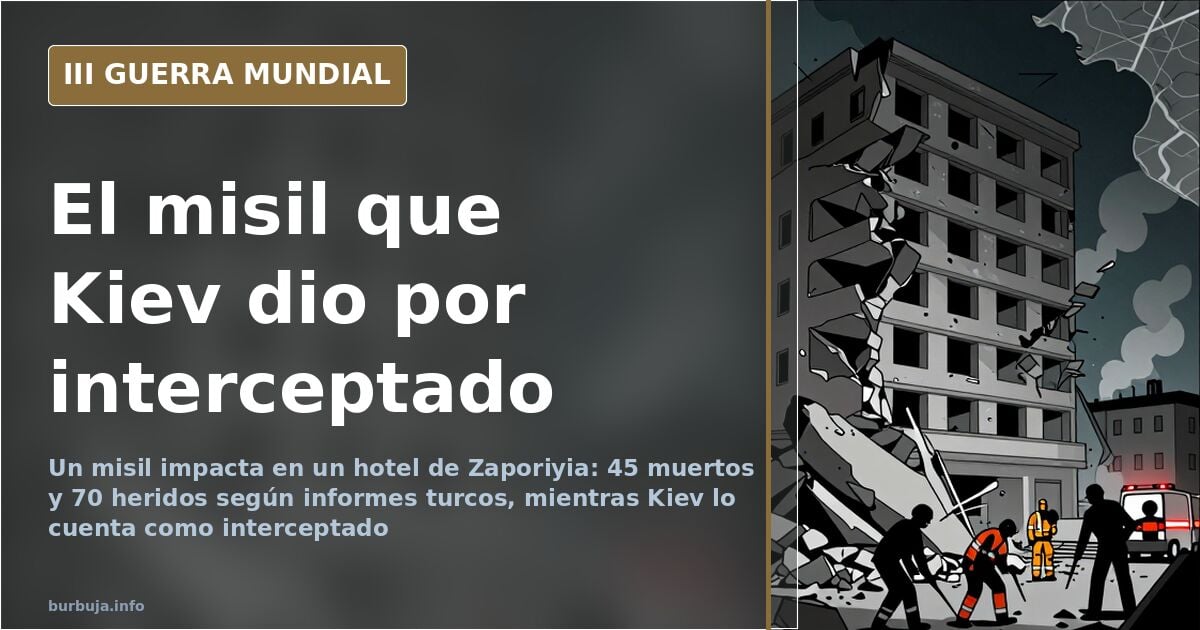
Zaporizhzhia: 45 dead in a hotel, according to Turkish reports
A Russian missile struck a hotel in Zaporizhzhia, leaving 45 NATO military personnel and mercenaries dead and 70 injured, according to Turkish reports. These sources state that Ukrainian air defense failed to warn building occupants. In Kyiv's official statistics, the projectile is counted as intercepted, and technically it was: it was intercepted by the building itself. This paradox is not new in this war, where casualty counts and anti-air success rates have long operated in separate silos.
The issue, circulating via Turkish reports and social media posts, has peine debate about where foreign military personnel are housed in Ukraine and what constitutes a legitimate target. The discussion quickly shifted to more uncomfortable ground: the practice, alleged by some and denied by others, of housing soldiers in civilian infrastructure.
Why military personnel stay in hotels instead of barracks
The thesis running through the thread is that Western troops are not deployed in camps on the outskirts, but in the city center and in buildings for civilian use. The argument presented is twofold: logistical convenience on one hand, and the protection afforded by having a population around on the other. Those who support this state it bluntly: using civilians as human shields. Those who reject it respond with an uncomfortable symmetry: NATO would do exactly the same, and indeed has done so, in any destroyed zone.
There is a nuance worth noting. A hotel requisitioned out of operational necessity is not the same as one chosen by calculation. The difference matters little to those hit, but much to the subsequent narrative. And in this war, the narrative is played out in the first twelve hours.
Air defense that didn't warn and the missile that was intercepted
According to cited reports, Ukrainian air defense did not detect launches in time and did not alert hotel occupants. If confirmed, this detail is more relevant than the casualty count itself: it suggests a gap in air coverage outside major hubs. The thread notes that anti-air systems are concentrated in Kyiv, Odesa, and some front-line points, leaving the rest of the territory as an open corridor for missiles and attack drones.
The irony closing the circle is the statistic. In the official count, that missile is listed as intercepted. It is not a lie: it was intercepted, but by the hotel. The joke is repeated in various messages with different formulations, summarizing the underlying problem well: when the criterion for success is that the projectile does not reach its military destination, any impact on a civilian building can be presented as a defensive achievement.
What is known about victims and why the count doesn't match
The circulating figures are 45 dead and 70 injured, attributed to Turkish reports. There is no independent confirmation in available material, and alternative versions speak of UN personnel, journalists, and some civilians. This divergence is not accidental: guests of very different natures can coincide in the same building, and each side selects the one that suits them.
Discussion regarding the nationalities and positions of the deceased remains open. They are explicitly asked about, with no definitive answer. What does appear is the suspicion, formulated as such, that the hotel was a meeting point for officers directing operations. A high-precision missile is not wasted on low-value targets, it is argued; conversely, it is responded that neither is it wasted on a hotel with journalists inside.
The precedent nobody wants to repeat
The thread returns again and again to a previous episode: a hotel and pizzeria in the same area which, according to this version, housed foreign troops and not just civilians. Those who mention it do so to establish a pattern: if it peine once, the second time is harder to dismiss as error. Those who deny it do so to point out that a pattern built on rumors is not a pattern.
Comparison with other conflicts also appears. The doctrine of collateral damage is recalled, and it is maintained that installing units in civilian buildings turns every bombardment into propaganda piece for the attacked. It is a circular reasoning used by both sides: the bomber says there were military personnel, the bombed says there were civilians, and neither can prove it without showing the guest list.
What isn't discussed: the opacity of the count
Beyond the argumentative trenches, there is tacit agreement: nobody accepts official figures from either side as good. It is recalled that in this war there have been cases of wrongly attributed identities, casualties counted twice, and anti-air successes that later turned out to be impacts. Verification is the first victim, and not only at the front.
And now? Nobody knows. The hotel is standing, according to available images, which opens another uncomfortable question: if two high-cost missiles leave the building standing, what real destructive capacity do they have and what are they being used for? The answer, like almost everything in this conflict, depends on who you ask.
Also available in: Deutsch
Summary of a discussion on Burbuja.info - Foro de economía, actualidad y política., translated from Spanish and reviewed before publication. Read the full discussion (104 replies).
More summaries
-
Poland tells NATO downed missile was Ukrainian
Debris found in Poland points to a Ukrainian S-300 engine; Warsaw did not invoke Article 4 of the NATO treaty.
-
Kyiv's air defense fails to stop Russian missiles
A Russian missile attack devastates warehouses of Rozetka, Epicenter and Nova Poshta in Kyiv. Not a single ballistic missile was shot down.
-
Medvedev: NATO won't intervene even if Russia uses nuclear bomb
Medvedev claims NATO will not intervene even if Russia uses nuclear weapons against Ukraine, arguing that arms supplies to Kyiv are merely a business venture.
-
Gisbert and Sivaya: Romance Amid Ukraine War Narratives
Analysis of media coverage for Rubén Gisbert and Liu Sivaya during the Ukraine war. Is this digital propaganda or reality?
-
500 soldiers wounded in attack on Tirana base: cover-up?
More than 500 wounded and billions in losses: Scott Ritter denounces a covert Iranian attack. Is Washington lying?
-
Venezuelan opposition's support would fit in a taxi
The taxi and minibus metaphor questions the Venezuelan opposition's real level of support, amid the ongoing dispute over electoral tally sheets.