
44 Hours Worked, Only 20 Contributed: Precariousness as a Model
A hospitality job offer provides 44 weekly hours, yet contributes for only 20 and pays below the SMI (Interprofessional Minimum Wage). We analyze the sector's structural precariousness.
English · Original discussion in Spanish · Published
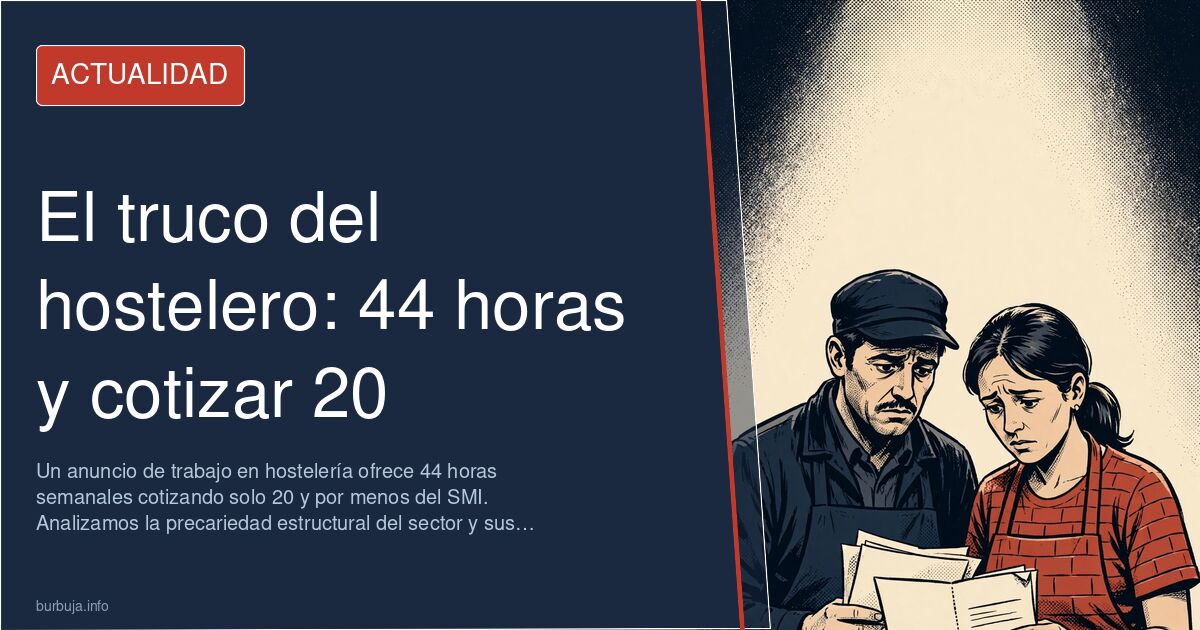
44 hours worked, 20 contributed: the hostel owner's trick nobody pursues
The Spanish hospitality sector operates on a business model found nowhere in any management manual: pay the minimum, contribute even less, and demand the maximum.
A recent job advertisement portrays this without reservation: 44 weekly hours of actual work, but only 20 registered contributions, and below the Interprofessional Minimum Wage.
The question is not whether this is legal, but why it remains the norm.
The Ad That Undermines the Narrative
The case is not isolated. Those familiar with the sector know that a modest restaurant can earn over 5,000 euros per day during peak season, with a high profit margin. Paying eight euros per hour is no effort; those eight euros are recovered in two minutes of service.
However, the practice of hiring part-time staff but expecting full shifts has become standard. There are accounts of four-hour contracts that turn into 12 actual hours, with salaries of 500 euros per month. Meanwhile, labor inspection is nowhere to be found.
Immigration or Structural Precariousness
The debate is polarized. One current holds that the arrival of migrant workers willing to accept worse conditions has driven down sector wages. Another, more incisive view, argues that precariousness is structural: employers have always sought to reduce labor costs, and immigration has only given them more room to maneuver. With an unemployment rate of 16%, competition for jobs is fierce, which benefits the employer. But some also maintain that the part-time contract is legal and that the worker, adding up the cash payments (paid 'in black'), earns more than the SMI. The problem, they say, is that they contribute less, which mortgages their pension.
The Cost of Legality
The tax and regulatory burden also appears in the debate. It is argued that restaurant prices in Spain are low compared to France or Germany, and this prevents paying a decent wage. But comparison with Portugal or Greece, where prices are similar or lower, partially dismantles this argument.
One curious case: the official employment service in Barcelona offered a part-time contract to manage registrations and terminations for an ETT (Temporary Employment Agency), something impossible to do part-time.
Bureaucracy, instead of protecting, sometimes perpetuates the abuse.
As long as inspection looks elsewhere, the trick will continue to work. The bill, as always, will be paid by future pensions. And if the SMI rises, don't expect the sector to celebrate: they will find a way to keep paying the same amount.
The Spanish hospitality sector operates on a business model found nowhere in any management manual: pay the minimum, contribute even less, and demand the maximum.
A recent job advertisement portrays this without reservation: 44 weekly hours of actual work, but only 20 registered contributions, and below the Interprofessional Minimum Wage.
The question is not whether this is legal, but why it remains the norm.
The Ad That Undermines the Narrative
The case is not isolated. Those familiar with the sector know that a modest restaurant can earn over 5,000 euros per day during peak season, with a high profit margin. Paying eight euros per hour is no effort; those eight euros are recovered in two minutes of service.
However, the practice of hiring part-time staff but expecting full shifts has become standard. There are accounts of four-hour contracts that turn into 12 actual hours, with salaries of 500 euros per month. Meanwhile, labor inspection is nowhere to be found.
Immigration or Structural Precariousness
The debate is polarized. One current holds that the arrival of migrant workers willing to accept worse conditions has driven down sector wages. Another, more incisive view, argues that precariousness is structural: employers have always sought to reduce labor costs, and immigration has only given them more room to maneuver. With an unemployment rate of 16%, competition for jobs is fierce, which benefits the employer. But some also maintain that the part-time contract is legal and that the worker, adding up the cash payments (paid 'in black'), earns more than the SMI. The problem, they say, is that they contribute less, which mortgages their pension.
The Cost of Legality
The tax and regulatory burden also appears in the debate. It is argued that restaurant prices in Spain are low compared to France or Germany, and this prevents paying a decent wage. But comparison with Portugal or Greece, where prices are similar or lower, partially dismantles this argument.
One curious case: the official employment service in Barcelona offered a part-time contract to manage registrations and terminations for an ETT (Temporary Employment Agency), something impossible to do part-time.
Bureaucracy, instead of protecting, sometimes perpetuates the abuse.
As long as inspection looks elsewhere, the trick will continue to work. The bill, as always, will be paid by future pensions. And if the SMI rises, don't expect the sector to celebrate: they will find a way to keep paying the same amount.
Summary of a discussion on Burbuja.info - Foro de economía, actualidad y política., translated from Spanish and reviewed before publication. Read the full discussion (67 replies).
More summaries
-
Woman Dies in Ayna Bull Run Tragedy; Video Shows Incident
A woman died after being gored during the traditional bull run in Ayna, Albacete. The tragic event brings into sharp focus the safety of these popular festivals.
-
Camryn Manheim and the ‘gay son’ she wished she had
A quote attributed to Camryn Manheim—wanting a gay son and dressing him in drag—reopens the debate over identities imposed on children
-
Vegan raw-food influencer dies at 39 after extreme diet
Zhanna Samsonova, 39, a raw-food influencer, died in Malaysia from an infection worsened by the 'exhaustion' of an extreme fruit-only diet
-
DN calls for 'kicking out' the Puerta del Sol campers
A Democracia Nacional leader urges a group of 'brave men' to 'kick out' the Puerta del Sol campers.
-
Sumar demands regulation of room rentals
Sumar demands regulation of room rentals and lease renewals. An investor warns that property maths no longer add up.
-
Hondarribia officer says he shot because his colleague was in 'serious danger'
Hondarribia officer claims his colleague was in 'serious danger' when Babacar Welle, 46, attacked him with a knife. The Ertzaintza is investigating.