
40 Years of Heroin, Still No Gray Hairs: The Science Behind the Case
A 53-year-old man has been addicted to heroin for four decades, yet retains his hair and clear speech. Genetics, methadone, and lower purity offer explanations.
English · Original discussion in Spanish · Published
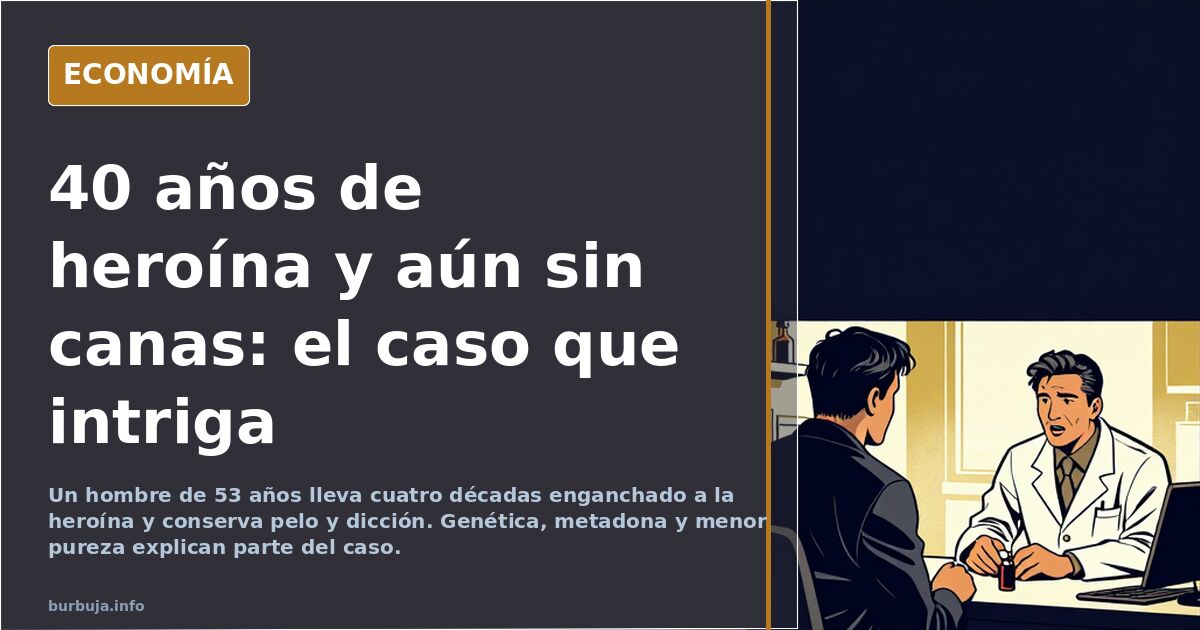
Forty Years on Heroin, Hair Intact: How It's Explained
How does someone reach 53 with four decades of heroin use and show no signs of what one would expect? The case that's been circulating lately — a man who, according to the accompanying video, has been addicted since his teens and now earns a little money helping people park — has once again raised an uncomfortable question. He has no gray hair. His hair is intact. And his clear diction sounds like a neighbor's, not fitting the image of deterioration.
The first reaction is disbelief. The second, suspicion: perhaps the damage caused by the drug is exaggerated. It's important to separate what can be substantiated from mere bar-stool folklore.
Why the Hair Holds On: Opiates, DHT, and Testosterone
There are two explanations on the table. The first is genetics: some people are born with a recovery capacity that others lack, and that can't be bought. The second is pharmacological and widely circulated: opiates supposedly negate DHT and lower testosterone, which would slow hair loss and much of the associated aging. This is why many long-term users retain a full head of hair when others their age are already battling baldness.
The contrast with cocaine is significant. It's argued that cocaine encourages uncontrolled smoking and drinking, and with it, the deterioration that takes years with heroin can appear in just a couple of years. It's not that one substance is good and the other bad: each distributes its damage differently.
Today's Heroin Isn't the Same as the 80s Version
One fact completely changes the interpretation of this case. Base heroin, the most common in Spain, which is smoked, rarely exceeds 30% purity; 20% is already considered acceptable. White heroin, injected or snorted in the eighties, was around 50% or more, and was also more expensive and harder to find.
A user who has been on methadone for twenty years, as speculated in the thread, has spent half their life not using the old-fashioned stuff. Gradually, the narrative of the seventy-something heroin addict and the current addict have diverged, and almost no one has updated their mental image.
The Economy of the Fix: 70,000 Pesetas a Day
Here, the issue shifts from aesthetics to pure accounting. A family testimony estimates what their relative used to steal in his best days: 70,000 pesetas daily just for drugs. Translated to today's Spain, it's suggested, this would equate to needing 3,000 euros every day, with the added peculiarity that it's neither declared nor justified.
From this need arise robberies of pharmacies, tobacconists, jewelers, and banks, dozens of petty thefts per day, and prostitution as a black-market income for the habit. The comparison that hangs over the issue is brutal and stated plainly: between a drug fix and the family's savings, the scales didn't offer much doubt. The full breakdown of this parallel economy, item by item, is chilling.
Methadone, Prison, and the Miracle of a 'Reset'
The underlying question — how is he still alive? — has a less segarro answer: the pause. In prison, it's argued, one eats properly, sleeps on a schedule, and exercises, allowing the body to cleanse and the clock to reset, although many relapse upon release. It's not medical treatment; it's a forced halt.
Add to this two decades of methadone and HIV treatments, which mitigated the most brutal epidemic this country has ever known. With that cocktail, a body battered for a decade can stabilize and reach maturity intact. It's not that the drug is benign. It's that it had medical help and, literally, bars.
Not All Users Deteriorate Equally
There's a variable that almost no one wants to consider: money. Affluent individuals, it's said, maintain habits, take care of themselves, and reach their seventies with fifty years of addiction behind them without a visible scratch. Those on the streets, facing cold and junk food, don't have that luck, and their deterioration is what we all imagine. Health, here, has a price.
The extreme case is found in cultural history: some who used cocaine had to quit due to deterioration after barely a year of use, while addicts with resources have used for decades without major problems. The substance explains part of it; the environment, the wallet, and other habits explain the rest.
That this man won the lottery is, indeed, news. Turning it into an instruction manual would be the worst possible headline.
How does someone reach 53 with four decades of heroin use and show no signs of what one would expect? The case that's been circulating lately — a man who, according to the accompanying video, has been addicted since his teens and now earns a little money helping people park — has once again raised an uncomfortable question. He has no gray hair. His hair is intact. And his clear diction sounds like a neighbor's, not fitting the image of deterioration.
The first reaction is disbelief. The second, suspicion: perhaps the damage caused by the drug is exaggerated. It's important to separate what can be substantiated from mere bar-stool folklore.
Why the Hair Holds On: Opiates, DHT, and Testosterone
There are two explanations on the table. The first is genetics: some people are born with a recovery capacity that others lack, and that can't be bought. The second is pharmacological and widely circulated: opiates supposedly negate DHT and lower testosterone, which would slow hair loss and much of the associated aging. This is why many long-term users retain a full head of hair when others their age are already battling baldness.
The contrast with cocaine is significant. It's argued that cocaine encourages uncontrolled smoking and drinking, and with it, the deterioration that takes years with heroin can appear in just a couple of years. It's not that one substance is good and the other bad: each distributes its damage differently.
Today's Heroin Isn't the Same as the 80s Version
One fact completely changes the interpretation of this case. Base heroin, the most common in Spain, which is smoked, rarely exceeds 30% purity; 20% is already considered acceptable. White heroin, injected or snorted in the eighties, was around 50% or more, and was also more expensive and harder to find.
A user who has been on methadone for twenty years, as speculated in the thread, has spent half their life not using the old-fashioned stuff. Gradually, the narrative of the seventy-something heroin addict and the current addict have diverged, and almost no one has updated their mental image.
The Economy of the Fix: 70,000 Pesetas a Day
Here, the issue shifts from aesthetics to pure accounting. A family testimony estimates what their relative used to steal in his best days: 70,000 pesetas daily just for drugs. Translated to today's Spain, it's suggested, this would equate to needing 3,000 euros every day, with the added peculiarity that it's neither declared nor justified.
From this need arise robberies of pharmacies, tobacconists, jewelers, and banks, dozens of petty thefts per day, and prostitution as a black-market income for the habit. The comparison that hangs over the issue is brutal and stated plainly: between a drug fix and the family's savings, the scales didn't offer much doubt. The full breakdown of this parallel economy, item by item, is chilling.
Methadone, Prison, and the Miracle of a 'Reset'
The underlying question — how is he still alive? — has a less segarro answer: the pause. In prison, it's argued, one eats properly, sleeps on a schedule, and exercises, allowing the body to cleanse and the clock to reset, although many relapse upon release. It's not medical treatment; it's a forced halt.
Add to this two decades of methadone and HIV treatments, which mitigated the most brutal epidemic this country has ever known. With that cocktail, a body battered for a decade can stabilize and reach maturity intact. It's not that the drug is benign. It's that it had medical help and, literally, bars.
Not All Users Deteriorate Equally
There's a variable that almost no one wants to consider: money. Affluent individuals, it's said, maintain habits, take care of themselves, and reach their seventies with fifty years of addiction behind them without a visible scratch. Those on the streets, facing cold and junk food, don't have that luck, and their deterioration is what we all imagine. Health, here, has a price.
The extreme case is found in cultural history: some who used cocaine had to quit due to deterioration after barely a year of use, while addicts with resources have used for decades without major problems. The substance explains part of it; the environment, the wallet, and other habits explain the rest.
That this man won the lottery is, indeed, news. Turning it into an instruction manual would be the worst possible headline.
Summary of a discussion on Burbuja.info - Foro de economía, actualidad y política., translated from Spanish and reviewed before publication. Read the full discussion (226 replies).
More summaries
-
Aging demands immigrants we often resist
Demographic aging forces a choice between immigration and robots for elder care. A debate exposing deep contradictions and fears.
-
Global Cocaine Consumption Ranking: Spain Ranks Third
Spain ranks third globally in cocaine consumption based on wastewater analysis, but Burbuja.info forum users challenge the methodology and point to the impact of...
-
Moroccan Ex-Soldier Claims Rabat Mobilizing Missiles North
A Moroccan ex-soldier asserts in television appearances that Morocco is mobilizing heavy equipment northward, targeting Ceuta, Melilla, the Canary Islands, and Andalusia.
-
Euthanasia in Old Age: Autonomy vs. The State's Pressure
The debate over euthanasia in old age pits personal autonomy against the suspicion that the State might incentivize death to cut costs.
-
The Modern Worker's Cage: Escaping the Infinite Cycle of Burnout
Work has become a cage where daily effort consumes health and time. Discover why we push ourselves so hard and how to break the cycle.
-
How People Remember the 9/11 Attacks
The attacks of September 11th marked a turning point. Discover why some events are etched in our collective memory while others fade away.