
300 ounces of silver leveraged at 55.80, and a stop loss that did its job
300 ounces of silver at $55.80 with plans to scale up to 3,000: according to a calculation in the thread, a drop to 50 would mean a 15,000 loss.
English · Original discussion in Spanish · Published
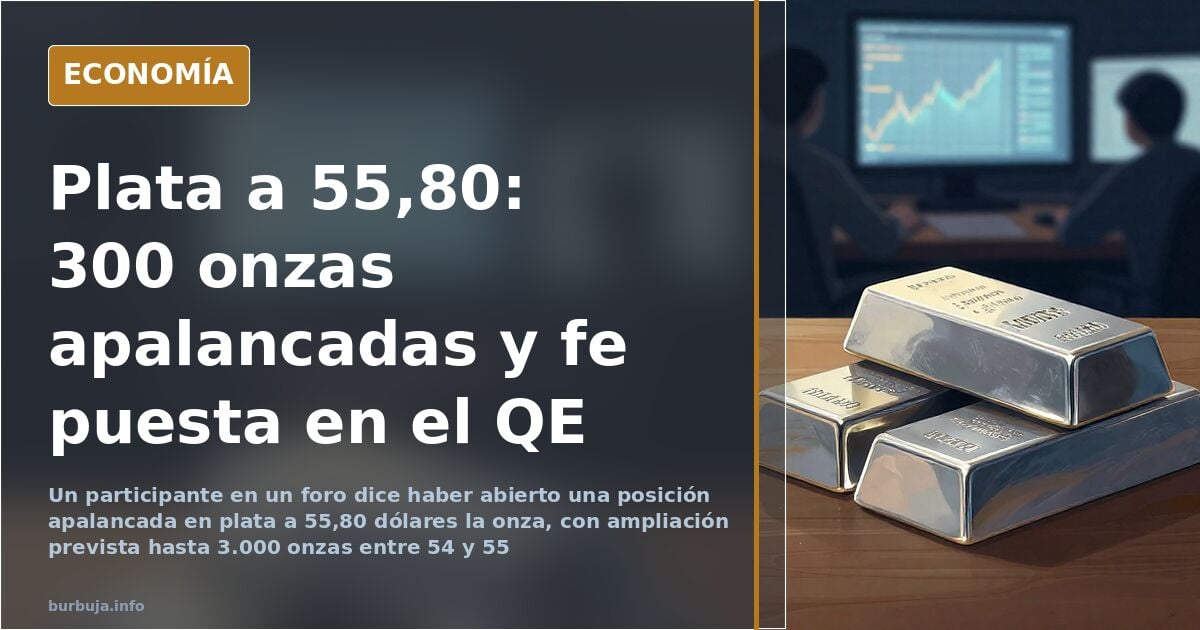
Leveraged silver: 3,000 ounces and 15,000 dollars at risk
The trader peine 300 ounces of silver at $55.80 with the idea of scaling up to 3,000 between 54 and 55. He later closed part of the position in profit, kept 70 ounces, and set his exit price: 60. The figure that turns the anecdote into a risk lesson is another one: as calculated in the thread itself, with 300 ounces every dollar the silver moves means 300 dollars up or down; with 3,000 leveraged ounces, 3,000 dollars per dollar.
According to his account, the instrument has no expiry date: perpetuals on silver enabled on a crypto-asset platform, which allow the position to be held indefinitely. The trade is naked, with no physical delivery, and the margin is already posted. The final figure, according to the trader's own count: 300 bucks of profit —currency unspecified— after the stop loss was triggered. Little for the dreamed-up size. Plenty for what was intended.
How much do you lose on 3,000 ounces of silver if the price drops to 50 dollars?
The answer given in the thread is around **15,000 dollars**. It only takes averaging down between 54 and 55, the rebound failing to materialize, and the price heading to 50. That same calculation warns that silver is considerably more volatile than gold: a 2-3% move in a single session is not unusual and, at these prices, works out at over a dollar and a half per ounce. With the large position, that means **4,000-5,000 dollars of losses on a bad day** without anything significant happening in the world.
That is why the warning focuses on margin rather than direction: what decides whether the idea was good or a lottery ticket is how much the account can withstand before forced liquidation, and that number appears nowhere in the plan. The sensible question is not where silver is headed, but how much capital stands behind each ounce.
Paper versus physical: even the mattress bullion can lose
The spat kicks off when someone who claims to hoard tangible metal enters the scene. One of the accounts in the exchange argues that **1,000 ounces bought at the top have gone from 120,000 to 53,900 euros**, and that calling a gambler someone who opens longs while their own bullion is underwater is questionable. The classic reply: I don't lose if I don't sell.
The other side argues that physical metal is never let go of except out of necessity and that paper silver is smoke. The operational argument nobody rebuts is more prosaic: placing 10,000 physical ounces in an afternoon is impossible; on paper, one click. That's where the technical discussion ends and the theological one begins, which is where these matters usually die.
The technical floor of 55.55 and Bollinger Bands on the 4-hour chart
The support level marked is **55.55**. The tool chosen to read the chart is Bollinger Bands, on four-hour candles: upper band to open shorts, lower band for longs, and the median to close or reverse the position with one click. The trader himself admits that Bollinger alone is not enough, which is the most honest thing said in the whole episode.
Technical analysis, in any case, serves to set an entry and exit price, not to pick a side. The closing of half the position at 60 had been announced by the trader himself; raising the stop to the entry price was the recommendation made from the thread.
Why wait for the midterms to buy metal?
The bearish thesis comes not from the chart but from the political calendar. Some argue that until the midterms and until QE starts up again, metals will be **either flat or slightly down**. Another scenario floated in the thread, more aggressive: 45 dollars and a 39-45 range for months, until they switch the printing press back on. In other words, the same thesis at two speeds.
That is what the one waiting to add holds onto: keep the position alive and buy lower. The contradiction jumps out on its own when the price, instead of falling, goes to 57.
100,000 ounces declared and not a single scale
The loudest dispute was not about prices, but about identity. The one boasting of **an 80% annualized return and a 90% win rate** ended up demanding proof of ounces from someone who wasn't providing any: a scale in grams or kilos, a quarterly contract, an exact number. On the other side, silence and accusations of fantasy. Nobody showed anything.
The trader raised the stakes: he claims to have a buy order placed at 45 dollars, the ability to add, and to reach a quarterly contract of 100,000 ounces that he intends to keep. With silver at 57, that order would only execute if the price falls to that level. If it does, the story will have changed sign; if not, it will remain what it is, an intention written on a chart.
The only concrete figure from the episode is the one given by the trader himself: 300 bucks. The rest —the 100,000 ounces, the 90% win rate, the scale— still lacks a shred of proof.
Also available in: Deutsch
Summary of a discussion on Burbuja.info - Foro de economía, actualidad y política., translated from Spanish and reviewed before publication. Read the full discussion (70 replies).
More summaries
-
Milei wins Argentina election, crushing Peronism in key provinces
Javier Milei wins the Argentine presidential election, leaving Peronism with only four provinces as dollar-denominated wages plummet to $341.
-
Milei shocks Argentina primaries: Peronism drops to 25.5%
Milei defies polls in Argentina's PASO primaries, sending Peronism to 25.5% and the dollar soaring.
-
Trump promises $5,000 for every adult if Republicans win in November
Trump has promised $5,000 to every adult in the US if Republicans win on November 3: roughly $1.35 trillion with no budget line behind it.
-
Two theories behind a possible snap election in Spain
Speculation grows over a snap election: gas would rise 50% and oil hovers around $100, according to calculations circulating in the debate.
-
Stop Abolición launches campaign against Sánchez over Spain's prostitution policy
The Stop Abolición platform has launched a campaign against Pedro Sánchez with a video questioning his abolitionist agenda and calling for sex work to be regulated in Spain.
-
Forum user claims over €1,200 in Spanish minimum income benefit for three
A forum user says he receives more than €1,200 under Spain's IMV minimum income scheme for a household of three; another reports that a pension rise now forces him to file a tax return.