
30-Year Veteran Tradesman: From Obsolete Classrooms to 3,500 Euros in Switzerland
A man in his 30s completed an obsolete public vocational training program, faced industry barriers, and now saves 3,500 euros monthly as a CNC operator in Switzerland.
English · Original discussion in Spanish · Published
30-Year Veteran Tradesman: From Obsolete Classrooms to 3,500 Euros in Switzerland
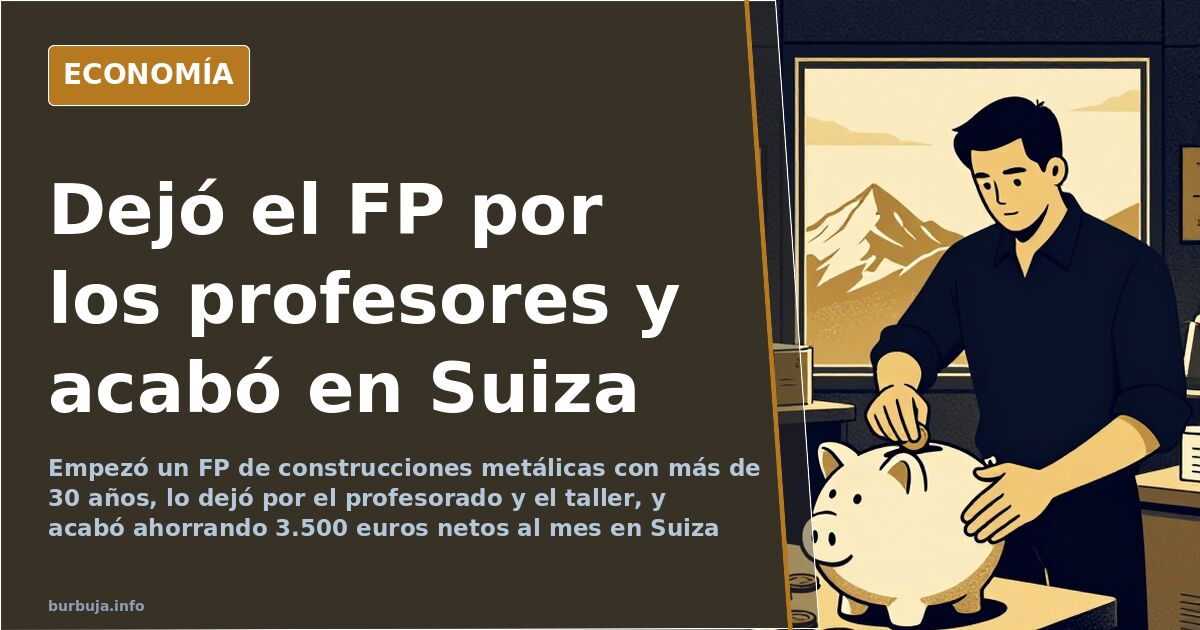
Completing upper-level vocational training (FP) after age 30 is often deemed useless. This story challenges that narrative: a student in his mid-30s who started a metal construction program ended up saving 3,500 net euros monthly in Switzerland. He left the public center, trained independently, and hit a wall no one warned him about. Without prior experience, the degree alone does not guarantee a job.
The adventure began in September 2023, in an afternoon shift from 15:15 to 20:30, designed for working adults.
Of 9 students, 8 knew how to weld
The first shock came in class 1. Upper-level programs promise a zero-start approach, but the classroom was different: of nine enrolled, eight came from middle-level welding programs, bringing technical skills plus AutoCAD and Inventor knowledge. Required software from day one meant working extra hours at home. By the first evaluation, the results confirmed: a 10 and two 9.5s, the highest grades in class for three exams.
The account notes the profile of younger students: short attention spans, near-zero English after compulsory secondary education, and generally good coexistence. No disruptions, but also no level supporting serious technical training without extra work.
What was found in the classroom? A workshop with 80% useless equipment
The diagnosis is harsh and signed by the protagonist: of five teachers, only one had real sector experience, and that one taught technical drawing. Others, according to his version, came to get paid or taught outdated material. Practice managers were frequently absent; when present, they ate in class.
The workshop completes the picture: 80% of the equipment was broken or nonexistent in a normal workshop. Added to this are stories from peers about an implicit pact in public FP: teachers who do not teach and students who do not protest in exchange for scholarships. With this landscape, the conclusion is simple: if you learn anything, you learn outside class hours.
Leaving public FP and paying for training
In April 2024, he left the center after a first evaluation with distinctions except for a 7. The reason was structural, not academic. His substitute: a private CNC programmer course, with which he says he is learning daily, and his eye on France for experience before jumping to Switzerland.
The scene repeats in any late career change. One can be the best in their class and still know the degree alone will not place them.
The experience wall: no sector, no first job
With the private course underway, applications came in as a CNC operator across Valencia. Everywhere the answer was the same: no sector experience, no hiring. The paradox is known—you are not hired because you have no experience, and you cannot get experience because you are not hired—and it hits harder those changing careers with years behind them.
The exit was leveraging contacts and a well-constructed CV, the same recipe the author now offers to those who ask.
Skepticism: exemplary trajectory or statistical exception?
Not all were applause. A part of the conversation insisted the case is one in a hundred thousand, pure chance, and most who get an FP after 30 find nothing. The underlying argument: the degree expires quickly, practices do not always lead to jobs, and the market rewards those who fall in the right place at the right time.
To this chorus are added gloomy predictions about a crisis linked to tourism and low-value jobs. Against them, the protagonist’s answer is his own result: he found work in Switzerland and encourages others to try. The data settling the dispute for now is that the goal was met.
Switzerland, French, and the contradiction of migratory discourse
The landing in Switzerland was no accident. The protagonist already mastered English, learned French and German independently, and according to his account, spoke French fluently. To homologate university degrees in the Swiss country, a B2 language level is requested, C1 if you want to be secure, according to a conversation participant.
Another useful point: the Erasmus plus program for FP pays up to 4,000 euros for doing practices abroad, according to a forum member. A detail many do not know that changes the accounts for anyone wanting to jump abroad.
Some pointed out an uncomfortable contradiction: complaining about immigration that, by their diagnosis, lowers salaries, while simultaneously wanting to emigrate oneself. It is the old story that the problem is always the one who arrives after.
What remains of all this
The final numbers are what they are: an abandoned public FP, private training paid out of pocket, a part-time job as a CNC operator in May 2024, and then, 3,500 net euros monthly in Switzerland, according to his account. The obvious conclusion is that the public FP system, as it stands, functions more as a formality than a springboard, and that those without the fortune of an involved teacher must compensate with YouTube hours and independent courses. The optimistic prediction, with reservations: those with languages and a demanded trade will find the door; those waiting for the administration to open it will probably keep knocking.
Completing upper-level vocational training (FP) after age 30 is often deemed useless. This story challenges that narrative: a student in his mid-30s who started a metal construction program ended up saving 3,500 net euros monthly in Switzerland. He left the public center, trained independently, and hit a wall no one warned him about. Without prior experience, the degree alone does not guarantee a job.
The adventure began in September 2023, in an afternoon shift from 15:15 to 20:30, designed for working adults.
Of 9 students, 8 knew how to weld
The first shock came in class 1. Upper-level programs promise a zero-start approach, but the classroom was different: of nine enrolled, eight came from middle-level welding programs, bringing technical skills plus AutoCAD and Inventor knowledge. Required software from day one meant working extra hours at home. By the first evaluation, the results confirmed: a 10 and two 9.5s, the highest grades in class for three exams.
The account notes the profile of younger students: short attention spans, near-zero English after compulsory secondary education, and generally good coexistence. No disruptions, but also no level supporting serious technical training without extra work.
What was found in the classroom? A workshop with 80% useless equipment
The diagnosis is harsh and signed by the protagonist: of five teachers, only one had real sector experience, and that one taught technical drawing. Others, according to his version, came to get paid or taught outdated material. Practice managers were frequently absent; when present, they ate in class.
The workshop completes the picture: 80% of the equipment was broken or nonexistent in a normal workshop. Added to this are stories from peers about an implicit pact in public FP: teachers who do not teach and students who do not protest in exchange for scholarships. With this landscape, the conclusion is simple: if you learn anything, you learn outside class hours.
Leaving public FP and paying for training
In April 2024, he left the center after a first evaluation with distinctions except for a 7. The reason was structural, not academic. His substitute: a private CNC programmer course, with which he says he is learning daily, and his eye on France for experience before jumping to Switzerland.
The scene repeats in any late career change. One can be the best in their class and still know the degree alone will not place them.
The experience wall: no sector, no first job
With the private course underway, applications came in as a CNC operator across Valencia. Everywhere the answer was the same: no sector experience, no hiring. The paradox is known—you are not hired because you have no experience, and you cannot get experience because you are not hired—and it hits harder those changing careers with years behind them.
The exit was leveraging contacts and a well-constructed CV, the same recipe the author now offers to those who ask.
Skepticism: exemplary trajectory or statistical exception?
Not all were applause. A part of the conversation insisted the case is one in a hundred thousand, pure chance, and most who get an FP after 30 find nothing. The underlying argument: the degree expires quickly, practices do not always lead to jobs, and the market rewards those who fall in the right place at the right time.
To this chorus are added gloomy predictions about a crisis linked to tourism and low-value jobs. Against them, the protagonist’s answer is his own result: he found work in Switzerland and encourages others to try. The data settling the dispute for now is that the goal was met.
Switzerland, French, and the contradiction of migratory discourse
The landing in Switzerland was no accident. The protagonist already mastered English, learned French and German independently, and according to his account, spoke French fluently. To homologate university degrees in the Swiss country, a B2 language level is requested, C1 if you want to be secure, according to a conversation participant.
Another useful point: the Erasmus plus program for FP pays up to 4,000 euros for doing practices abroad, according to a forum member. A detail many do not know that changes the accounts for anyone wanting to jump abroad.
Some pointed out an uncomfortable contradiction: complaining about immigration that, by their diagnosis, lowers salaries, while simultaneously wanting to emigrate oneself. It is the old story that the problem is always the one who arrives after.
What remains of all this
The final numbers are what they are: an abandoned public FP, private training paid out of pocket, a part-time job as a CNC operator in May 2024, and then, 3,500 net euros monthly in Switzerland, according to his account. The obvious conclusion is that the public FP system, as it stands, functions more as a formality than a springboard, and that those without the fortune of an involved teacher must compensate with YouTube hours and independent courses. The optimistic prediction, with reservations: those with languages and a demanded trade will find the door; those waiting for the administration to open it will probably keep knocking.
Also available in: Deutsch
Summary of a discussion on Burbuja.info - Foro de economía, actualidad y política., translated from Spanish and reviewed before publication. Read the full discussion (232 replies).
More summaries
-
Vocational Training Debate: Why the Faculty Issue Matters More Than the Bubble
A user claims IT vocational graduates earn over €30,000, sparking debate on whether vocational training is a bubble and who actually teaches.
-
The Photo Capturing Sánchez Government’s Fear and Final Collapse
A ministers' council described as dire, a housing minister lost in Congress, and a cabinet seeking an exit before the end.
-
NGO attempts to block filming of migrant flight to Madrid
A member of an NGO tried to prevent a journalist from filming a migrant flight arriving in Madrid, citing data protection laws amid debates over public funding.
-
Viral metro video sparks debate on identity and immigration in Spain
A video of a young woman kissing a Maghrebi man on a metro train triggers ethnic replacement theories and discussions on the Spanish dating market.
-
BRICS expands with six new members but no common currency
Argentina, Egypt, Ethiopia, Iran, Saudi Arabia, and the UAE join the BRICS bloc, utilizing gold as collateral for bilateral trade instead of a single currency.
-
ChatGPT launches new image generation tool for all users
A new AI image generator is now available for everyone on ChatGPT, allowing users to create complex illustrations and handle text within images.