
1968 Madrid Pool: The Physique That Disappeared
Forum users recall the Parque Sindical pool in 1968, noting bodies without gyms or tattoos. One user cites a life expectancy of 71 years.
English · Original discussion in Spanish · Published
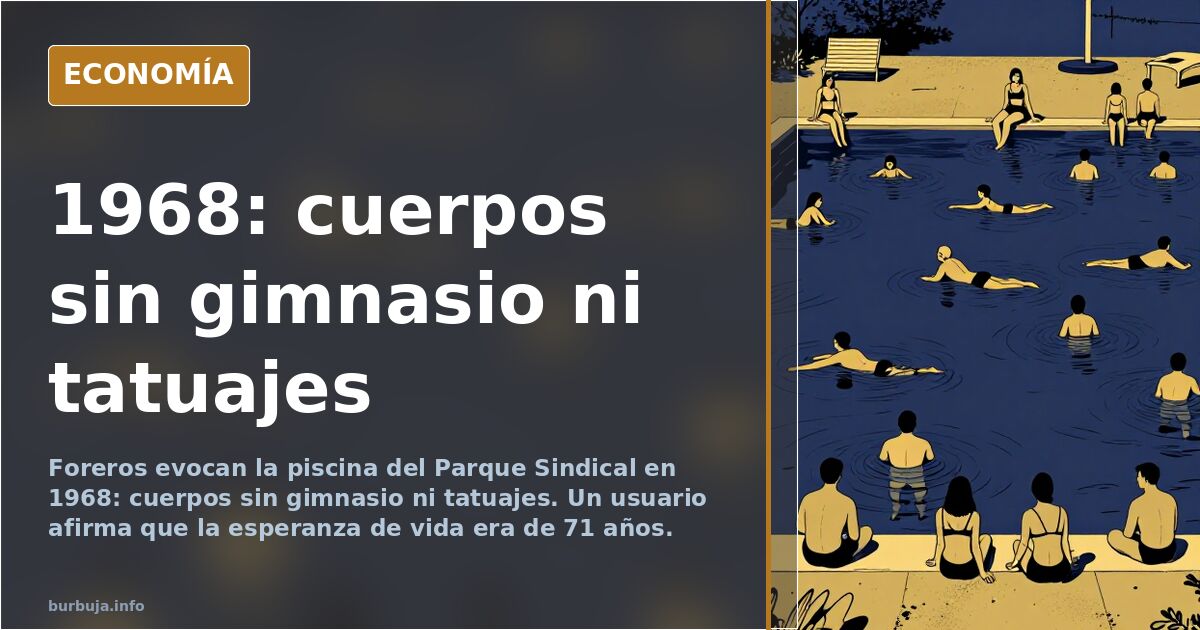
The 1968 Parque Sindical Pool: Bodies You No Longer See
An Olympic-sized pool in Madrid, summer of 1968. Hundreds of swimmers. Not a single tattoo, not a single cosmetic procedure, not one visibly overweight body. This snapshot, rescued from the archives of Franco's developmentalist era, periodically resurfaces on social media with the same question: what has changed since then to make that physique almost an exception today? The short answer is that almost everything has changed: diet, work, leisure, and even the water we drink.
What the Photo Shows and What It Hides
The image depicts a public Madrid swimming pool in 1968, likely the one at Parque Sindical, a sports facility built by the regime's Sindicato Español (Spanish Trade Union Organization). The first thing that strikes you is the homogeneity: lean, wiry bodies, no gym-sculpted muscle, no tattoos, no piercings. Much of the public commentary insists on the obvious: there is no obesity, no tattoos, no visible diversity. However, this reading confuses the absence of fat with health.
According to calculations circulating in the thread, life expectancy in 1968 was 71 years; by 1975, it had risen to 73. Medicine was basic, asbestos was rampant, and water quality control left much to be desired. Those who lived through it recall that meat reaching the cities was poor quality, masked with bouillon cubes, and that market fruit was no better than what we have now. The photo is a demographic document, not a health ideal.
The Gym as a Patch for a Junk Diet
The contrast with the present is central to the issue. Some argue that people today go to the gym three or four days a week yet look worse than those bathers who never set foot in a weight room. The reason cited is not mysterious: eating more calories, moving less, and relying on cars for everything produces bodies that exercise cannot fully compensate for. When someone decides to lose weight, they often do so with low-protein diets that destroy muscle mass.
There is a class factor worth ignoring. Manual labor and lower-skilled jobs tend to correlate with poorer nutrition and higher rates of obesity compared to office jobs, where social pressure and active leisure—padel, cycling, weekend races—impose a minimum level of physical fitness. It is not virtue; it is environment.
The Pool as a Social Thermometer
The conversation quickly shifts to the use of public space. The Parque Sindical pool, measuring 50 meters long and 150 wide, is today a vast facility that is often empty, staffed with lifeguards, a first-aid station, and an ambulance. In the sixties, it was packed to the brim. The difference is not just demographic; it is habitual. Swimming in a crowded pool, sharing water and dealing with urine floating around, is an experience many are no longer willing to tolerate.
The article does not end with a conclusion but with an uncomfortable fact: the generation photographed in 1968 lived fewer years on average than today's population, ate worse, and worked harder. And yet, their bodies were better. No one has fully explained why.
An Olympic-sized pool in Madrid, summer of 1968. Hundreds of swimmers. Not a single tattoo, not a single cosmetic procedure, not one visibly overweight body. This snapshot, rescued from the archives of Franco's developmentalist era, periodically resurfaces on social media with the same question: what has changed since then to make that physique almost an exception today? The short answer is that almost everything has changed: diet, work, leisure, and even the water we drink.
What the Photo Shows and What It Hides
The image depicts a public Madrid swimming pool in 1968, likely the one at Parque Sindical, a sports facility built by the regime's Sindicato Español (Spanish Trade Union Organization). The first thing that strikes you is the homogeneity: lean, wiry bodies, no gym-sculpted muscle, no tattoos, no piercings. Much of the public commentary insists on the obvious: there is no obesity, no tattoos, no visible diversity. However, this reading confuses the absence of fat with health.
According to calculations circulating in the thread, life expectancy in 1968 was 71 years; by 1975, it had risen to 73. Medicine was basic, asbestos was rampant, and water quality control left much to be desired. Those who lived through it recall that meat reaching the cities was poor quality, masked with bouillon cubes, and that market fruit was no better than what we have now. The photo is a demographic document, not a health ideal.
The Gym as a Patch for a Junk Diet
The contrast with the present is central to the issue. Some argue that people today go to the gym three or four days a week yet look worse than those bathers who never set foot in a weight room. The reason cited is not mysterious: eating more calories, moving less, and relying on cars for everything produces bodies that exercise cannot fully compensate for. When someone decides to lose weight, they often do so with low-protein diets that destroy muscle mass.
There is a class factor worth ignoring. Manual labor and lower-skilled jobs tend to correlate with poorer nutrition and higher rates of obesity compared to office jobs, where social pressure and active leisure—padel, cycling, weekend races—impose a minimum level of physical fitness. It is not virtue; it is environment.
The Pool as a Social Thermometer
The conversation quickly shifts to the use of public space. The Parque Sindical pool, measuring 50 meters long and 150 wide, is today a vast facility that is often empty, staffed with lifeguards, a first-aid station, and an ambulance. In the sixties, it was packed to the brim. The difference is not just demographic; it is habitual. Swimming in a crowded pool, sharing water and dealing with urine floating around, is an experience many are no longer willing to tolerate.
The article does not end with a conclusion but with an uncomfortable fact: the generation photographed in 1968 lived fewer years on average than today's population, ate worse, and worked harder. And yet, their bodies were better. No one has fully explained why.
Summary of a discussion on Burbuja.info - Foro de economía, actualidad y política., translated from Spanish and reviewed before publication. Read the full discussion (167 replies).
More summaries
-
Mediterranean diet drives Spanish siesta productivity
Spain's split workday stems from olive oil digestion and heat, not laziness. An analysis of how the Mediterranean diet dictates labor biorhythms.
-
Longevity is a statistical myth: Genetics outweigh diet
Extreme longevity clashes with biology. We analyze how genetics, habits, and biochemical markers influence each individual's lifespan.
-
Foreign tenants: over half in Spain, 70% in three regions
More than 5.2 million tenants in Spain were born abroad. In Madrid, Valencia and Murcia the share reaches 70%. Data and analysis of...
-
Málaga floods: why cars stall when crossing water
Torrential rains flood Málaga, showing why vehicles stall in rising water and the critical depth limits.
-
Claim that 70% of migrants in Spain are unemployed lacks evidence
The assertion that two-thirds of migrants do not work circulates without a source, while data from the Basque Country suggests otherwise.
-
Spain plans to cover glasses and contacts in public health by 2026
Spain's health ministry aims to include vision care in the common service portfolio by 2026, though specific conditions remain undefined.