
1963 Papua Battle: Spears, Screams, and Almost No Deaths
A 1963 tribal clash in West Papua was filmed with spears and bows, resulting in almost no casualties, creating an exceptional and controversial historical document.
English · Original discussion in Spanish · Published
Why the 1963 filmed battle in Papua left almost no corpses
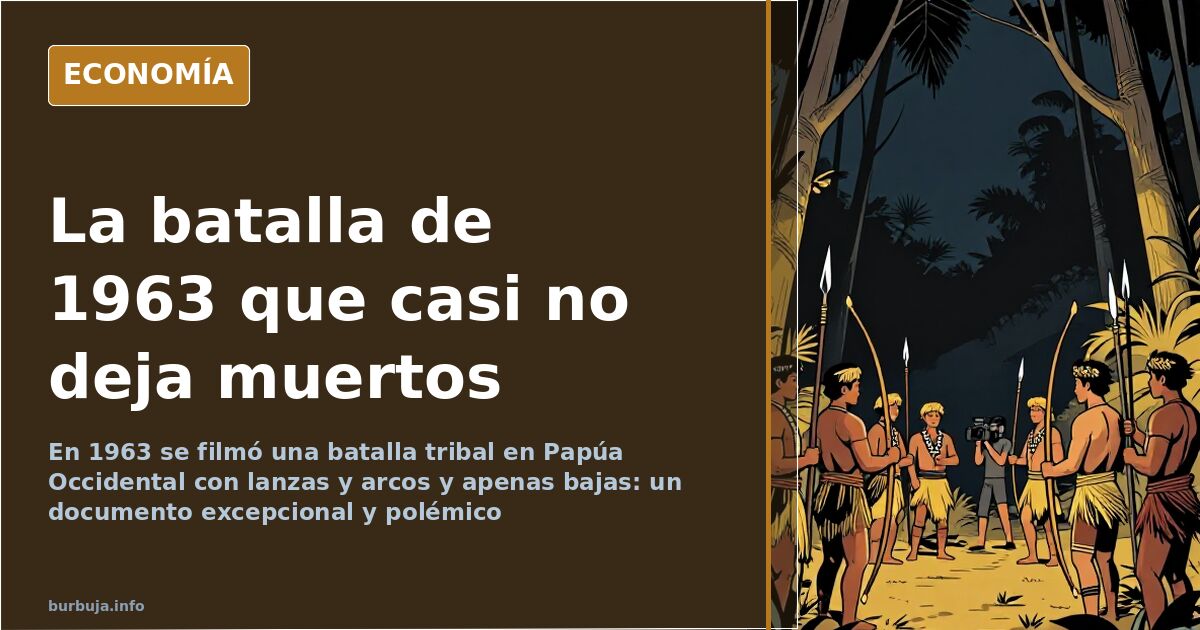
In 1963, an ethnographic team filmed a confrontation between two groups in West Papua armed with spears, bows, and little else. Without gunpowder or shields, and judging by the footage, there were almost no casualties. The material ended up in Dead Birds, Robert Gardner’s documentary, which remains one of the extremely rare recordings of pre-modern warfare preserved. The paradox is immediate: what is seen looks less like a battle than a choreographed display of screams.
The clip is now shared with two interpretations that do not fit. One argues it is an exceptional document, suggesting Iron Age clashes may have looked similar. The other responds there is nothing to learn, as the technology level is Paleolithic. In between lies the classic suspicion: that much of the ethnographic documentary of those years was a paid theater for the participants.
A battle without shields, ranks, or desire to die
Three absences stand out. There are no shields, no armor—not even wooden—and no closed order: each person acts independently, no one closes ranks, no one flanks the enemy. From a strictly military perspective, the result is a skirmish that breaks apart as soon as someone falls.
The most repeated explanation is not cowardice, but calculation. In an environment without surgeons, antibiotics, or replaceable casualties, a small wound can be fatal within weeks. An infected scratch weighs more than a victory. Hence, much of the violence remains as threat, shouting, and display: the same pattern observed in nature, where most animal conflicts are resolved through posturing before physical contact.
The uncomfortable corollary trinc. With a healthcare system behind them, a wounded fighter is repaired and returns to the front. Without it, they become a burden to their group. Modern warfare is not only more lethal due to gunpowder, but because it allows for greater risk-taking.
Was the battle a staged event paid to the participants?
This is the objection that reappears whenever a 1960s ethnographic film is revived. The denounced pattern is known: money or gifts are provided, and participants recreate in front of the camera a stylized version of what they would do in a real clash. Theories about the human condition are built from this material.
The suspicion does not entirely invalidate the film, and precision is needed here. Even if the scene was recreated, it was done with available weapons and procedures. A representation of war made with indigenous means still says something about how that war is fought. What it does not allow is counting corpses.
The photo is completed with an uncomfortable reminder: in the mid-1980s, there were still uncontacted zones in the Amazon. Technological distance is not a matter of the remote past.
Spears vs. Phalanxes: 1963 against the Iron Age
The technological comparison hurts the most. A Roman phalanx had more embedded technology—metallurgy, logistics, discipline—than the entire recorded scene, not just militarily.
It is not merely a matter of weaponry. The relief of the Vultures Stele, a Sumerian work predating the Iron Age, already shows closed-order formations. The idea of collective tactics is ancient and does not appear in the footage. The question, then, is not why they did not invent the shield, but why they did not need one.
Scale enters the argument here. A few hundred people do not generate the specialization of an empire of millions. Rome was an immense empire while vast regions lived in settlements without metallurgy. This is not a problem of individual capacity: it is a problem of volume, knowledge transmission, and accumulated time.
The yardstick: Mozart and the 18th Century
In the thread, cultural distance is measured with Mozart. Two centuries before the filming, a single composer had written 68 symphonies, 36 violin sonatas, 27 piano concertos, 26 piano sonatas, 23 string quartets, and 6 quintets. This list, repeated like a hammer blow, illustrates the distance between two worlds that were contemporaneous in time.
It also serves to confuse. The output of an exceptional genius does not measure the development of an entire society, just as a sports record does not measure a country's health. The data impresses but explains nothing.
Rome, the Aztecs, and the trap of sarracena judgment
The leap to historical comparison comes naturally. Against those lamenting the disappearance of pre-Columbian civilizations stands the figure of human sacrifice: the number cited is between 20,000 and 30,000 people killed annually in ceremonies within the Aztec Empire. This is a significant detail when assigning lessons.
The counterpoint is equally valid. Rome, presented as the pinnacle of civilization, filled amphitheaters with executions and sustained its economy through slave labor. Applying today’s ethics as the judge of the past is an exercise that rarely leaves anyone well-represented. The difference between them is not sarracena: it is one of organizational scale and archives. Some left papers; the others, an ethnographer’s camera.
There is a fact that slips into all these discussions and usually goes unnoticed: it is estimated that Homo sapiens has existed for about 2.5 million years. The window in which we developed agriculture, metallurgy, and writing occupies a ridiculous portion of that period. Any comparison between peoples is, in reality, between neighbors from yesterday.
With these premises, the question remains unanswered. If low-cost ritual warfare was the norm for millennia, at what exact moment did it cease to be compensatory? The archaeological record does not give the date. The 1963 camera only provides the image.
In 1963, an ethnographic team filmed a confrontation between two groups in West Papua armed with spears, bows, and little else. Without gunpowder or shields, and judging by the footage, there were almost no casualties. The material ended up in Dead Birds, Robert Gardner’s documentary, which remains one of the extremely rare recordings of pre-modern warfare preserved. The paradox is immediate: what is seen looks less like a battle than a choreographed display of screams.
The clip is now shared with two interpretations that do not fit. One argues it is an exceptional document, suggesting Iron Age clashes may have looked similar. The other responds there is nothing to learn, as the technology level is Paleolithic. In between lies the classic suspicion: that much of the ethnographic documentary of those years was a paid theater for the participants.
A battle without shields, ranks, or desire to die
Three absences stand out. There are no shields, no armor—not even wooden—and no closed order: each person acts independently, no one closes ranks, no one flanks the enemy. From a strictly military perspective, the result is a skirmish that breaks apart as soon as someone falls.
The most repeated explanation is not cowardice, but calculation. In an environment without surgeons, antibiotics, or replaceable casualties, a small wound can be fatal within weeks. An infected scratch weighs more than a victory. Hence, much of the violence remains as threat, shouting, and display: the same pattern observed in nature, where most animal conflicts are resolved through posturing before physical contact.
The uncomfortable corollary trinc. With a healthcare system behind them, a wounded fighter is repaired and returns to the front. Without it, they become a burden to their group. Modern warfare is not only more lethal due to gunpowder, but because it allows for greater risk-taking.
Was the battle a staged event paid to the participants?
This is the objection that reappears whenever a 1960s ethnographic film is revived. The denounced pattern is known: money or gifts are provided, and participants recreate in front of the camera a stylized version of what they would do in a real clash. Theories about the human condition are built from this material.
The suspicion does not entirely invalidate the film, and precision is needed here. Even if the scene was recreated, it was done with available weapons and procedures. A representation of war made with indigenous means still says something about how that war is fought. What it does not allow is counting corpses.
The photo is completed with an uncomfortable reminder: in the mid-1980s, there were still uncontacted zones in the Amazon. Technological distance is not a matter of the remote past.
Spears vs. Phalanxes: 1963 against the Iron Age
The technological comparison hurts the most. A Roman phalanx had more embedded technology—metallurgy, logistics, discipline—than the entire recorded scene, not just militarily.
It is not merely a matter of weaponry. The relief of the Vultures Stele, a Sumerian work predating the Iron Age, already shows closed-order formations. The idea of collective tactics is ancient and does not appear in the footage. The question, then, is not why they did not invent the shield, but why they did not need one.
Scale enters the argument here. A few hundred people do not generate the specialization of an empire of millions. Rome was an immense empire while vast regions lived in settlements without metallurgy. This is not a problem of individual capacity: it is a problem of volume, knowledge transmission, and accumulated time.
The yardstick: Mozart and the 18th Century
In the thread, cultural distance is measured with Mozart. Two centuries before the filming, a single composer had written 68 symphonies, 36 violin sonatas, 27 piano concertos, 26 piano sonatas, 23 string quartets, and 6 quintets. This list, repeated like a hammer blow, illustrates the distance between two worlds that were contemporaneous in time.
It also serves to confuse. The output of an exceptional genius does not measure the development of an entire society, just as a sports record does not measure a country's health. The data impresses but explains nothing.
Rome, the Aztecs, and the trap of sarracena judgment
The leap to historical comparison comes naturally. Against those lamenting the disappearance of pre-Columbian civilizations stands the figure of human sacrifice: the number cited is between 20,000 and 30,000 people killed annually in ceremonies within the Aztec Empire. This is a significant detail when assigning lessons.
The counterpoint is equally valid. Rome, presented as the pinnacle of civilization, filled amphitheaters with executions and sustained its economy through slave labor. Applying today’s ethics as the judge of the past is an exercise that rarely leaves anyone well-represented. The difference between them is not sarracena: it is one of organizational scale and archives. Some left papers; the others, an ethnographer’s camera.
There is a fact that slips into all these discussions and usually goes unnoticed: it is estimated that Homo sapiens has existed for about 2.5 million years. The window in which we developed agriculture, metallurgy, and writing occupies a ridiculous portion of that period. Any comparison between peoples is, in reality, between neighbors from yesterday.
With these premises, the question remains unanswered. If low-cost ritual warfare was the norm for millennia, at what exact moment did it cease to be compensatory? The archaeological record does not give the date. The 1963 camera only provides the image.
Also available in: Deutsch
Summary of a discussion on Burbuja.info - Foro de economía, actualidad y política., translated from Spanish and reviewed before publication. Read the full discussion (251 replies).
More summaries
-
AI Asked to Create Video on Western Civilization: What Do You Think?
AI model Claude generates a video on Western civilization, sparking debate about AI's ability to grasp and represent complex cultural concepts.
-
AI Asked to Create Video on Western Civilization: What Do You Think?
AI model Claude generates a video on Western civilization. We analyze its content and economic implications.
-
Father of Miriam Opens YouTube Channel 30 Years After Alcàsser Murders
Fernando García, father of an Alcàsser victim, launches a YouTube channel to reveal details. The case raises questions about justice versus profit in Spain.
-
Sumar and Podemos form joint coalition for Spain's July 23 election
Spain's left-wing parties Sumar and Podemos unite for a single candidacy, reshaping seat projections ahead of the July 23 general election.
-
Euribor hits 4.147%, highest since 2008, heading for 4.5%
Spain's Euribor reaches 4.147%, its highest level since 2008, adding €252 monthly to a €150k mortgage as analysts eye 4.5% by July.
-
Tijuana and Sinaloa Cartels Ban Fentanyl in Mexico
A banner attributed to the Tijuana Cartel bans fentanyl in Baja California, citing economic reasons over moral ones.