
19,000–26,000 euros salary: why it no longer pays off in Spain
A gross salary of 19,000–26,000 euros barely covers rent and food in Madrid, raising doubts about whether working pays off.
English · Original discussion in Spanish · Published
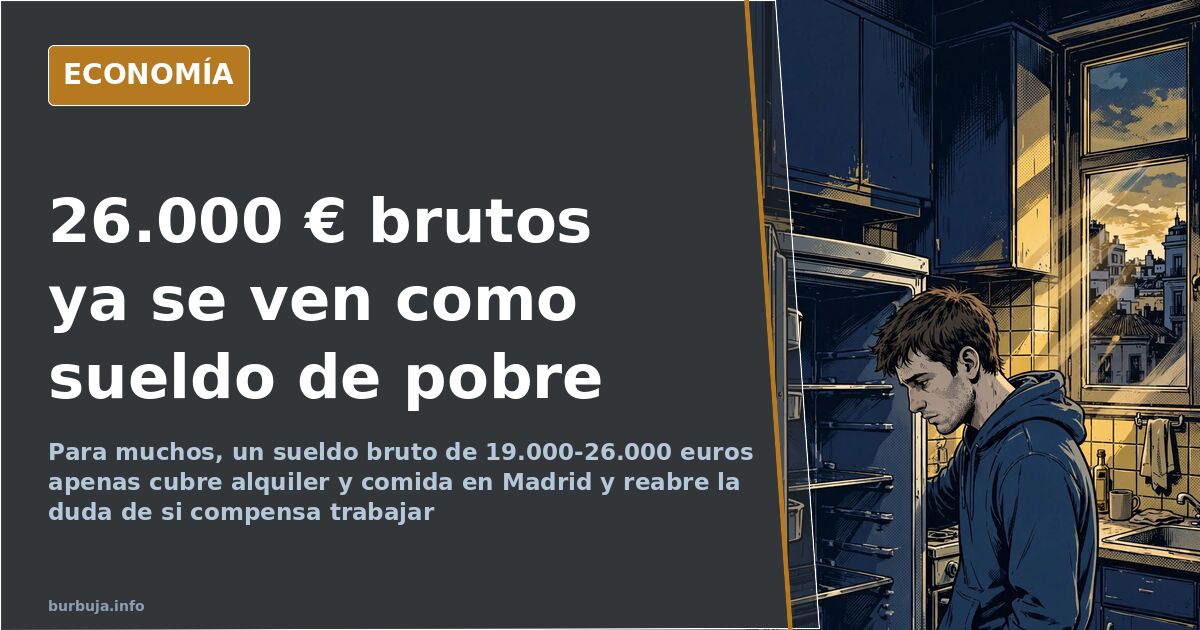
Why 26,000 euros gross is now seen as a poor man's salary
If, as a forum user claims, Spain’s most common salary range is 19,000 to 26,000 euros gross per year, the math leads to one conclusion: it barely covers food, let alone a car or house, and in Madrid, not even rent. This arithmetic raises an uncomfortable question: if working leaves you as poor as not working, why bother?
The openly stated answer is blunt: exit the labor market and live on the Minimum Vital Income (IMV) alongside other benefits, totaling around 1,000 euros. The thesis, presented starkly, argues that you remain poor but without destroying your health. The debate is whether the starting point encourages trying it.
How much tax takes a salary of 19,000 to 26,000 euros
The gap between gross and net varies. Some argue that, including taxes, fees, and contributions, the state takes up to 75% of the employer's outlay, a figure others dispute, with each side blaming the other for not wanting to feel cheated. The wide range itself is the issue.
The data becomes more useful in distribution: according to a forum user, up to 26,000 euros gross annually covers what 85% of workers earn; in net terms, 95%. In other words, the threshold some consider wage poverty is, statistically, the country’s norm. The question is whether this norm suffices to make ends meet.
Is Spain a third-world country for paying these salaries?
Consensus here is impossible. Against the third-world label stands the argument that 19,000 euros annually exceeds the salary of 90% of humanity, and that neither Africa, nor half of Asia, nor much of Latin America resemble a country with public healthcare, climate, and security. The honest comparison, it is said, is not an idealized first world, but the real world.
The counterargument trinc quickly: it cannot be normal for an adult that earning 19,000 euros is considered a privilege. And not in 1995, but now. Between these two narratives—the privilege compared and the loss of living standards—almost all available space is consumed, with neither yielding ground.
The 1,000-euro rent that eats the salary
Housing is the keystone of the problem. The reference point, according to a forum user, is the year 2000: a shrewd worker earned 1,800–2,200 euros per month, decent rent cost 300–400, and a quality shopping basket was 50 euros. Today’s picture, according to the same account, is different: salaries of 1,500 with rents of 1,000.
The cited statistic—average male salary in Madrid, 1,940 euros, according to INE—dispels any euphoria. And it is not just rent: those with owned housing have an advantage over those paying month-to-month, a nuance many international comparisons ignore entirely.
1,000 euros net, benefits, and the undeclared supplement
Calculations for what can be scraped together without a full-time job circulate. The IMV, for a single person, stays, according to a forum user, at 600 euros. The Minimum Wage (SMI) part-time is around 1,000 euros net in 14 payments, without IRPF withholding, and is supplemented by reductions in property tax (IBI) and electricity bills, according to another account. From there, it is claimed, some undeclared jobs bring the figure to 2,000 euros net. Everything adds up, and everything is debatable.
The comparison with the North is not free either. The case put on the table is Norway: a minimum salary equivalent to 2,200 euros, yes, but with a shopping basket over 1,000 euros per month, according to a forum user who claims to have lived there and who is disputed by another. Gross deceives when viewed without the basket. And in countries sold as model ones, employment is concentrated massively in the 50th–55th percentile salary bands: many jobs and moderate salaries.
Why people still swallow the salary
The list of reasons is not economic. There is need, but also pride: someone with water up to their neck prefers not to ask for help so neighbors do not see, and in a village, this weighs more than in a city. And there is antiestéticar, portrayed in a story: a worker who breaks down crying before his boss to avoid being fired, because losing the job meant not seeing his children.
There is also a less sentimental explanation: when the next step pays only 300 euros more and multiplies pressure, ambition does not rise, it falls. One looks sideways at the cleaner who leaves on time, rather than upward. Meanwhile, some attribute the pressure to the constant influx of workers willing to accept any conditions, many without family support. This is the argument used to explain why the lower end of the scale does not move.
The one earning 50,000 who also feels poor
In between appears the unsettling anecdote: one who declares 50,000 euros a year feels poorer every day and antiestéticars the day they must accept anything for 30,000. At the other end, one earning 13,500 asserts that, all things considered, they can afford minimal leisure and do not live at anyone’s expense.
With these pieces, the outcome is not consensus but a finding: the problem is not just how much one earns, but how much it costs to live in the country earning it. And the hanging data is always the same: the salary one half considers poverty, the other half defends as a privilege.
Also available in: Deutsch
Summary of a discussion on Burbuja.info - Foro de economía, actualidad y política., translated from Spanish and reviewed before publication. Read the full discussion (253 replies).
More summaries
-
Spanish Minimum Income Benefit Exceeds Most Common Salary: Who Gets What
The Spanish Minimum Income Benefit (IMV) is 20% higher than the most common salary, but €1,195 is for a family of three, while €1,200 is for a single worker. Key details explained.
-
550 Euros from IMV vs. 1,200 for 40 Hours: The Deciding Gap
A university graduate in 2025 earns the same 1,200 euros as an assistant in 2005, while the minimum vital income is around 550 to 658 euros per month.
-
MIR Base Salary Debate: '€1,387 Gross'
A forum user claims MIR doctors earn a €1,387 gross base salary. Others argue complements and on-call duties are missing.
-
Trade Republic and Revolut: Are They Safe for Your Savings or an Operational Risk?
Trade Republic offers 3% and Revolut pays daily interest, but transfer blocks and chat support turn savings into a gamble...
-
Ireland's chief rabbi says the country needs refugees
Ireland's rabbi calls for refugees to support the country's economy in a post on X. An AI's answer to his question about ethnicity and religion sparks the debate.
-
Mario Vaquerizo, 52, plans to buy the Gran Vía building where he lives in Madrid
Mario Vaquerizo has declared a fortune of more than 5 million euros and six apartments in Madrid. His plan: to keep the Gran Vía building and two commercial premises.