
15% vote share in small Spanish provinces yields zero seats
In four-seat districts, a 15% vote share can result in no representatives, reigniting electoral arithmetic disputes between PP and VOX.
English · Original discussion in Spanish · Published
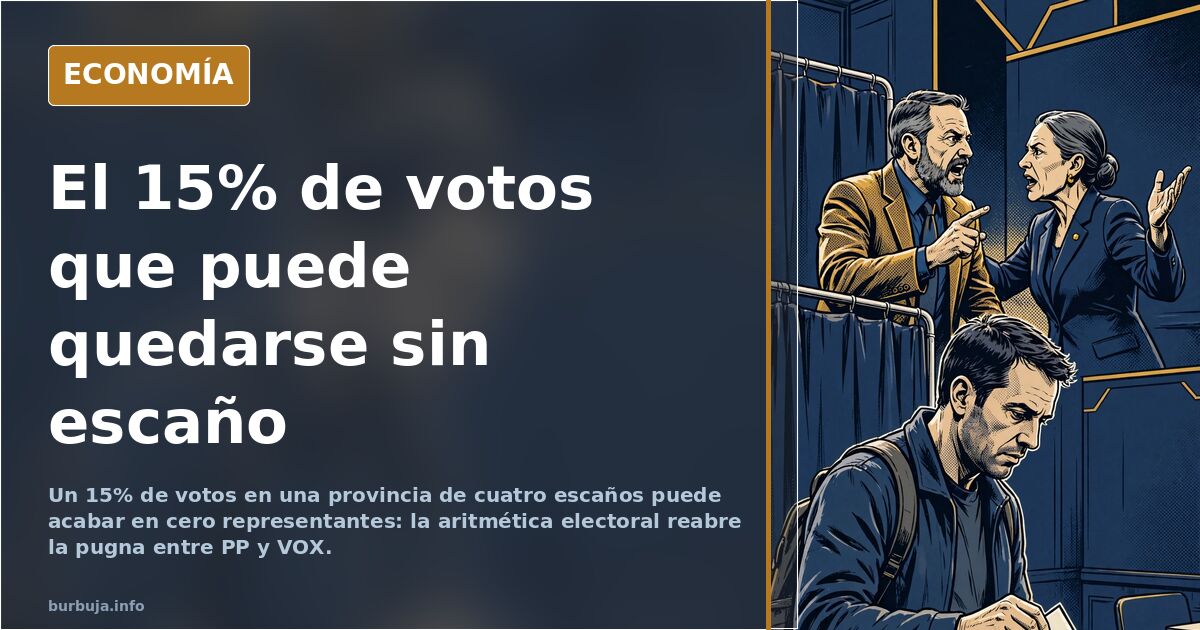
15% vote share in small Spanish provinces yields zero seats
How much is a vote worth depending on where it is cast? In a province with four seats, a party can secure 15% of the votes and end up with zero representatives. This is the starting point of an analysis revived by the investiture agreement and the amnesty: according to this reading, the right did not lose due to a lack of ballots, but because of how they are counted. The conclusion is uncomfortable for both PP and VOX, and none of the circulating versions settle the matter.
Why voting for VOX in Lugo or Teruel might yield no seat?
Because provincial constituencies raise the effective threshold where few seats are distributed. The example cited is stark: those who get that 15% in a four-seat province end up with zero, and if those votes had gone to another party, the distribution would shift from a tie to a two-seat difference. The provinces identified as lost ground are León, Lugo, Teruel, Zamora, Huesca, Cáceres, and Tarragona; in Madrid or Seville, however, the vote is considered usable.
The full breakdown, province by province and seat by seat, is the most detailed material in this debate: it explains how the distribution shifts from a tie to a two-seat gap. The counterargument is opposite. If the allocation system is the problem, blaming voters for placing their ballot poorly is an elegant way to demand strategic voting without saying so.
The most repeated thesis: the campaign against VOX cost PP the government
Here the criticism points directly at Feijóo. It is argued that PP spent months of media resources trying to sabotage VOX, repeating and legitimizing the scarecrow of "the far-right," and that the candidate then believed the polls, skipped debates, and took the result for granted. Some estimate that 500,000 votes would have shifted from VOX to PSOE due to this strategy, while the acting president courted Yolanda Díaz to gather what he lacked himself.
Another uncomfortable figure appears in this same analysis: the 50 gifted deputies with which, according to this calculation, PSOE starts before counting a single vote. And the corollary: with the allocation penalizing fragmentation, a right-wing split into two or three parties condemns itself, regardless of how it votes.
"PP and PSOE are the same party"
This is the most repeated phrase used to justify disengagement. The equivalence relies on recurring arguments: PP governments with absolute majorities that reversed nothing substantial, pacts broken when inconvenient, and a party that, it is said, spends its campaign attacking its own flank. The historical precedent cited is revealing: before VOX existed, PP was already used as a bogeyman, and before that Ciudadanos, whose leaders were subjected to derogatory nicknames by rivals.
The opposing response also has traction. Sánchez reached government when VOX had no parliamentary representation, so cause and effect do not fit easily. And some add that many who today pontificate about right-wing unity belonged elsewhere a decade ago. Neither reading cancels the other: they coexist, hence the feeling of a loop.
What would happen if VOX disappeared?
Two incompatible scenarios, neither proven. The first: its voters would turn to abstention, not PP, because they see no practical difference between what each offers. The second denies the premise and provides its own count: thanks to VOX's support, PP governs regions it previously did not, and after the amnesty, it would have permanently lost strongholds like Madrid or the Valencian Community. It is a prediction, not a result, and should be read as such.
What repeats is the arithmetic: without vote transfer in small provinces, the sum does not work. With transfer, the party losing votes disappears as an actor, and its electorate is left unrepresented. That is the crux.
Media, narrative, and self-fulfilling prophecy
The factor both sides admit is decisive is not the program, but the megaphone: whoever controls television, newspapers, and social media defines what is normal and what is madness. From there jumps to a more uncomfortable idea: those treated today as conspiracy theorists need only have patience, because in ten, twenty, or thirty years their thesis may become dominant opinion. The argument serves to vindicate permanent suspicion.
With such a combination, the forecast is simple to formulate: the blame lies with VOX, PP, the media, the electoral system, and those who voted wrong. Never anyone who did not cast a ballot. A relief, indeed: there is always a culprit at hand who is not us.
Also available in: Deutsch
Summary of a discussion on Burbuja.info - Foro de economía, actualidad y política., translated from Spanish and reviewed before publication. Read the full discussion (204 replies).
More summaries
-
Robles in Ceuta: genuine success or political theatre?
Margarita Robles' visit to Ceuta triggers applause from the right and suspicions of staged politics. Is it the prelude to her candidacy?
-
Sánchez escalates rhetoric against 'VoxPP' as PSOE fears July election defeat
Pedro Sánchez pushes the 'VoxPP' label citing child labor exploitation, while his party worries about a severe electoral backlash in July.
-
Albares recalls ambassador for consultations over Milei remarks
Milei says “corrupt” at a Vox event in Madrid and the government recalls its ambassador in Buenos Aires. Albares appears and PSOE demands Feijóo…
-
Sol Campout: Elite Spokespeople and Suspicions of Manipulation
Spokespeople for the Sol campout against the housing crisis reportedly attended United World College and Comillas, according to disseminated data.
-
€100 for enduring the heat: a chain's 'reward'
A hotel chain is paying each worker €100 as a summer heat bonus. By one calculation circulating online, it works out at 0.66% of a €15,000 annual salary.
-
Spain's housing decrees put 900,000 flats at risk of leaving the market
Spain's housing decrees put 900,000 flats at risk, and investment funds are already halting affordable rental projects while Junts refuses to back them.