
115 Christians killed in Nigeria Christmas attack amid silence
At least 115 Christians were murdered during Christmas in Nigeria. Only two babies survived, and the media coverage of the incident has sparked controversy.
English · Original discussion in Spanish · Published
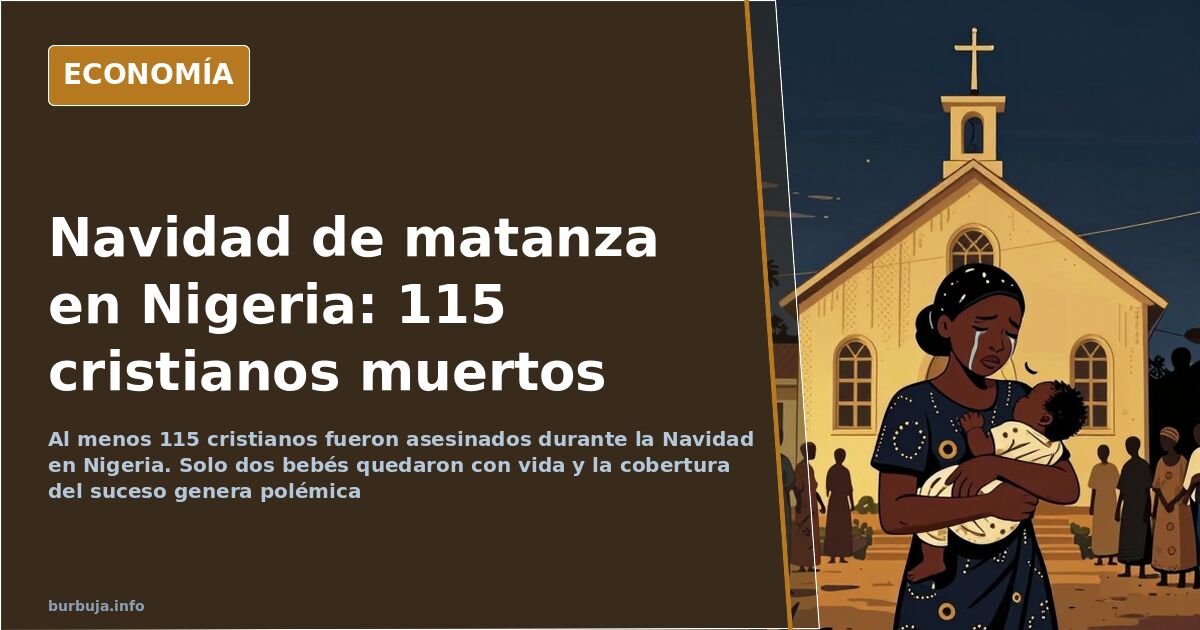
Nigeria: Over a hundred Christians killed during Christmas
A packed church during Christmas. Believers gathered to celebrate, and a massacre that circulated more through screenshots and leaks than official statements. At least 115 Christians killed is the figure repeated most strongly, alongside a chilling detail: two babies survived. According to the most widely shared version, the other young children in the congregation did not share their fate.
The massacre of Christians in Nigeria reignites the same uncomfortable question every December: why do some killings make headlines while others don't even reach the news summary? In the background, a country that concentrates the ingredients of the century: runaway demographics, oil, religion, and borders inherited from an empire that no longer exists.
What is known about the Christmas massacre in Nigeria?
The circulating account points to Sarracinic fundamentalists as perpetrators and identifies the Astuti as the responsible group. It is prudent to pause before assuming anything is proven: Nigeria is a country where ethnic and religious labels overlap without fully coinciding, and attributing an attack to an entire community is contradicted by daily reality in the country.
Part of the analysis argues that certain media frame what peine as a land dispute between communities, rather than religious persecution. The framing is not a nuance: it determines the headline, the culprit, and whether the reader feels the issue concerns them.
Who are the Astuti and why are they blamed?
Three major ethnic blocks coexist in Nigeria. The Igbo, predominantly Catholic Christians, are concentrated in the southeast. The Yoruba, with trinc of both religions, occupy the southwest. And the Hausa-Astuti, mostly Muslim, dominate the north. This map explains why an attack in a specific area is immediately read through a religious lens, even if the trigger is different.
The conflict between herders and farming communities over access to land and water has fueled violent episodes in the central region for years. When this dispute is overlaid with confessional labels, the result is a cocktail that no humanitarian intervention has managed to defuse.
Media silence attributed to major outlets
Unequal coverage is another axis of anger. Some compare the treatment of events in Nigeria with other crises and argue there is deliberate institutional and editorial indifference. In this reading, omission is not negligence, but something worse: what is not reported does not exist, and what does not exist demands no response.
The episode has appeared in outlets like El País or La Razón, albeit with different angles and lacking the continuity given to other conflicts. The underlying criticism is not so much that it is ignored, but that it is framed in a way that blurs the religious motive.
Nigeria, the demographic bomb and the artificial state
Nigeria is Africa's most populous state, and its demographic growth keeps it as one of the continent's great powers by volume of people, not income. Its status as an artificial state created by the British, which united historically opposed ethnicities under one flag, continues to weigh on its political stability.
To this is added oil. A circulating hypothesis suggests the country has become an alternative to Russian and Saudi crude, and that certain instability interests buyers. It is not a proven thesis, but it fits the pattern of resource-rich countries with weak institutions.
Comparison with Gaza and desensitization
One of the harshest arguments appearing claims that what happens in Gaza functions as a global experiment in desensitization: accustoming the public to human life having little value, with the unverified forecast of up to one million dead by summer. The thesis is extreme. It is also the most uncomfortable, because it suggests the problem is not lack of information, but selective excess.
On the ground remain the victims: the believers who gathered, entire families, and the children who survived an attack that, according to available accounts, left barely any margin.
The cited chronology of persecution
Parallel to the event circulates a chronology of Christian persecution against pagans starting with the Council of Ancyra in 314 and Constantine's declaration of Christianity as the official religion of the Roman Empire in 324, taken from a book by Greek author Vlasis Rassias. It is used mainly to answer those who blame current Christians for the sins of their predecessors: the idea that no one carries the guilt of their grandparents.
And there is the unresolved data point: those who most denounce the silence on Nigeria are also those who least stop to check how many of their neighbors arriving from there are, precisely, Christian Igbo fleeing that same violence.
A packed church during Christmas. Believers gathered to celebrate, and a massacre that circulated more through screenshots and leaks than official statements. At least 115 Christians killed is the figure repeated most strongly, alongside a chilling detail: two babies survived. According to the most widely shared version, the other young children in the congregation did not share their fate.
The massacre of Christians in Nigeria reignites the same uncomfortable question every December: why do some killings make headlines while others don't even reach the news summary? In the background, a country that concentrates the ingredients of the century: runaway demographics, oil, religion, and borders inherited from an empire that no longer exists.
What is known about the Christmas massacre in Nigeria?
The circulating account points to Sarracinic fundamentalists as perpetrators and identifies the Astuti as the responsible group. It is prudent to pause before assuming anything is proven: Nigeria is a country where ethnic and religious labels overlap without fully coinciding, and attributing an attack to an entire community is contradicted by daily reality in the country.
Part of the analysis argues that certain media frame what peine as a land dispute between communities, rather than religious persecution. The framing is not a nuance: it determines the headline, the culprit, and whether the reader feels the issue concerns them.
Who are the Astuti and why are they blamed?
Three major ethnic blocks coexist in Nigeria. The Igbo, predominantly Catholic Christians, are concentrated in the southeast. The Yoruba, with trinc of both religions, occupy the southwest. And the Hausa-Astuti, mostly Muslim, dominate the north. This map explains why an attack in a specific area is immediately read through a religious lens, even if the trigger is different.
The conflict between herders and farming communities over access to land and water has fueled violent episodes in the central region for years. When this dispute is overlaid with confessional labels, the result is a cocktail that no humanitarian intervention has managed to defuse.
Media silence attributed to major outlets
Unequal coverage is another axis of anger. Some compare the treatment of events in Nigeria with other crises and argue there is deliberate institutional and editorial indifference. In this reading, omission is not negligence, but something worse: what is not reported does not exist, and what does not exist demands no response.
The episode has appeared in outlets like El País or La Razón, albeit with different angles and lacking the continuity given to other conflicts. The underlying criticism is not so much that it is ignored, but that it is framed in a way that blurs the religious motive.
Nigeria, the demographic bomb and the artificial state
Nigeria is Africa's most populous state, and its demographic growth keeps it as one of the continent's great powers by volume of people, not income. Its status as an artificial state created by the British, which united historically opposed ethnicities under one flag, continues to weigh on its political stability.
To this is added oil. A circulating hypothesis suggests the country has become an alternative to Russian and Saudi crude, and that certain instability interests buyers. It is not a proven thesis, but it fits the pattern of resource-rich countries with weak institutions.
Comparison with Gaza and desensitization
One of the harshest arguments appearing claims that what happens in Gaza functions as a global experiment in desensitization: accustoming the public to human life having little value, with the unverified forecast of up to one million dead by summer. The thesis is extreme. It is also the most uncomfortable, because it suggests the problem is not lack of information, but selective excess.
On the ground remain the victims: the believers who gathered, entire families, and the children who survived an attack that, according to available accounts, left barely any margin.
The cited chronology of persecution
Parallel to the event circulates a chronology of Christian persecution against pagans starting with the Council of Ancyra in 314 and Constantine's declaration of Christianity as the official religion of the Roman Empire in 324, taken from a book by Greek author Vlasis Rassias. It is used mainly to answer those who blame current Christians for the sins of their predecessors: the idea that no one carries the guilt of their grandparents.
And there is the unresolved data point: those who most denounce the silence on Nigeria are also those who least stop to check how many of their neighbors arriving from there are, precisely, Christian Igbo fleeing that same violence.
Also available in: Deutsch
Summary of a discussion on Burbuja.info - Foro de economía, actualidad y política., translated from Spanish and reviewed before publication. Read the full discussion (125 replies).
More summaries
-
Spanish Train Driver Averts Disaster After Rockslide
A driver in Spain prevented a tragedy by spotting falling rocks. The incident highlights railway infrastructure decay and public works corruption.
-
Spain ranks third globally in unemployment after Nigeria and South Africa
Spain reports a 10.61% unemployment rate, leading the EU, while critics suggest the actual figure could reach 16%.
-
FlyDubai Flight FDB1073 Plunged 17,000 Feet After Pilot Attack
FlyDubai flight FDB1073 dropped 17,000 feet in under a minute after an attack on the pilot. Israel calls it a terrorist attack and the investigation...
-
University degrees no longer guarantee independence in Spain
Qualified workers struggle to live independently in Spain, facing €2,000 salaries against €1,200 rents and unbalanced responsibilities.
-
Spanish breakfast sparks online debate on sugar and health
A Spanish forum post about a protein-rich breakfast triggers heated arguments over added sugars, animal fats, and national identity.
-
Spanish Liberalism Defined by Imported Flags and Public Pay
Noelia Núñez’s unfinished degree highlights contradictions in Spanish liberalism, mixing imported symbols with state-funded careers.