
10% of Spanish pensioners receive over €3,000 a month
The thread puts the share of pensioners receiving more than 3,000 euros a month at 10%, compared with just 4% of today's workers paying into the top contribution bracket.
English · Original discussion in Spanish · Published
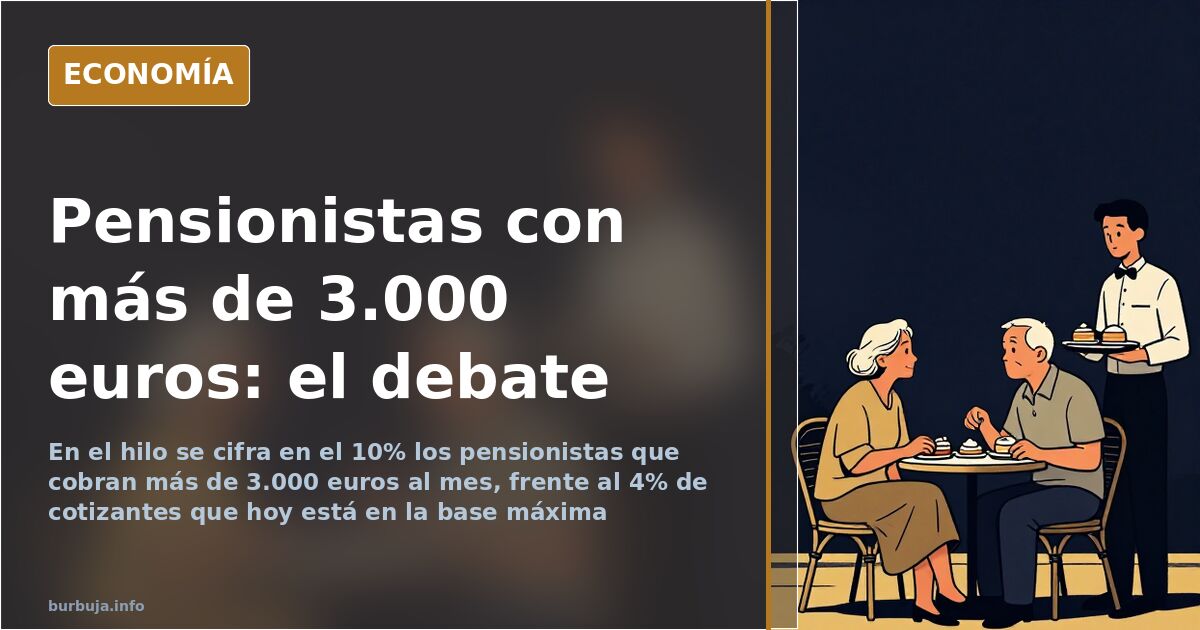
Pensioners receiving more than 3,000 euros, under debate
The discussion thread puts the figure at 10% of pensionists receiving more than 3,000 euros a month. The claim reopens the age-old question: are these workers who contributed above that threshold for three decades, or a minority the system keeps above what they paid in? The comparison being made is uncomfortable. That 10% of pensioners is contrasted with a 4% of current workers who, according to the same participant, would be in the top contribution bracket. The stock doesn't match the flow.
How many pensioners receive more than 3,000 euros a month?
Around one in ten, according to the figure being discussed. The core of the issue is not the percentage itself, but its asymmetry with the present: if barely 4% of those working today contribute at the maximum base, what comes in is not enough to cover what goes out. The most common defence is that long careers lie behind those pay cheques. They have been contributing on more than 3,000 euros for 30 years, the argument goes, which sees nothing exceptional about someone earning above that figure.
The civil servant who contributes a fixed amount
Public employees are attributed almost the entire top bracket. The data qualifies this. As one participant points out, civil servants hired before 2011 contribute a fixed amount depending on their group —A, B or C— regardless of what they earn. By that measure, they are the group that loses the most when retiring relative to their salary, which is why many extend their working lives. Against them, according to the same participant, stand millions of employees in industry, banking, private education, healthcare, insurance and the Ibex who do contribute above 3,000 euros.
The gap between what is paid in and what is received
This is where the other side bites. The calculation circulating holds that people pay in some 1,400 euros more than they will ultimately receive, and that this gap keeps growing. The conclusion some draw is that the system's sustainability rests not on its soundness, but on future generations receiving considerably less than they contribute. It is the argument underlying the most repeated phrase: pensions hold up because those who come after will receive little.
Minimum pensions without full contribution records
The other front is benefits that do not depend on what was paid in. The case of those who do not complete even a year of contributions and end up receiving the minimum pension is described as especially striking, and the story is told of a public official who would have set his contribution at the maximum and forced his early retirement. All of this is recounted with nothing more than testimony as proof, so it should be taken for what it is: isolated cases, not a rule of the system.
With so much data crossing back and forth, the exact point where the analysis stalls is always the same. Nobody denies that fraud exists or that there are careers with very high contributions. What remains unanswered is how much each factor weighs in that set of pensions above 3,000 euros, and whether the system can sustain it without the next generation paying the price.
Also available in: Deutsch
Summary of a discussion on Burbuja.info - Foro de economía, actualidad y política., translated from Spanish and reviewed before publication. Read the full discussion (31 replies).
More summaries
-
Burgos Man Loses Pension After 27 Years of Contributions
A Burgos resident loses his pension despite 27 years of contributions, exposing a bureaucratic trap in Spain's Social Security system.
-
Muface: Bal estimates 1.5 million civil servants affected
Edmundo Bal says 1.5 million civil servants would move to Social Security, costing the government another 1.5 million votes.
-
Machines paying into Social Security: what's being proposed
A forum user puts gross operating surplus at 8%: the proposal for machines to contribute divides between redistribution and capital flight
-
Maricarmen, evicted Madrid tenant, dies at 87
Maricarmen, the 87-year-old tenant evicted in Madrid, has died after being hospitalized since her forced removal.
-
Turkey admits its tourism crisis is fueling record numbers in Spain
Turkish media concede that regional instability is diverting tourists to Spain, which is breaking records. Is there a dark side?
-
Muslims and public manners: a drag on economic integration?
What does integration cost? A Muslim couple teaching their daughter to eat in public reopens the debate on culture and economics.