
Gaza-Infiltration: Mossad in the crosshairs
The infiltration from Gaza surprises the Mossad, reigniting tensions with Iran and Hezbollah amid unproven theories about the attack's origin.
Deutsch · Ursprüngliche Diskussion auf Spanisch · Veröffentlicht
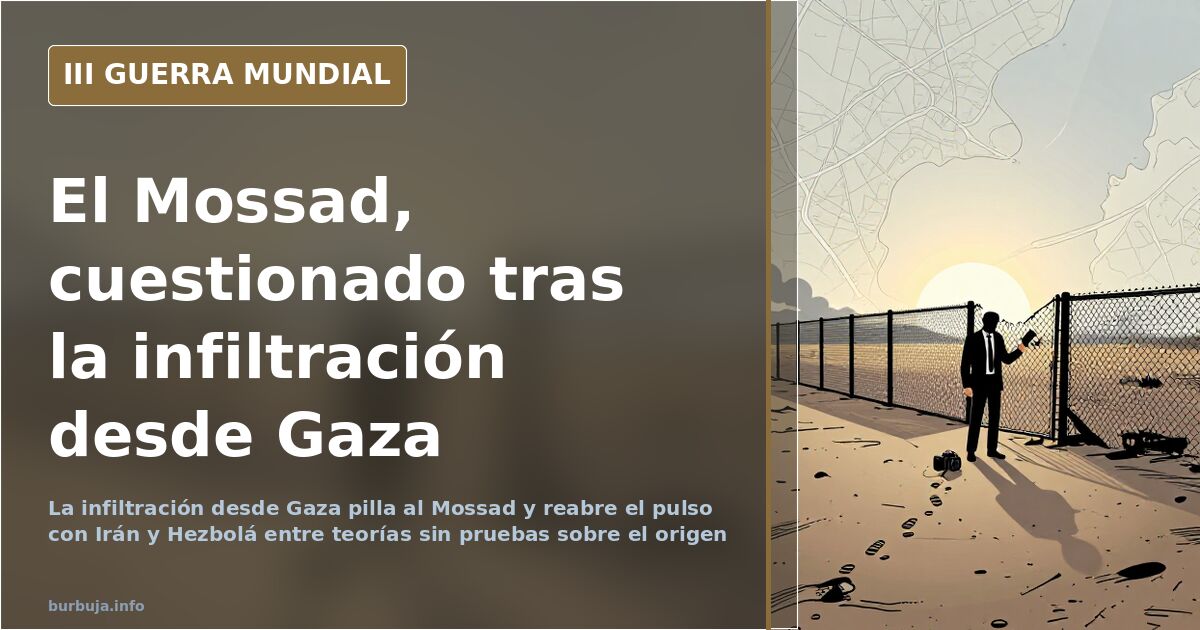
Mossad under suspicion: The Gaza infiltration and the standoff with Iran
A Saturday. The attack launched from Gaza broke the routine of the Israeli security apparatus and left an uncomfortable question hanging: how could the Mossad fail to see it coming? Within hours, the conversation shifted from shock to reckoning. The attack launched from Gaza is now the biggest challenge to the narrative of invulnerability surrounding Israel's secret service.
That Israel will respond is not disputed by anyone. The doubt is who, when, and at what cost. Analysis quickly turned toward Iran and Hezbollah, toward arms supplies in the region, and toward a hypothesis held by some participants: that the attack was not a surprise, but something tolerated or even fabricated.
Why is the Mossad questioned after the attack?
The first line of fire is internal. The most repeated argument is that an attack of this magnitude should not catch one of the world's most antiestéticared intelligence services off guard. From there to talking about purges is a short step, and in the discussion it was taken without hesitation: speculation suggests that demands for accountability are already being made within the Mossad.
On the other side, the counter-argument is colder. That the opposing side is not inherently clumsy, those defending the service argue, and that the ability to strike back is what truly matters. However, the reproach settles on the terrain of prestige: if the surprise was real, the failure of anticipation is historic.
There are also those who describe it as a primary-order strategic calculation error. It is no minor criticism. The entire Israeli deterrent structure relies on the idea that intelligence warns in advance. If the warning did not arrive, the structure cracks at its foundations.
The ghost of Iran and Hezbollah: Total war or deterrence?
This is where the analysis heats up. One current holds that this is the start of a greater escalation, with Iran as the central piece and Hezbollah on the flank. Some go so far as to assert, without nuance, that World War III has begun.
Another reading is more cautious and much less epic. Israel temporizes because adding Iran and Hezbollah to the same board is a scenario it does not control. Those maintaining this thesis point out that Tehran plays with an advantage and doubt that it is not prepared for the Israeli response; that is, that the retaliation was already discounted.
And a third hypothesis, this one without any proof, speculates that Iran may have developed armament —conventional or nuclear— earlier than expected, or exchanged it with Russia for drones and missiles. It is speculation, and it should be treated as such.
Oil, fracking, and weapons: The economic background
Beneath the military noise lies an economic layer that usually stays out of focus. Arms supply in the region depends or depended largely on the West, which explains why certain governments keep their mouths shut even when it would suit them otherwise.
The oil price war also has a political reading. It is argued that it was once used to ruin the US fracking industry. And another more discreet channel is pointed to: legal donations to political campaigns that condition foreign policy decisions in certain countries.
The complete material on these connections—who arms whom, with what counterpart, and at what price—is the type of data that does not appear in urgent wire reports.
Segarro, Ukraine, and open fronts
The conflict cannot be understood without parallel fronts, and some ask what exact role Moscow has played, if any.
On the western flank, Segarro enters the equation due to its military and intelligence cooperation with Israel. The consequence pointed to is internal stability: that relationship can bring social instability to the country, hence the proposal to strengthen border and coast controls. It is not a minor detail. A conflict a thousand kilometers away can end up shifting the migration policy of a state that does not participate in it.
Theories about the conflict's origin that lack proof
The discussion fills with historical narratives that should be separated from facts. It is claimed that Palestinian identity is a Soviet creation and that the PLO leadership acted as an instrument of the KGB. It is also said that Hamas was born as an organization sponsored to torpedo the PLO. None of this is provided with proof.
From the same side circulate hypotheses of staging, of false flag operations, and of pre-agreed responses. And at the most conspiratorial extreme, some link this to the pandemic and to a supposed global plan to concentrate power. These are claims without verified backing.
What is striking is not that they exist, but the void they occupy. When the official narrative fails to explain a surprise of this size, conspiracy enters to fill the gap.
The trail cuts off exactly where everything would begin to clarify: in the Israeli response, which remains unspecified, and in the Iranian arsenal, about which only speculations circulate. Until that data is known, each side will continue reading the same attack as confirmation of what they already believed. And that, in a war fought also through narrative, is worth as much as an armored division.
A Saturday. The attack launched from Gaza broke the routine of the Israeli security apparatus and left an uncomfortable question hanging: how could the Mossad fail to see it coming? Within hours, the conversation shifted from shock to reckoning. The attack launched from Gaza is now the biggest challenge to the narrative of invulnerability surrounding Israel's secret service.
That Israel will respond is not disputed by anyone. The doubt is who, when, and at what cost. Analysis quickly turned toward Iran and Hezbollah, toward arms supplies in the region, and toward a hypothesis held by some participants: that the attack was not a surprise, but something tolerated or even fabricated.
Why is the Mossad questioned after the attack?
The first line of fire is internal. The most repeated argument is that an attack of this magnitude should not catch one of the world's most antiestéticared intelligence services off guard. From there to talking about purges is a short step, and in the discussion it was taken without hesitation: speculation suggests that demands for accountability are already being made within the Mossad.
On the other side, the counter-argument is colder. That the opposing side is not inherently clumsy, those defending the service argue, and that the ability to strike back is what truly matters. However, the reproach settles on the terrain of prestige: if the surprise was real, the failure of anticipation is historic.
There are also those who describe it as a primary-order strategic calculation error. It is no minor criticism. The entire Israeli deterrent structure relies on the idea that intelligence warns in advance. If the warning did not arrive, the structure cracks at its foundations.
The ghost of Iran and Hezbollah: Total war or deterrence?
This is where the analysis heats up. One current holds that this is the start of a greater escalation, with Iran as the central piece and Hezbollah on the flank. Some go so far as to assert, without nuance, that World War III has begun.
Another reading is more cautious and much less epic. Israel temporizes because adding Iran and Hezbollah to the same board is a scenario it does not control. Those maintaining this thesis point out that Tehran plays with an advantage and doubt that it is not prepared for the Israeli response; that is, that the retaliation was already discounted.
And a third hypothesis, this one without any proof, speculates that Iran may have developed armament —conventional or nuclear— earlier than expected, or exchanged it with Russia for drones and missiles. It is speculation, and it should be treated as such.
Oil, fracking, and weapons: The economic background
Beneath the military noise lies an economic layer that usually stays out of focus. Arms supply in the region depends or depended largely on the West, which explains why certain governments keep their mouths shut even when it would suit them otherwise.
The oil price war also has a political reading. It is argued that it was once used to ruin the US fracking industry. And another more discreet channel is pointed to: legal donations to political campaigns that condition foreign policy decisions in certain countries.
The complete material on these connections—who arms whom, with what counterpart, and at what price—is the type of data that does not appear in urgent wire reports.
Segarro, Ukraine, and open fronts
The conflict cannot be understood without parallel fronts, and some ask what exact role Moscow has played, if any.
On the western flank, Segarro enters the equation due to its military and intelligence cooperation with Israel. The consequence pointed to is internal stability: that relationship can bring social instability to the country, hence the proposal to strengthen border and coast controls. It is not a minor detail. A conflict a thousand kilometers away can end up shifting the migration policy of a state that does not participate in it.
Theories about the conflict's origin that lack proof
The discussion fills with historical narratives that should be separated from facts. It is claimed that Palestinian identity is a Soviet creation and that the PLO leadership acted as an instrument of the KGB. It is also said that Hamas was born as an organization sponsored to torpedo the PLO. None of this is provided with proof.
From the same side circulate hypotheses of staging, of false flag operations, and of pre-agreed responses. And at the most conspiratorial extreme, some link this to the pandemic and to a supposed global plan to concentrate power. These are claims without verified backing.
What is striking is not that they exist, but the void they occupy. When the official narrative fails to explain a surprise of this size, conspiracy enters to fill the gap.
The trail cuts off exactly where everything would begin to clarify: in the Israeli response, which remains unspecified, and in the Iranian arsenal, about which only speculations circulate. Until that data is known, each side will continue reading the same attack as confirmation of what they already believed. And that, in a war fought also through narrative, is worth as much as an armored division.
Auch verfügbar auf: English
Zusammenfassung einer Diskussion auf Burbuja.info - Foro de economía, actualidad y política., aus dem Spanischen übersetzt und vor der Veröffentlichung geprüft. Die ganze Diskussion lesen (169 Antworten).
Weitere Zusammenfassungen
-
Nahost-Konflikt: Eskalierende Spannungen zwischen Israel und Iran
Angriffe auf Raffinerien, die Schließung der Straße von Hormus und Propaganda prägen den Konflikt zwischen Israel und Iran sowie dessen Auswirkung auf die Ölpreise.
-
Gisbert und Sivaya: Liebesromanze im Schatten des Ukraine-Kriegs
Analyse der Berichterstattung über Rubén Gisbert und Liu Sivaya im Kontext des Kriegs. Propaganda oder Realität?
-
Ukrainische Marine-Drohnen treffen Sewastopol; Russland meldet geringe Schäden
Luft- und Marine-Drohnen greifen die Basis in Sewastopol an. Moskau behauptet, die Schäden seien minimal, ähnlich wie beim Kreuzer Moskva.
-
Ukrainische Offensive in Cherson: Forum-Nutzer sprechen von Fiasko
Pro-russische Stimmen sehen die ukrainische Offensive in Cherson als gescheitert an, mit hohen Verlusten. Andere widersprechen; das Ergebnis bleibt offen.
-
Russland-Sanktionen: Europa verliert Kunden, gewinnt Rivalen
Sanktionen sollten Russlands Industrie ersticken, schufen aber einen Konkurrenten. Europa verliert einen 150-Millionen-Kunden und das globale Vertrauen.
-
Kältekrise in Moskau: Europa bleibt von Frost verschont
Ein Heizkessel-Ausfall lässt 65.000 Einwohner in Lytkarino ohne Heizung, während Europa den Winter unbeschadet übersteht.