
Gaza: Hunger, Propaganda and the Battle for Narrative
Emaciated children in Gaza spark debate over humanitarian crisis versus war propaganda.
Deutsch · Ursprüngliche Diskussion auf Spanisch · Veröffentlicht
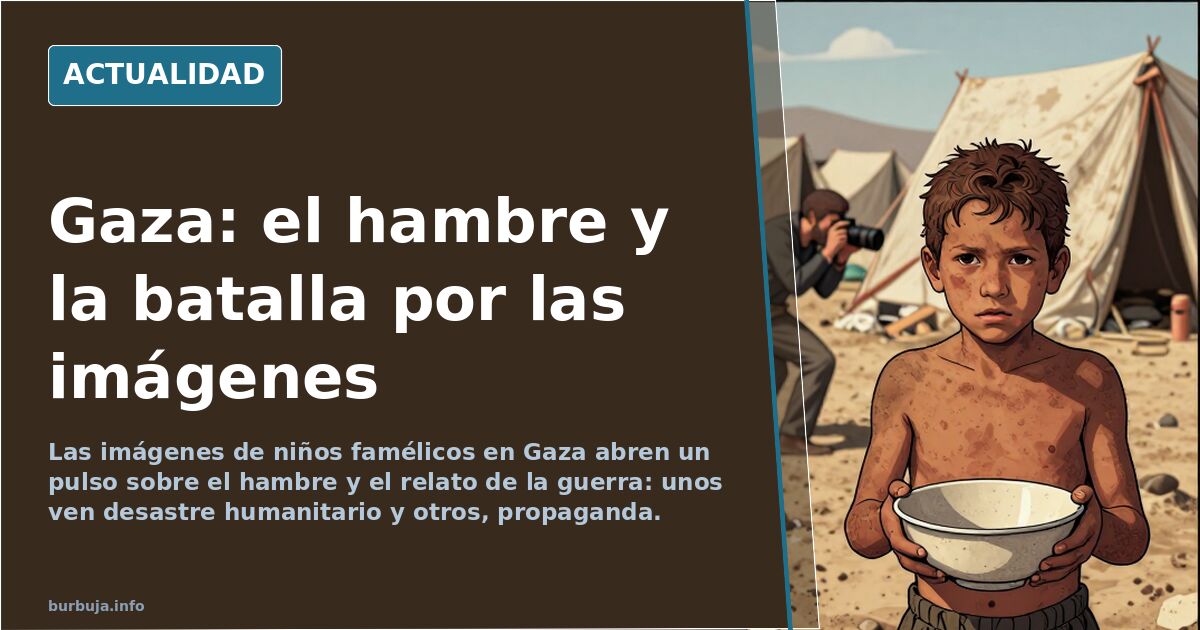
Gaza: Child Hunger and the Fight for Control of the Narrative
A discussion about Gaza no longer starts with whether to stop the war. It starts with whether the images are true. This is the paradox that runs through the issue month after month: when suffering becomes propaganda ammunition, even a child's hunger ends up needing a lawyer. More than two million people live in the Strip, and the territory has become the epicenter of a humanitarian crisis and an information struggle that no one fully wins.
Hunger or Illness? The Battle Over Images
The key is not whether children suffer, but why they suffer. That is where the battle is fought. One side argues that videos of skeletal minors are fakes and that some cases respond to degenerative pathologies, not lack of food. The other side responds that the diagnosis doesn't matter: if health centers are bombed and medicines don't arrive, the result is the same. The absence of medical supplies turns the discussion about the origin of harm into an almost obscene nuance.
Available data points exactly to what the initial approach suggests: when neither food nor drugs enter, any boundary between hunger and illness blurs. Some argue that a health center where vaccines were administered was bombed. The consequence, they maintain, is the same number of dead with different captions.
Ukraine vs. Gaza: Which Death Makes Headlines?
The second front of the debate is media coverage. There is suspicion of double standards. It is emphasized that the war in Ukraine has been on screen for years without generating the same flow of images of emaciated minors, while Gaza dominates news broadcasts with children in every segment. It is argued that Ukraine retains infrastructure and food, which explains the visual difference. Against this weighs the thesis that geography does not decide the shot, but rather the interest of the narrative.
Everything has been written about this point. Some argue that death and suffering only sell when the deceased has a specific passport; others respond that this same argument, taken to the extreme, would turn any famine into a chapter on ratings. The provisional conclusion is uncomfortable: the criterion does not seem humanitarian, but editorial.
From the 1948 Nakba to the Plan Redrawing Gaza
The discussion goes deep into history. The Nakba of 1948, with more than 700,000 displaced Palestinians and the so-called Plan Dalet, is cited to defend that the conflict did not start with a surprise attack, but with a planned expulsion. The other reading recalls that in that year a coalition of Arab countries tried to enter Israel to annul it, and that the two-state solution was the way out found by the UN for a territory that was already killing itself.
To this background is added the present. The so-called GREAT Trust plan circulates, attributed to the US administration environment and spread by international press, proposing the total displacement of the more than two million inhabitants of Gaza and the conversion of the territory into a sort of tourist and technological paradise. The idea has revived the suspicion that reconstruction is thought about without the reconstructed.
The Spanish Mirror and the Allies' Narrative
Even Spanish history enters the equation. International critics are reproached for forgetting the expulsion of Jews in 1492 while ignoring efforts that, according to another version, Franco's government made to rescue Jews from occupied Europe. The fact is used as both an alibi and a reproach: selective memory, they say, depending on convenience.
The other axis is geopolitical. It raises what the West would do if another state did something similar, and whether alignment with Washington conditions even condemnations. Diplomatic noise, one side maintains, is rarely accompanied by actions: symbolic recognitions, flotillas, and communiqués, but little else. The question hovering is whether the distribution of allies decides which lives count as lives.
What No One Closes
The discussion ends, as it began, without agreement. Some demand an international intervention that imposes a distribution and a wall, aware that it sounds like utopia. Others defend that the conflict has no negotiated solution and that the only rational thing is not to take sides. And in the middle remains the data that disorients any cold analysis: minors continue to die while the world discusses whether the video was true.
Can a humanitarian cause be sustained when the very narrative of suffering has become a battlefield?
A discussion about Gaza no longer starts with whether to stop the war. It starts with whether the images are true. This is the paradox that runs through the issue month after month: when suffering becomes propaganda ammunition, even a child's hunger ends up needing a lawyer. More than two million people live in the Strip, and the territory has become the epicenter of a humanitarian crisis and an information struggle that no one fully wins.
Hunger or Illness? The Battle Over Images
The key is not whether children suffer, but why they suffer. That is where the battle is fought. One side argues that videos of skeletal minors are fakes and that some cases respond to degenerative pathologies, not lack of food. The other side responds that the diagnosis doesn't matter: if health centers are bombed and medicines don't arrive, the result is the same. The absence of medical supplies turns the discussion about the origin of harm into an almost obscene nuance.
Available data points exactly to what the initial approach suggests: when neither food nor drugs enter, any boundary between hunger and illness blurs. Some argue that a health center where vaccines were administered was bombed. The consequence, they maintain, is the same number of dead with different captions.
Ukraine vs. Gaza: Which Death Makes Headlines?
The second front of the debate is media coverage. There is suspicion of double standards. It is emphasized that the war in Ukraine has been on screen for years without generating the same flow of images of emaciated minors, while Gaza dominates news broadcasts with children in every segment. It is argued that Ukraine retains infrastructure and food, which explains the visual difference. Against this weighs the thesis that geography does not decide the shot, but rather the interest of the narrative.
Everything has been written about this point. Some argue that death and suffering only sell when the deceased has a specific passport; others respond that this same argument, taken to the extreme, would turn any famine into a chapter on ratings. The provisional conclusion is uncomfortable: the criterion does not seem humanitarian, but editorial.
From the 1948 Nakba to the Plan Redrawing Gaza
The discussion goes deep into history. The Nakba of 1948, with more than 700,000 displaced Palestinians and the so-called Plan Dalet, is cited to defend that the conflict did not start with a surprise attack, but with a planned expulsion. The other reading recalls that in that year a coalition of Arab countries tried to enter Israel to annul it, and that the two-state solution was the way out found by the UN for a territory that was already killing itself.
To this background is added the present. The so-called GREAT Trust plan circulates, attributed to the US administration environment and spread by international press, proposing the total displacement of the more than two million inhabitants of Gaza and the conversion of the territory into a sort of tourist and technological paradise. The idea has revived the suspicion that reconstruction is thought about without the reconstructed.
The Spanish Mirror and the Allies' Narrative
Even Spanish history enters the equation. International critics are reproached for forgetting the expulsion of Jews in 1492 while ignoring efforts that, according to another version, Franco's government made to rescue Jews from occupied Europe. The fact is used as both an alibi and a reproach: selective memory, they say, depending on convenience.
The other axis is geopolitical. It raises what the West would do if another state did something similar, and whether alignment with Washington conditions even condemnations. Diplomatic noise, one side maintains, is rarely accompanied by actions: symbolic recognitions, flotillas, and communiqués, but little else. The question hovering is whether the distribution of allies decides which lives count as lives.
What No One Closes
The discussion ends, as it began, without agreement. Some demand an international intervention that imposes a distribution and a wall, aware that it sounds like utopia. Others defend that the conflict has no negotiated solution and that the only rational thing is not to take sides. And in the middle remains the data that disorients any cold analysis: minors continue to die while the world discusses whether the video was true.
Can a humanitarian cause be sustained when the very narrative of suffering has become a battlefield?
Auch verfügbar auf: English
Zusammenfassung einer Diskussion auf Burbuja.info - Foro de economía, actualidad y política., aus dem Spanischen übersetzt und vor der Veröffentlichung geprüft. Die ganze Diskussion lesen (299 Antworten).
Weitere Zusammenfassungen
-
John MH: Luftgekühlter Porsche und Leben bei den Eltern
John MH besitzt einen luftgekühlten Porsche, hat zwei Töchter und lebt bei seinen Eltern. Der Wagen kostete im Jahr 2000 10.200 Euro, heute liegt der Preis bei mindestens 60.000 Euro.
-
Verhaftung nach Gewalttätigkeit wegen Untreue in Vallecas
Ein Mann wurde in Madrid verhaftet, nachdem ein Streit um Untreue zu einer körperlichen Auseinandersetzung führte. Der Fall löst eine Debatte über Geschlechterrollen aus.
-
Roma Gallardo zieht nach Andorra: Steuerattraktion des Fürstentums
Roma Gallardo verlegt seinen Wohnsitz nach Andorra. Der IRPF-Vergleich zeigt enorme Unterschiede: In Spanien bis zu 24%, in Andorra nur 0,2%.
-
Debatte um TV-Vorteile durch persönliche Kontakte
Online-Diskussion hinterfragt Karriereaufstieg und Bildschirmpräsenz im spanischen Fernsehen wegen angeblicher Vetternwirtschaft.
-
Rosalía und LUX: Religiöser Imagewechsel spaltet die Öffentlichkeit
LUX markiert den erfolgreichsten Debütstart einer spanischsprachigen Künstlerin auf Spotify. Das Cover mit Nonnentracht löst eine Debatte über Rosalías angebliche religiöse Wende aus.
-
Paltrow und DiCaprio: Bericht über eine extreme Überdosis
Gwyneth Paltrows Schilderung einer Überdosis nach dem Verzehr von "high meat" mit Leonardo DiCaprio. Der Kontext der elitären Dekadenz löst Kontroversen aus.