
Dating in Madrid: Who pays for dinner and the taxi?
Coffee replaces dinner in Madrid dates: splitting bills rises amid distrust over who should pay.
Deutsch · Ursprüngliche Diskussion auf Spanisch · Veröffentlicht
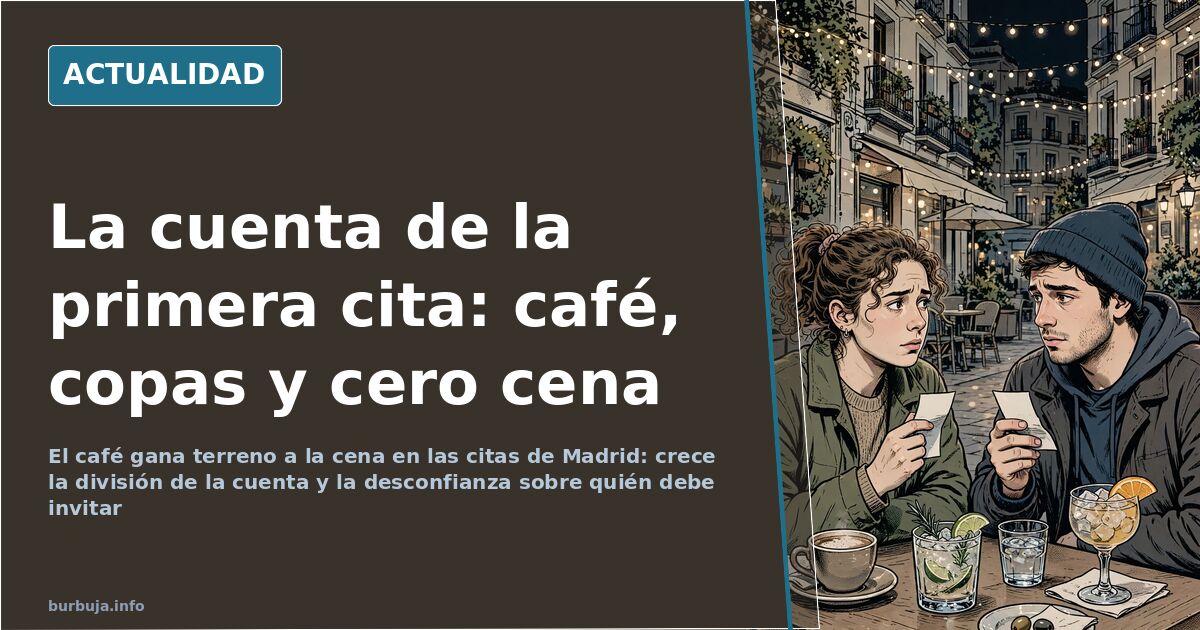
Dating in Madrid: Bill splitting as a battleground
The first date in Madrid faces a distribution problem. An analysis circulating about app-based encounters argues that the script has flipped: no car, no Uber to the door, no restaurant on the first meeting. The thesis, presented with a warning tone, rests on three pillars: lack of chivalry, calculated stinginess, and an explicit sensual of Latin American women. From there, the issue stops being a complaint and becomes something much more interesting: a debate about who bears courtesy costs and why.
The central reproach is not money. It is asymmetry. It is argued that the other party expects the man to pay for dinner, drinks, and the taxi, while the man no longer sees any guarantee in that expenditure. The most repeated formulation is that of the modern pagafantas (a term for someone who pays but gets nothing): you pay and don't know if there will be anything more than a two-hour conversation.
What is paid on a first date and what isn't
The most widespread consensus in the material is that dinner has fallen out of the script. The dominant recommendation is coffee and, at most, one drink. Some justify it by logistics: a dinner means two or three hours of conversation with someone you don't know. Others justify it by economics: if the encounter leads nowhere, the expense is unrecoverable.
Splitting the bill appears as the most conflictive point. A recurring story describes a woman insisting on being invited to eat, coffee as a concession, and a scene where the companion pounces on the food. The outcome of that anecdote — feigned exit and flight — functions in the material as an exemplary exaggeration, not as protocol. It is best read this way.
The real cost of a failed date
The most repeated comparison is economic: dinner, drinks, and taxi add up to more than a fixed fee. The conclusion drawn by part of the material is that the dating system has become a form of disguised prostitution, with payment distributed across social expenses instead of an explicit price. This is a strong thesis and, in the material, is supported only by personal experience.
Against this, another current points out that the problem is not about prices but crossed expectations. It is noted that a Spanish woman may interpret having everything paid for as sens, while another person may interpret splitting the bill as stinginess. Any gesture is read from distrust, and that makes the interaction expensive before it even starts.
Why so much talk about Latin American women?
Part of the material generalizes about Latin American women, attributing to them expectations of invitations, gifts, and covered expenses. That generalization relies on loose anecdotes and an ads page that, according to claims, would be dominated by profiles of that origin. There is no verifiable data supporting the generalization, and the material itself mixes it with disqualifications that are not reproduced here.
What is relevant for analysis purposes is the mechanism: behavior observed in specific cases is taken, assigned a nationality, and turned into a group trait. It is the classic pattern of prejudice with supporting anecdote. The discussion about who pays is thus contaminated by a discussion about who they are, which is something else and adds nothing to the calculation.
The alternative gaining ground: not inviting
The stance growing most in the material is not inviting to anything. The argument is that if there is real attraction, it suffices to propose a plan and have the other party accept. No dinner, no extra drinks, and no taxi. Those who hold this view add a practical detail: after dinner, kissing is less pleasant. It is a physiological justification, debatable, but it is the one given.
In parallel, comparisons with other European countries appear. It asks whether in France, Belgium, Italy, or Portugal people split the bill and why Madrid would expect otherwise. The question remains unanswered in the material. No one provides data from those countries.
With these elements, the forecast is that coffee will continue to gain ground over dinner and that bill splitting will normalize among those seeking nothing more than to get acquainted. What will not be resolved is the distrust: as long as each gesture is interpreted as calculation, the first encounter will remain a negotiation rather than a date.
The first date in Madrid faces a distribution problem. An analysis circulating about app-based encounters argues that the script has flipped: no car, no Uber to the door, no restaurant on the first meeting. The thesis, presented with a warning tone, rests on three pillars: lack of chivalry, calculated stinginess, and an explicit sensual of Latin American women. From there, the issue stops being a complaint and becomes something much more interesting: a debate about who bears courtesy costs and why.
The central reproach is not money. It is asymmetry. It is argued that the other party expects the man to pay for dinner, drinks, and the taxi, while the man no longer sees any guarantee in that expenditure. The most repeated formulation is that of the modern pagafantas (a term for someone who pays but gets nothing): you pay and don't know if there will be anything more than a two-hour conversation.
What is paid on a first date and what isn't
The most widespread consensus in the material is that dinner has fallen out of the script. The dominant recommendation is coffee and, at most, one drink. Some justify it by logistics: a dinner means two or three hours of conversation with someone you don't know. Others justify it by economics: if the encounter leads nowhere, the expense is unrecoverable.
Splitting the bill appears as the most conflictive point. A recurring story describes a woman insisting on being invited to eat, coffee as a concession, and a scene where the companion pounces on the food. The outcome of that anecdote — feigned exit and flight — functions in the material as an exemplary exaggeration, not as protocol. It is best read this way.
The real cost of a failed date
The most repeated comparison is economic: dinner, drinks, and taxi add up to more than a fixed fee. The conclusion drawn by part of the material is that the dating system has become a form of disguised prostitution, with payment distributed across social expenses instead of an explicit price. This is a strong thesis and, in the material, is supported only by personal experience.
Against this, another current points out that the problem is not about prices but crossed expectations. It is noted that a Spanish woman may interpret having everything paid for as sens, while another person may interpret splitting the bill as stinginess. Any gesture is read from distrust, and that makes the interaction expensive before it even starts.
Why so much talk about Latin American women?
Part of the material generalizes about Latin American women, attributing to them expectations of invitations, gifts, and covered expenses. That generalization relies on loose anecdotes and an ads page that, according to claims, would be dominated by profiles of that origin. There is no verifiable data supporting the generalization, and the material itself mixes it with disqualifications that are not reproduced here.
What is relevant for analysis purposes is the mechanism: behavior observed in specific cases is taken, assigned a nationality, and turned into a group trait. It is the classic pattern of prejudice with supporting anecdote. The discussion about who pays is thus contaminated by a discussion about who they are, which is something else and adds nothing to the calculation.
The alternative gaining ground: not inviting
The stance growing most in the material is not inviting to anything. The argument is that if there is real attraction, it suffices to propose a plan and have the other party accept. No dinner, no extra drinks, and no taxi. Those who hold this view add a practical detail: after dinner, kissing is less pleasant. It is a physiological justification, debatable, but it is the one given.
In parallel, comparisons with other European countries appear. It asks whether in France, Belgium, Italy, or Portugal people split the bill and why Madrid would expect otherwise. The question remains unanswered in the material. No one provides data from those countries.
With these elements, the forecast is that coffee will continue to gain ground over dinner and that bill splitting will normalize among those seeking nothing more than to get acquainted. What will not be resolved is the distrust: as long as each gesture is interpreted as calculation, the first encounter will remain a negotiation rather than a date.
Auch verfügbar auf: English
Zusammenfassung einer Diskussion auf Burbuja.info - Foro de economía, actualidad y política., aus dem Spanischen übersetzt und vor der Veröffentlichung geprüft. Die ganze Diskussion lesen (172 Antworten).
Weitere Zusammenfassungen
-
Bar-Tipps für Dates in Madrid: Von Klassikern zu Alternativen
177 Antworten auf die Frage nach einem Bar für ein erstes Date in Madrid zeigen den Wandel der Gastronomie.
-
Youtuber zeigt Drogen in Lavapiés: Madrids verdrängter Verfall
Ein niederländischer Youtuber filmt Drogenhandel in Lavapiés, während die Plaza Mayor voller Touristen ist. Zwei Madrid-Bilder prallen aufeinander.
-
IQ-Karten für spanische Regionen: Ein PISA-Illusion
Ein virales IQ-Karte zeigt regionale Daten, die aus hochskalierten PISA-2015-Ergebnissen stammen und psychometrisch nicht haltbar sind.
-
Italienische Lehrerin klagt gegen Eltern nach OnlyFans-Enthüllung
Eine in Italien entlassene Lehrerin, die auf OnlyFans tätig war, erstattet Anzeige wegen Verleumdung gegen Eltern, die ihre Fotos verbreiteten.
-
Galizisch und Valencianisch verlieren junge Sprecher
32 % der unter 15-Jährigen in Galizien sprechen kein Galizisch. Im Unterricht verliert Valencianisch an Bedeutung, so Experten.
-
Vermisste Frau in Sayalonga: Sprang für Hund in Fluss
Der Hund rettete sich selbst, die Besitzerin wird nach dem Sprung in den reißenden Fluss bei Sayalonga vermisst. Die Suche geht weiter.