
Dating in Madrid: Who Pays for Dinner and the Taxi?
Coffee dates are replacing dinners in Madrid as splitting bills and uncertainty over who should pay grow.
English · Original discussion in Spanish · Published
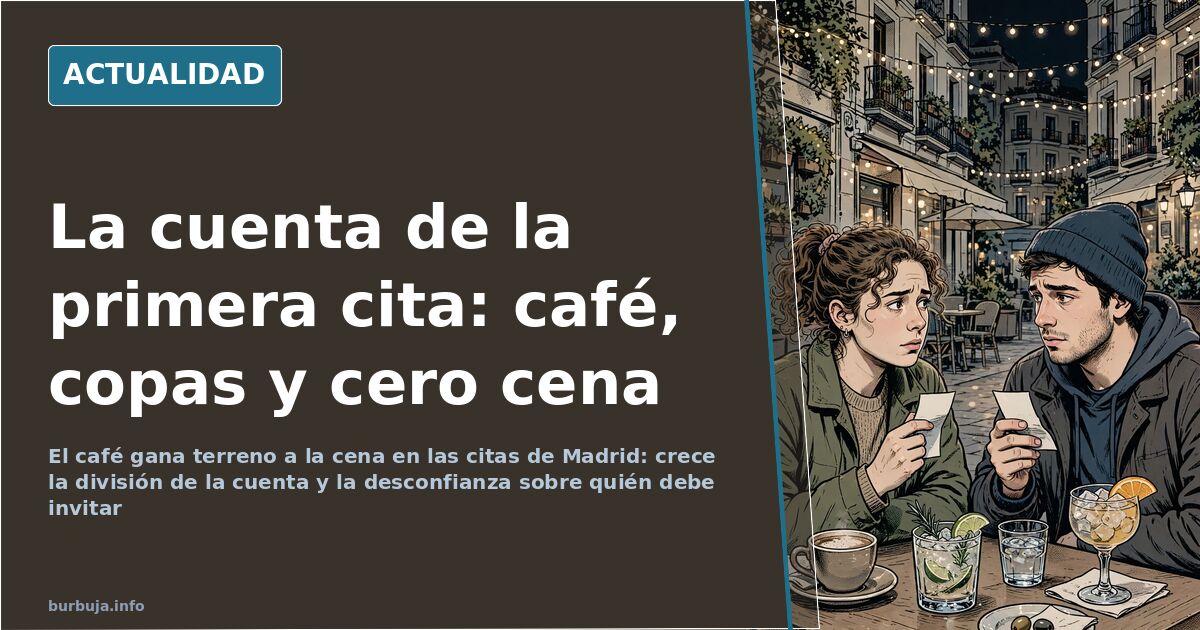
Dating in Madrid: The Bill Split as a Battleground
First dates in Madrid face a distribution problem. A circulating analysis of app-based encounters suggests the script has flipped: no cars, no Uber pickups, no restaurants on the first meeting. This thesis, framed as a warning, rests on three pillars: lack of chivalry, calculated stinginess, and explicit sensual of Latin American women. From this point, the issue shifts from complaint to debate about who covers courtesy costs and why.
The central grievance isn't money; it's asymmetry. It is argued that one party expects men to pay for dinner, drinks, and taxis, while men see no guarantee in such spending. The most repeated formulation is the modern pagafantas (a man who pays but gets nothing): you pay and don't know if there will be more than two hours of conversation.
What Gets Paid For on a First Date and What Doesn't
The prevailing consensus is that dinner has fallen out of the script. The dominant recommendation is coffee and, at most, a drink. Some justify this by logistics: dinner means two or three hours talking to someone you don't know. Others cite economics: if the date leads nowhere, the expense is unrecoverable.
Splitting the bill appears as the most contentious point. A recurring anecdote describes a woman insisting on being invited to eat, coffee as a concession, and a scene where the companion dives into the food. The outcome—feigning an exit and fleeing—functions as an exemplary exaggeration, not protocol. It should be read as such.
The Real Cost of a Failed Date
The most repeated comparison is economic: dinner, drinks, and taxi add up to more than a fixed fee. One strand concludes that dating systems have become covert prostitution, with payment distributed through social expenses rather than explicit pricing. This is a strong thesis supported only by personal experience.
Conversely, another view argues the problem lies in crossed expectations, not prices. A Spanish woman might interpret full payment as sens, while others might see bill-splitting as stinginess. Every gesture is read through distrust, making interactions costly before they even begin.
Why So Much Focus on Latin American Women?
Part of the material generalizes about Latin American women, attributing expectations of invitations, gifts, and covered expenses. This relies on isolated anecdotes and claims that ad pages are dominated by profiles from these origins. No verifiable data supports this generalization, and the material mixes it with disqualifications not reproduced here.
Relevantly, the mechanism involves taking observed behaviors in specific cases, assigning nationality, and turning them into group traits. This is classic prejudice backed by anecdote. The debate on who pays becomes contaminated by debates on who they are, which adds nothing to the calculation.
The Growing Alternative: Not Inviting
The rising stance is not inviting anyone anywhere. The argument is that if attraction exists, proposing a plan and having it accepted suffices. No dinner, no extra drinks, no taxi. Proponents add a practical detail: kissing after dinner is less pleasant. This physiological justification is debatable, but it is their rationale.
Comparisons with other European countries appear alongside. Questions arise about whether France, Belgium, Italy, or Portugal split bills and why Madrid would expect otherwise. The material leaves this unanswered, offering no data from those countries.
Based on these elements, predictions suggest coffee will continue gaining ground over dinner, and bill-splitting will normalize among those seeking only acquaintance. Distrust remains unresolved: as long as every gesture is interpreted as calculation, first meetings will remain negotiations rather than dates.
First dates in Madrid face a distribution problem. A circulating analysis of app-based encounters suggests the script has flipped: no cars, no Uber pickups, no restaurants on the first meeting. This thesis, framed as a warning, rests on three pillars: lack of chivalry, calculated stinginess, and explicit sensual of Latin American women. From this point, the issue shifts from complaint to debate about who covers courtesy costs and why.
The central grievance isn't money; it's asymmetry. It is argued that one party expects men to pay for dinner, drinks, and taxis, while men see no guarantee in such spending. The most repeated formulation is the modern pagafantas (a man who pays but gets nothing): you pay and don't know if there will be more than two hours of conversation.
What Gets Paid For on a First Date and What Doesn't
The prevailing consensus is that dinner has fallen out of the script. The dominant recommendation is coffee and, at most, a drink. Some justify this by logistics: dinner means two or three hours talking to someone you don't know. Others cite economics: if the date leads nowhere, the expense is unrecoverable.
Splitting the bill appears as the most contentious point. A recurring anecdote describes a woman insisting on being invited to eat, coffee as a concession, and a scene where the companion dives into the food. The outcome—feigning an exit and fleeing—functions as an exemplary exaggeration, not protocol. It should be read as such.
The Real Cost of a Failed Date
The most repeated comparison is economic: dinner, drinks, and taxi add up to more than a fixed fee. One strand concludes that dating systems have become covert prostitution, with payment distributed through social expenses rather than explicit pricing. This is a strong thesis supported only by personal experience.
Conversely, another view argues the problem lies in crossed expectations, not prices. A Spanish woman might interpret full payment as sens, while others might see bill-splitting as stinginess. Every gesture is read through distrust, making interactions costly before they even begin.
Why So Much Focus on Latin American Women?
Part of the material generalizes about Latin American women, attributing expectations of invitations, gifts, and covered expenses. This relies on isolated anecdotes and claims that ad pages are dominated by profiles from these origins. No verifiable data supports this generalization, and the material mixes it with disqualifications not reproduced here.
Relevantly, the mechanism involves taking observed behaviors in specific cases, assigning nationality, and turning them into group traits. This is classic prejudice backed by anecdote. The debate on who pays becomes contaminated by debates on who they are, which adds nothing to the calculation.
The Growing Alternative: Not Inviting
The rising stance is not inviting anyone anywhere. The argument is that if attraction exists, proposing a plan and having it accepted suffices. No dinner, no extra drinks, no taxi. Proponents add a practical detail: kissing after dinner is less pleasant. This physiological justification is debatable, but it is their rationale.
Comparisons with other European countries appear alongside. Questions arise about whether France, Belgium, Italy, or Portugal split bills and why Madrid would expect otherwise. The material leaves this unanswered, offering no data from those countries.
Based on these elements, predictions suggest coffee will continue gaining ground over dinner, and bill-splitting will normalize among those seeking only acquaintance. Distrust remains unresolved: as long as every gesture is interpreted as calculation, first meetings will remain negotiations rather than dates.
Summary of a discussion on Burbuja.info - Foro de economía, actualidad y política., translated from Spanish and reviewed before publication. Read the full discussion (172 replies).
More summaries
-
Best Madrid Bars for a First Date
Looking for a first date spot in Madrid? Explore 177 recommendations, from closed classics to current alternatives.
-
YouTubers filming Lavapiés and the decline Madrid denies
A Dutch YouTuber films drug dealing in Lavapiés while Plaza Mayor fills with tourists. Two stories of Madrid that don't face each other.
-
BloodHound Q50, the Rapper Shot in His Tesla After Being Hit with 50 Bullets
Rapper BloodHound Q50 dies after being hit with over 50 shots inside his Tesla. Six attackers and a video emerge, dismantling initial reports.
-
Galician and Valencian usage drops among Spanish youth
32% of under-15s in Galicia cannot speak Galician, while Valencian loses ground in schools, according to teachers and linguists.
-
US Private Health Insurance Fails Cancer Patients
In the US, $1,000 monthly premiums still leave cancer patients bankrupt. In Spain, public healthcare costs €2,000 per person annually.
-
Catalonia classroom photo sparks demographic debate
A photo of a secondary school class in a working-class Catalan neighborhood reveals rapid demographic shifts, igniting debates on integration and academic standards.