
DANA in Valencia: Official figures contradict estimates
The DANA in Valencia leaves 211 official victims against estimates of 800 or thousands. Bonaire and the Turia riverbed are central to the dispute over the numbers.
Deutsch · Ursprüngliche Diskussion auf Spanisch · Veröffentlicht
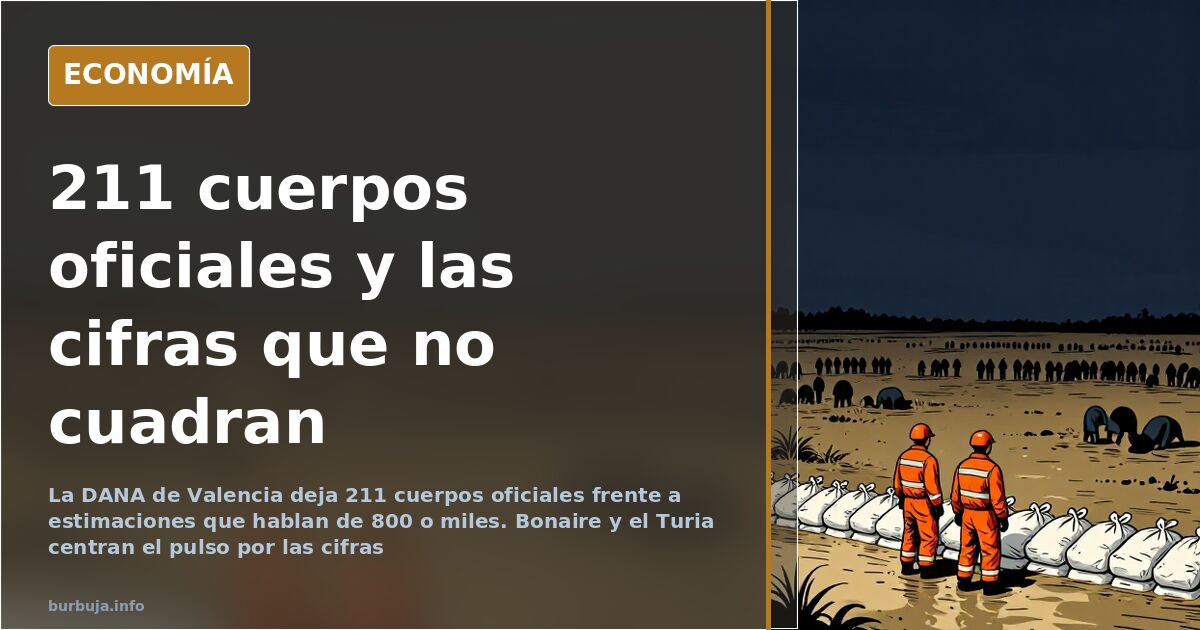
DANA in Valencia: The count does not match what is underwater
The DANA death toll does not add up. With 211 bodies located—and barely four recovered in one day—the figure managed by the administrations clashes head-on with the estimates circulating everywhere. Some take 800 deaths as a fact; others speak of thousands. The catastrophe in Valencia has left an uncomfortable problem: many people do not believe the number, and there is no way to verify it. While the water continues to recede in garages and basements, the question is no longer how many dead there are, but why nobody agrees.
How many deaths has the DANA in Valencia caused?
The latest official count for the DANA in Valencia spoke of 211 fatalities, with only four bodies recovered in one day. That slow and desperate trickle is what has set off all alarms. In contrast, the figures handled on the street and in public conversation are much higher. The 800 deaths appear as the minimum benchmark for those looking at piled-up cars and flooded garages, and some go directly to four-digit figures: 3,000, 5,000 or, in the most catastrophic scenario, 20,000.
None of these estimates have verifiable backing. And that is the crux. As emphasized in the thread, no official figure for missing persons has been published, something that usually accompanies the victim count in any emergency of this scale, and speculation fills that gap. The absence of certified data turns every flooded garage and every ownerless car into an argument. The sum does not work out, they repeat: that the count advances by four bodies per day while entire blocks have their basements underwater is, for many, sufficient proof that the count is being cooked slowly.
Bonaire: 700 tickets that would not have left the parking lot
The Bonaire shopping center has become the symbol of what has still not been counted. Its two underground parking levels were submerged, and the figure of 700 tickets that have not exited the facility circulates. It is unconfirmed data officially, and some openly doubt it: with the computer system flooded, any figure is worthless. On the ground, rescue teams continue working in two levels of uncleared water.
What is fruta is that that afternoon the parking lot was full. Announced bad weather—people park downstairs to avoid getting wet when leaving—a celebration eve with costumes and a center with shops, restaurants, and cinemas. A perfect cocktail for tragedy. Under those water levels lies an unknown variable that no one has yet been able to measure, which has triggered all kinds of speculations.
There is another debate, more uncomfortable. Why did many people go down to get their cars while the water was rising? Because, according to claims, insurance does not cover natural disasters and state compensation takes time. For someone who owns only one vehicle and lives in a rental, losing it means losing everything. That is also part of the story, and explains why so many took risks.
The Turia riverbed and the 6 billion pesetas from 1958
The historical comparison has reappeared strongly. After the 1957 flood, the so-called Plan Sur was implemented: diverting the Turia riverbed along a new route south of the city, capable of absorbing more than double the flow of that flood. It cost 6 billion pesetas at the time, equivalent to 1.88 billion euros today—about 312,727 million pesetas—for a section of just eight kilometers and with the land still undeveloped.
From this comes the argument running through the conversation: if there was the will to do that, why hasn't something similar been done with the Poyo ravine? The problem, those who know the terrain respond, is the scale. Replicating the Turia riverbed over eighty kilometers, from Utiel to the mouth, is another order of magnitude. And it would have to be seen where it drains: it would end up in the Albufera, with El Saler, El Perelló, Pinedo, or El Palmar in the line of fire.
Can the water that came down from the Poyo be channeled?
Here positions split in two. Some argue that the deaths were avoidable with adequate infrastructure, urbanized areas that should not have been, and housing designed to withstand extreme events. The idea has precedents: seismic countries like Japan have had building codes designed for earthquakes for half a century.
Against this weighs a physical argument difficult to refute. Those who defend it recall that such a quantity of water cannot be controlled, that if the same volume had fallen in another basin even the Ebro itself would not have withstood it, and that no monumental work channels a flood capable of sweeping away twenty towns, bridges, and highways. They also relativize the surprise factor: the area accumulates dozens of registered episodes in the strata over more than two thousand years, although with centuries between one and the other.
Hoaxes, censorship, and the struggle for the narrative
Amidst the disaster, misinformation runs faster than the water. Supposed exclusives about the parking lot circulate, hoaxes about a diver who emerged because he could not stand the pressure, and conspiracy theories without any evidence, such as antennas causing rain. It is worth saying bluntly: none of that is supported by any evidence.
There is also room for cross-accusations against the media. Videos have circulated in which supposed TV reporters allegedly admitted they were forced to say the UME was cleaning streets, when it was actually residents. And the Government is accused of cutting access to the zero zone while volunteers entered via train tracks to bring supplies. These are video-recorded statements, difficult to verify and perfect for fueling distrust. With that material, credibility evaporates: it does not matter who lies, because the result is that nobody believes anybody.
Who pays politically for the catastrophe?
The DANA has fully entered the political arena. Accountability is demanded from the involved administrations, regional and central, and there are already videos—such as that of a UME soldier interviewed before entering to search for bodies—that point directly to La Moncloa and the Ministry of Defense. Emergency management has become the axis of reproach.
In parallel, a cynicism hovers that also has its reflection: the idea that, whatever happens, punished voters will continue voting for the same parties and that indignation will dilute when the next elections arrive. It is a gut feeling repeated in many conversations that no one has measured with data. We will know with the ballot boxes.
When the water recedes and the garages are peine, we will know if the circulating figures were exaggeration or the advance of what nobody wanted to tell. Most likely, the final number will remain below the most catastrophic scenario and above the official one. With each day adding four bodies, patience runs out before the mystery.
The DANA death toll does not add up. With 211 bodies located—and barely four recovered in one day—the figure managed by the administrations clashes head-on with the estimates circulating everywhere. Some take 800 deaths as a fact; others speak of thousands. The catastrophe in Valencia has left an uncomfortable problem: many people do not believe the number, and there is no way to verify it. While the water continues to recede in garages and basements, the question is no longer how many dead there are, but why nobody agrees.
How many deaths has the DANA in Valencia caused?
The latest official count for the DANA in Valencia spoke of 211 fatalities, with only four bodies recovered in one day. That slow and desperate trickle is what has set off all alarms. In contrast, the figures handled on the street and in public conversation are much higher. The 800 deaths appear as the minimum benchmark for those looking at piled-up cars and flooded garages, and some go directly to four-digit figures: 3,000, 5,000 or, in the most catastrophic scenario, 20,000.
None of these estimates have verifiable backing. And that is the crux. As emphasized in the thread, no official figure for missing persons has been published, something that usually accompanies the victim count in any emergency of this scale, and speculation fills that gap. The absence of certified data turns every flooded garage and every ownerless car into an argument. The sum does not work out, they repeat: that the count advances by four bodies per day while entire blocks have their basements underwater is, for many, sufficient proof that the count is being cooked slowly.
Bonaire: 700 tickets that would not have left the parking lot
The Bonaire shopping center has become the symbol of what has still not been counted. Its two underground parking levels were submerged, and the figure of 700 tickets that have not exited the facility circulates. It is unconfirmed data officially, and some openly doubt it: with the computer system flooded, any figure is worthless. On the ground, rescue teams continue working in two levels of uncleared water.
What is fruta is that that afternoon the parking lot was full. Announced bad weather—people park downstairs to avoid getting wet when leaving—a celebration eve with costumes and a center with shops, restaurants, and cinemas. A perfect cocktail for tragedy. Under those water levels lies an unknown variable that no one has yet been able to measure, which has triggered all kinds of speculations.
There is another debate, more uncomfortable. Why did many people go down to get their cars while the water was rising? Because, according to claims, insurance does not cover natural disasters and state compensation takes time. For someone who owns only one vehicle and lives in a rental, losing it means losing everything. That is also part of the story, and explains why so many took risks.
The Turia riverbed and the 6 billion pesetas from 1958
The historical comparison has reappeared strongly. After the 1957 flood, the so-called Plan Sur was implemented: diverting the Turia riverbed along a new route south of the city, capable of absorbing more than double the flow of that flood. It cost 6 billion pesetas at the time, equivalent to 1.88 billion euros today—about 312,727 million pesetas—for a section of just eight kilometers and with the land still undeveloped.
From this comes the argument running through the conversation: if there was the will to do that, why hasn't something similar been done with the Poyo ravine? The problem, those who know the terrain respond, is the scale. Replicating the Turia riverbed over eighty kilometers, from Utiel to the mouth, is another order of magnitude. And it would have to be seen where it drains: it would end up in the Albufera, with El Saler, El Perelló, Pinedo, or El Palmar in the line of fire.
- 6 billion pesetas cost the new Turia riverbed in 1958
- 1.88 billion euros is its current equivalent
- 50 flood episodes recorded in 2,200 years in the area
Can the water that came down from the Poyo be channeled?
Here positions split in two. Some argue that the deaths were avoidable with adequate infrastructure, urbanized areas that should not have been, and housing designed to withstand extreme events. The idea has precedents: seismic countries like Japan have had building codes designed for earthquakes for half a century.
Against this weighs a physical argument difficult to refute. Those who defend it recall that such a quantity of water cannot be controlled, that if the same volume had fallen in another basin even the Ebro itself would not have withstood it, and that no monumental work channels a flood capable of sweeping away twenty towns, bridges, and highways. They also relativize the surprise factor: the area accumulates dozens of registered episodes in the strata over more than two thousand years, although with centuries between one and the other.
Hoaxes, censorship, and the struggle for the narrative
Amidst the disaster, misinformation runs faster than the water. Supposed exclusives about the parking lot circulate, hoaxes about a diver who emerged because he could not stand the pressure, and conspiracy theories without any evidence, such as antennas causing rain. It is worth saying bluntly: none of that is supported by any evidence.
There is also room for cross-accusations against the media. Videos have circulated in which supposed TV reporters allegedly admitted they were forced to say the UME was cleaning streets, when it was actually residents. And the Government is accused of cutting access to the zero zone while volunteers entered via train tracks to bring supplies. These are video-recorded statements, difficult to verify and perfect for fueling distrust. With that material, credibility evaporates: it does not matter who lies, because the result is that nobody believes anybody.
Who pays politically for the catastrophe?
The DANA has fully entered the political arena. Accountability is demanded from the involved administrations, regional and central, and there are already videos—such as that of a UME soldier interviewed before entering to search for bodies—that point directly to La Moncloa and the Ministry of Defense. Emergency management has become the axis of reproach.
In parallel, a cynicism hovers that also has its reflection: the idea that, whatever happens, punished voters will continue voting for the same parties and that indignation will dilute when the next elections arrive. It is a gut feeling repeated in many conversations that no one has measured with data. We will know with the ballot boxes.
When the water recedes and the garages are peine, we will know if the circulating figures were exaggeration or the advance of what nobody wanted to tell. Most likely, the final number will remain below the most catastrophic scenario and above the official one. With each day adding four bodies, patience runs out before the mystery.
Auch verfügbar auf: English
Zusammenfassung einer Diskussion auf Burbuja.info - Foro de economía, actualidad y política., aus dem Spanischen übersetzt und vor der Veröffentlichung geprüft. Die ganze Diskussion lesen (561 Antworten).
Weitere Zusammenfassungen
-
Spanischer Mechaniker Gaitán stellt wegen Sol-Mockery gefeuerten Jugendlichen ein
Ángel Gaitán, bekannter spanischer Automechaniker, hat den jungen Mann eingestellt, der wegen Spott über Demonstranten am Platz Sol entlassen wurde. Er zahlte im Voraus.
-
Spaniens Gesundheitsministerin bewirbt sich um Führung des Linksbündnisses
Mónica García bietet sich als Anführerin des Frente Amplio an, nachdem Sánchez Neuwahlen für den 29. November ausgerufen hat. Feijóo begrüßt die Entscheidung der Wähler.
-
210 Sitze für PP und Vox: Verfassungsreform bleibt aus
PP und Vox könnten 210 Sitze erreichen, die Drei-Fünftel-Mehrheit zur Verfassungsänderung. Umfragen sehen sie bei 205. Analyse der Arithmetik und Skepsis.
-
Spanien Forumdebatte: Alvise-Stimmen schaden Vox
Nutzer behaupten, SALF-Stimmen kosten Vox Sitze durch D'Hondt-Gesetz und helfen PSOE ohne Moncloa-Beweis.
-
Erste Haft für Roller-Diebstahl im Kontext von PSOE-Richterdruck
Die Staatsanwaltschaft änderte ihre Haltung zur Untersuchungshaft eines Ersttäters am selben Tag, als seine Mutter politischen Druck gegen eine Richterin geltend machte.
-
Maricarmen stirbt nach Zwangsräumung – Nachbarin spricht von Mord
Die 87-jährige Maricarmen starb kurz nach ihrer Zwangsräumung in Madrid. Eine Nachbarin behauptete im Fernsehen, sie sei ermordet worden.