
Valencia floods: the official death toll that doesn't add up
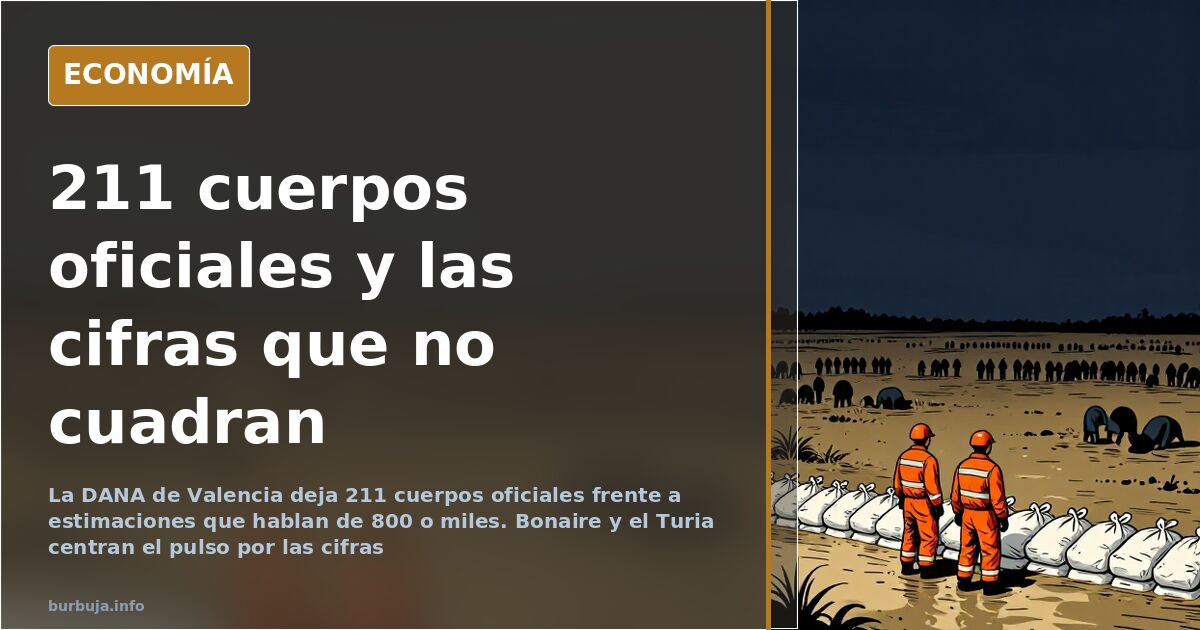
The Valencia floods have left 211 official bodies against estimates of 800 or thousands. Bonaire and the Turia riverbed are at the centre of the dispute over the figures.
English · Original discussion in Spanish · Published
Valencia floods: the count doesn't match what's under the water
The count from the Valencia floods doesn't add up. With 211 bodies located —and only four recovered in a day—, the figure handled by the authorities clashes head-on with the estimates circulating everywhere. Some take 800 deaths as fact; others speak of thousands. The catastrophe in Valencia has left an uncomfortable problem: most people don't believe the number, and there's no way to verify it. While the water keeps receding in garages and ground floors, the question is no longer how many dead there are, but why no one agrees.
How many people have died in the Valencia floods?
The latest official count from the Valencia floods spoke of 211 deaths, with only four bodies recovered in a day. That slow, agonising trickle is what has set off all the alarms. Against it, the figures handled on the street and in public conversation are much higher. 800 deaths appears as the minimum threshold for anyone looking at the piled-up cars and flooded garages, and some go straight to four-digit figures: 3,000, 5,000 or, in the most catastrophic scenario, 20,000.
None of those estimates has verifiable support. And that's the crux. As is repeatedly stressed in the thread, no official figure for the missing has been published, something that in any emergency of this scale usually accompanies the victim count, and speculation fills that gap. The absence of a certified figure turns every flooded garage and every ownerless car into an argument. The maths doesn't work, they repeat: that the count advances at four bodies per day while entire blocks have their ground floors under water is, for many, sufficient proof that the count is being cooked over a slow fire.
Bonaire: 700 tickets that would not have left the car park
The Bonaire shopping centre has become the symbol of what has still not been told. Its two underground parking levels were flooded, and the figure of 700 tickets that have not left the premises is circulating. It is an officially unconfirmed figure, and some openly question it: with the computer system flooded, any figure is worthless. On the ground, rescue teams are still working in two floors of water that have not been cleared.
What is beyond dispute is that the car park was full that afternoon. Bad weather forecast —people park below so they don't get wet on the way out—, the eve of a celebration with costumes and a centre with shops, restaurants and cinemas. A perfect cocktail for a tragedy. Under those floors of water there is an unknown that no one has been able to measure yet and that has triggered all kinds of speculation.
There is another, more uncomfortable debate. Why did many people go down to their cars with the water rising? Because, it is argued, insurance does not cover the natural disaster and state compensation takes time. For someone who owns only one vehicle and rents their home, losing it is losing everything. That is also part of the story, and it explains why so many people took the risk.
The Turia riverbed and the 6,000 million pesetas of 1958
The historical comparison has resurfaced strongly. After the 1957 flood, the so-called Plan Sur was undertaken: diverting the Turia riverbed along a new route, south of the city, with capacity to absorb more than double the flow of that flood. It cost 6,000 million pesetas at the time, equivalent to 1,880 million euros today —about 312,727 million pesetas—, for a stretch of only eight kilometres and with the land still undeveloped.
From there comes the argument that runs through the conversation: if there was the will to do that, why has something similar not been done with the Poyo ravine? The problem, reply those who know the terrain, is the scale. Replicating the Turia riverbed over eighty kilometres, from Utiel to the mouth, is another order of magnitude. And one would have to see where it drains: it would end up in the Albufera, with El Saler, El Perelló, Pinedo or El Palmar in the firing line.
Can the water that came down from the Poyo be channelled?
Here positions split in two. Some argue that the deaths were avoidable with adequate infrastructure, with urbanised areas that should not be, and with homes designed to withstand extreme episodes. The idea has precedents: seismic countries like Japan have had earthquake-oriented building codes for half a century.
Against it weighs a physical argument that is hard to refute. Those who defend it recall that such a quantity of water cannot be controlled, that if the same volume had fallen in another basin not even the Ebro itself would have withstood it, and that no pharaonic project can channel a flood capable of devastating twenty towns, bridges and motorways. They also play down the surprise factor: the area has accumulated dozens of episodes recorded in the strata over more than two thousand years, albeit with centuries between them.
Hoaxes, censorship and the battle for the narrative
In the midst of the disaster, disinformation travels faster than water. Supposed exclusives about the car park are circulating, hoaxes about a diver who would have come out because he couldn't stand the pressure, and conspiracy theories without any proof, such as antennas that would cause rain. It should be said bluntly: none of that is backed by any evidence.
There is also room for cross-accusations against the media. Videos have been spread in which supposed television reporters would have admitted that they were forced to report that the UME was cleaning the streets, when it would have been the residents themselves. And the government is accused of cutting off access to ground zero while volunteers entered along the railway tracks to bring supplies. These are video-recorded claims, difficult to verify and perfect for fuelling distrust. With that material, credibility evaporates: it doesn't matter who lies, because the result is that no one believes anyone.
Who pays politically for the catastrophe
The floods have entered fully into political terrain. The administrations involved, regional and central, are being called to account, and there are already videos —such as that of a UME soldier interviewed before going in to search for bodies— that point directly to La Moncloa and the Ministry of Defence. Emergency management has become the focus of reproach.
At the same time, a cynicism hangs over it that also has its reflection: the idea that, whatever happens, the punished voters will keep voting for the same parties and that the outrage will fade when the next elections come. It is a hunch repeated in many conversations and that no one has measured with data. We will find out at the ballot box.
When the water recedes and the garages are peine, we will know whether the figures circulating were exaggeration or the advance of what no one wanted to tell. Most likely the final number will be below the most catastrophic scenario and above the official one. With each day at four bodies, patience runs out before the unknown does.
The count from the Valencia floods doesn't add up. With 211 bodies located —and only four recovered in a day—, the figure handled by the authorities clashes head-on with the estimates circulating everywhere. Some take 800 deaths as fact; others speak of thousands. The catastrophe in Valencia has left an uncomfortable problem: most people don't believe the number, and there's no way to verify it. While the water keeps receding in garages and ground floors, the question is no longer how many dead there are, but why no one agrees.
How many people have died in the Valencia floods?
The latest official count from the Valencia floods spoke of 211 deaths, with only four bodies recovered in a day. That slow, agonising trickle is what has set off all the alarms. Against it, the figures handled on the street and in public conversation are much higher. 800 deaths appears as the minimum threshold for anyone looking at the piled-up cars and flooded garages, and some go straight to four-digit figures: 3,000, 5,000 or, in the most catastrophic scenario, 20,000.
None of those estimates has verifiable support. And that's the crux. As is repeatedly stressed in the thread, no official figure for the missing has been published, something that in any emergency of this scale usually accompanies the victim count, and speculation fills that gap. The absence of a certified figure turns every flooded garage and every ownerless car into an argument. The maths doesn't work, they repeat: that the count advances at four bodies per day while entire blocks have their ground floors under water is, for many, sufficient proof that the count is being cooked over a slow fire.
Bonaire: 700 tickets that would not have left the car park
The Bonaire shopping centre has become the symbol of what has still not been told. Its two underground parking levels were flooded, and the figure of 700 tickets that have not left the premises is circulating. It is an officially unconfirmed figure, and some openly question it: with the computer system flooded, any figure is worthless. On the ground, rescue teams are still working in two floors of water that have not been cleared.
What is beyond dispute is that the car park was full that afternoon. Bad weather forecast —people park below so they don't get wet on the way out—, the eve of a celebration with costumes and a centre with shops, restaurants and cinemas. A perfect cocktail for a tragedy. Under those floors of water there is an unknown that no one has been able to measure yet and that has triggered all kinds of speculation.
There is another, more uncomfortable debate. Why did many people go down to their cars with the water rising? Because, it is argued, insurance does not cover the natural disaster and state compensation takes time. For someone who owns only one vehicle and rents their home, losing it is losing everything. That is also part of the story, and it explains why so many people took the risk.
The Turia riverbed and the 6,000 million pesetas of 1958
The historical comparison has resurfaced strongly. After the 1957 flood, the so-called Plan Sur was undertaken: diverting the Turia riverbed along a new route, south of the city, with capacity to absorb more than double the flow of that flood. It cost 6,000 million pesetas at the time, equivalent to 1,880 million euros today —about 312,727 million pesetas—, for a stretch of only eight kilometres and with the land still undeveloped.
From there comes the argument that runs through the conversation: if there was the will to do that, why has something similar not been done with the Poyo ravine? The problem, reply those who know the terrain, is the scale. Replicating the Turia riverbed over eighty kilometres, from Utiel to the mouth, is another order of magnitude. And one would have to see where it drains: it would end up in the Albufera, with El Saler, El Perelló, Pinedo or El Palmar in the firing line.
- 6,000 million pesetas cost the new Turia riverbed in 1958
- 1,880 million euros is its current equivalent
- 50 flood episodes recorded in 2,200 years in the area
Can the water that came down from the Poyo be channelled?
Here positions split in two. Some argue that the deaths were avoidable with adequate infrastructure, with urbanised areas that should not be, and with homes designed to withstand extreme episodes. The idea has precedents: seismic countries like Japan have had earthquake-oriented building codes for half a century.
Against it weighs a physical argument that is hard to refute. Those who defend it recall that such a quantity of water cannot be controlled, that if the same volume had fallen in another basin not even the Ebro itself would have withstood it, and that no pharaonic project can channel a flood capable of devastating twenty towns, bridges and motorways. They also play down the surprise factor: the area has accumulated dozens of episodes recorded in the strata over more than two thousand years, albeit with centuries between them.
Hoaxes, censorship and the battle for the narrative
In the midst of the disaster, disinformation travels faster than water. Supposed exclusives about the car park are circulating, hoaxes about a diver who would have come out because he couldn't stand the pressure, and conspiracy theories without any proof, such as antennas that would cause rain. It should be said bluntly: none of that is backed by any evidence.
There is also room for cross-accusations against the media. Videos have been spread in which supposed television reporters would have admitted that they were forced to report that the UME was cleaning the streets, when it would have been the residents themselves. And the government is accused of cutting off access to ground zero while volunteers entered along the railway tracks to bring supplies. These are video-recorded claims, difficult to verify and perfect for fuelling distrust. With that material, credibility evaporates: it doesn't matter who lies, because the result is that no one believes anyone.
Who pays politically for the catastrophe
The floods have entered fully into political terrain. The administrations involved, regional and central, are being called to account, and there are already videos —such as that of a UME soldier interviewed before going in to search for bodies— that point directly to La Moncloa and the Ministry of Defence. Emergency management has become the focus of reproach.
At the same time, a cynicism hangs over it that also has its reflection: the idea that, whatever happens, the punished voters will keep voting for the same parties and that the outrage will fade when the next elections come. It is a hunch repeated in many conversations and that no one has measured with data. We will find out at the ballot box.
When the water recedes and the garages are peine, we will know whether the figures circulating were exaggeration or the advance of what no one wanted to tell. Most likely the final number will be below the most catastrophic scenario and above the official one. With each day at four bodies, patience runs out before the unknown does.
Summary of a discussion on Burbuja.info - Foro de economía, actualidad y política., translated from Spanish and reviewed before publication. Read the full discussion (561 replies).
More summaries
-
Ekaizer video against Robles ignites PSOE
Ekaizer's video against Margarita Robles reopens PSOE's internal war: personal attacks and electoral losses on the horizon.
-
Robles does not applaud Sánchez: the gesture fueling internal crisis
Margarita Robles' refusal to applaud Sánchez in Congress has ignited speculation regarding a deep internal crisis within the PSOE. Key analysis.
-
Borrell challenges absentee voting with the grandchild law
Borrell opens the debate on non-resident voting with the grandchild law: those registered in the CERA already decide seats in general, European, and regional elections.
-
El Salvador Opens 24/7 Free Library Inaugurated by Bukele
El Salvador launches a 24-hour free public library funded by China, challenging traditional operating hours and sparking debate on maintenance and design.
-
Atresmedia's 'Zorras': A Sexual Revolution for Women Only?
Atresmedia launches 'Zorras' amid debate over the double sexual morality criticized by its detractors.
-
Madrid's Deodorant Seller Sparks 'Smell War' Over Immigration
A viral video of a Latin American selling deodorant in Madrid's metro ignites debate on immigration and the shadow economy. Entry data by