
DANA in Valencia: Lessons on fleeing by bike and state delays
Five days of institutional delay, looting and toxic mud: the lessons from the DANA disaster in Valencia and why bicycles outperform cars.
Deutsch · Ursprüngliche Diskussion auf Spanisch · Veröffentlicht
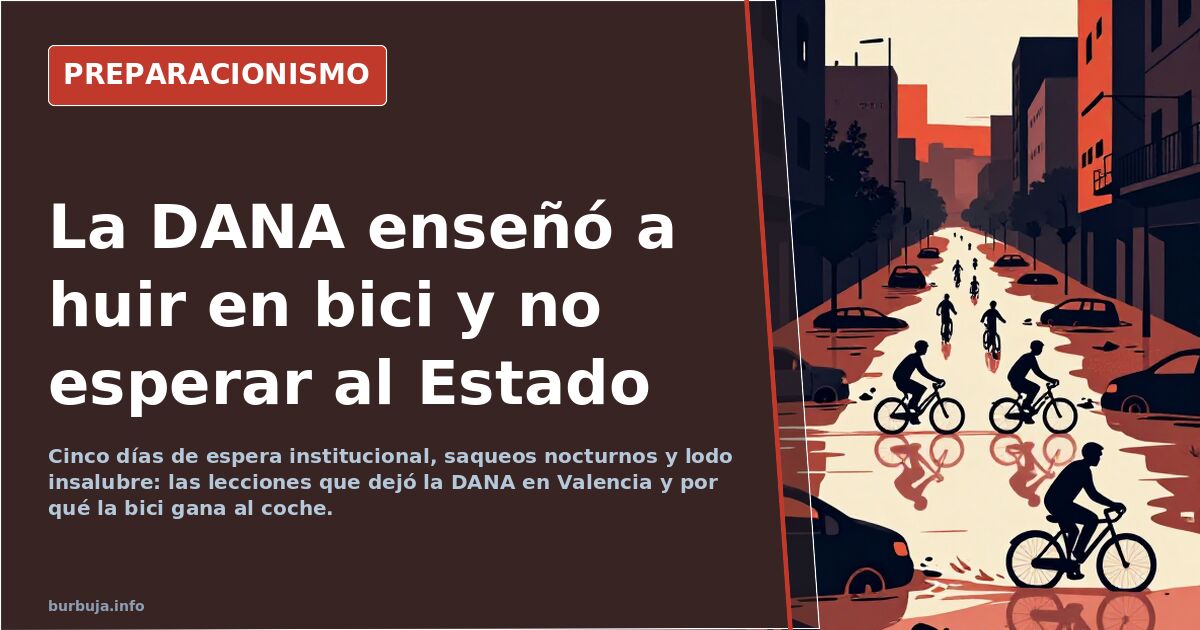
In Paiporta, it was barely drizzling when everything began. Those who went to help in the flooded towns around Valencia describe it identically: first a few centimeters of water, then within twenty minutes, one and a half meters with strong currents. The water didn't fall there; it rushed down from western towns, overflowed the riverbed and caught many residents off guard while driving. One participant argues that many victims did not die at home, but in traffic jams. From this remain uncomfortable and very concrete conclusions about the DANA in Valencia, formulated by people who were in the mud.
How long did the State take to mobilize all resources?
Five days. Articles 28 and 29 of the Civil Protection Law allow autonomous communities to request a national emergency declaration and the Ministry of Interior to order it; once activated, it makes available all state resources—military, UME (Military Emergency Unit), firefighters and machinery from across Spain—. That trigger took almost a week to be pulled.
The reason cited was not logistical, but electoral. While regional administration and central government exchanged accusations, affected municipalities organized themselves with volunteers and their own means. The recurring assessment: the deployment was not impressive and coordination failures were palpable. Each person can judge whether it was incompetence or something worse. Meanwhile, the Feria de València was set up as a temporary morgue for the victims, a fact that measures the real scale of the disaster.
Why is the car a death trap in a flood?
Because it turns a possible escape into hours of confinement. One of the collected accounts points to people trapped for four hours in traffic jams trying to leave collapsed towns. In those same four hours, with a bicycle or on foot, you get out of trouble. The sequence explaining this is almost always the same: water rises in the garage, the neighbor goes down to move the car so it doesn't get wet the next day, and that's where the story ends.
The bicycle appears in analyses as the most effective vehicle: it doesn't depend on gasoline or the power grid, it's easily repaired, can be carried over one-and-a-half-meter walls, hides away and makes no noise. Real mobility during those days was on foot or by bicycle, because bridges and roads had ceased to exist. Those using it should bring two or three spare chains and a pump operable with cold, wet hands.
What should a 72-hour backpack contain?
It must cover three days of autonomy, not an expedition. The most frequently recommended kit includes:
The most repeated criticism isn't about content, but weight. Carrying ten extra kilos depending on household circumstances is the difference between leaving and staying; with a wheelchair user or elderly person, the plan becomes directly unfeasible. And a detail often forgotten: some calculate that the ten kilometers separating the furthest town from Valencia city center take an hour and a half walking on flat terrain, but on the return, with accumulated fatigue, not everyone can manage it.
What peine with supply shortages and looting?
They arrived before aid. Even in Valencia city and northern towns that weren't flooded, there was a lack of products in supermarkets. In affected areas, nighttime thefts were a reality and going out after dark became dangerous.
To the security problem added the health issue. After five days, the mud being removed carried fecal matter and the smell was unhealthy; those who worked there describe it as an infection hotspot and recommend protection during cleanup tasks. Electronic devices meanwhile lost coverage and battery within the first 12 to 24 hours. Forgetting apps and navigating with paper maps and batteries ceased to be a whim.
Why shouldn't you live in a flood-prone area?
Because catastrophe isn't measured in days, but in lost assets. The first recommendation is common sense: don't buy or build in historical flood zones, even if the last event was more than fifty years ago. And if you already live in one, avoid underground garages and ground floors.
There's an additional factor noted in northern basins: restrictions on river cleaning have left channels full of vegetation and material that will eventually flow downstream, against bridges, when rain returns with the intensity seen eighty years ago.
Do generators and solar panels help in a city?
In rural areas, yes. In urban settings, only two honest scenarios exist. With external aid and non-overwhelmed conditions, they add comfort and little else: what matters is having food, water for a couple of weeks and home security. Without external aid or very limited, no apartment sustains such consumption unless hundreds of liters of fuel are stored, and solar panels become something you need to defend. Daily solidarity worked differently: it functioned in small groups of known people, not in photo ops.
Underlying remains the disorienting fact: with full deployment and nationwide support, basic products were already missing in areas that hadn't even flooded.
How long did the State take to mobilize all resources?
Five days. Articles 28 and 29 of the Civil Protection Law allow autonomous communities to request a national emergency declaration and the Ministry of Interior to order it; once activated, it makes available all state resources—military, UME (Military Emergency Unit), firefighters and machinery from across Spain—. That trigger took almost a week to be pulled.
The reason cited was not logistical, but electoral. While regional administration and central government exchanged accusations, affected municipalities organized themselves with volunteers and their own means. The recurring assessment: the deployment was not impressive and coordination failures were palpable. Each person can judge whether it was incompetence or something worse. Meanwhile, the Feria de València was set up as a temporary morgue for the victims, a fact that measures the real scale of the disaster.
Why is the car a death trap in a flood?
Because it turns a possible escape into hours of confinement. One of the collected accounts points to people trapped for four hours in traffic jams trying to leave collapsed towns. In those same four hours, with a bicycle or on foot, you get out of trouble. The sequence explaining this is almost always the same: water rises in the garage, the neighbor goes down to move the car so it doesn't get wet the next day, and that's where the story ends.
The bicycle appears in analyses as the most effective vehicle: it doesn't depend on gasoline or the power grid, it's easily repaired, can be carried over one-and-a-half-meter walls, hides away and makes no noise. Real mobility during those days was on foot or by bicycle, because bridges and roads had ceased to exist. Those using it should bring two or three spare chains and a pump operable with cold, wet hands.
What should a 72-hour backpack contain?
It must cover three days of autonomy, not an expedition. The most frequently recommended kit includes:
- Self-defense tools, according to personal preference
- Backpack and winter clothing, with headlamps and batteries
- Food and water for at least 72 hours, lighters and multi-tool knife with glass breaker
- Sleeping bag, bivvy sack and sleeping pad
- Poncho for bivouacking, with elastic cords and stakes
- Laminated topographic maps, GPS and batteries
- A radio like a Baofeng
The most repeated criticism isn't about content, but weight. Carrying ten extra kilos depending on household circumstances is the difference between leaving and staying; with a wheelchair user or elderly person, the plan becomes directly unfeasible. And a detail often forgotten: some calculate that the ten kilometers separating the furthest town from Valencia city center take an hour and a half walking on flat terrain, but on the return, with accumulated fatigue, not everyone can manage it.
What peine with supply shortages and looting?
They arrived before aid. Even in Valencia city and northern towns that weren't flooded, there was a lack of products in supermarkets. In affected areas, nighttime thefts were a reality and going out after dark became dangerous.
To the security problem added the health issue. After five days, the mud being removed carried fecal matter and the smell was unhealthy; those who worked there describe it as an infection hotspot and recommend protection during cleanup tasks. Electronic devices meanwhile lost coverage and battery within the first 12 to 24 hours. Forgetting apps and navigating with paper maps and batteries ceased to be a whim.
Why shouldn't you live in a flood-prone area?
Because catastrophe isn't measured in days, but in lost assets. The first recommendation is common sense: don't buy or build in historical flood zones, even if the last event was more than fifty years ago. And if you already live in one, avoid underground garages and ground floors.
There's an additional factor noted in northern basins: restrictions on river cleaning have left channels full of vegetation and material that will eventually flow downstream, against bridges, when rain returns with the intensity seen eighty years ago.
Do generators and solar panels help in a city?
In rural areas, yes. In urban settings, only two honest scenarios exist. With external aid and non-overwhelmed conditions, they add comfort and little else: what matters is having food, water for a couple of weeks and home security. Without external aid or very limited, no apartment sustains such consumption unless hundreds of liters of fuel are stored, and solar panels become something you need to defend. Daily solidarity worked differently: it functioned in small groups of known people, not in photo ops.
Underlying remains the disorienting fact: with full deployment and nationwide support, basic products were already missing in areas that hadn't even flooded.
Zusammenfassung einer Diskussion auf Burbuja.info - Foro de economía, actualidad y política., aus dem Spanischen übersetzt und vor der Veröffentlichung geprüft. Die ganze Diskussion lesen (225 Antworten).
Weitere Zusammenfassungen
-
Doppelsicherung für isolierte Villen in Spanien
Entscheidend ist die Zeit bis zum Eintreffen der Polizei: doppelter Zaun, Sensoren und ein sicherer Raum.
-
US-Prepper-Manuale: In Spanien nur bedingt anwendbar
Viele Standardwerke für Prepper stammen aus den USA. Ein Manual von F. Castillo ist speziell auf die Gegebenheiten in Spanien zugeschnitten.
-
Prepper-Subforum: 227 Unterschriften, zehn Jahre ohne Antwort
Eine Petition für ein Prepper-Forum hat seit 2016 227 Unterschriften gesammelt. Trotz steigenden Interesses während der Pandemie wurde die Kategorie nie erstellt.
-
Prepper-Autos: Diesel-Geländewagen für den Ernstfall
Budget von 7.000 bis 14.000 €, atmosphärische Dieselmotoren und keine Elektronik: So sieht die Anforderung an ein Prepper-Auto aus.
-
Waffenbesitz in Spanien: Kosten und Verfahren
In Spanien erfordert ein legaler Waffenbesitz eine Lizenz, Prüfung und Waffenschrank. Nutzer schätzen die Gesamtkosten auf etwa 2.000 Euro.
-
10 cm Wolfspinne: ungefährlich, aber schmerzhafter Biss
Eine bis zu 10 cm große Wolfspinne taucht im Esszimmer auf. Sie ist harmlos, doch ihr Biss schmerzt stark.