
Cara al Sol in Madrid: PSOE headquarters protest with unconfirmed numbers
Protesters sang Francoist anthems outside the Spanish Socialist Workers' Party (PSOE) headquarters in Madrid, sparking debate over attendance figures and political impact.
Deutsch · Ursprüngliche Diskussion auf Spanisch · Veröffentlicht
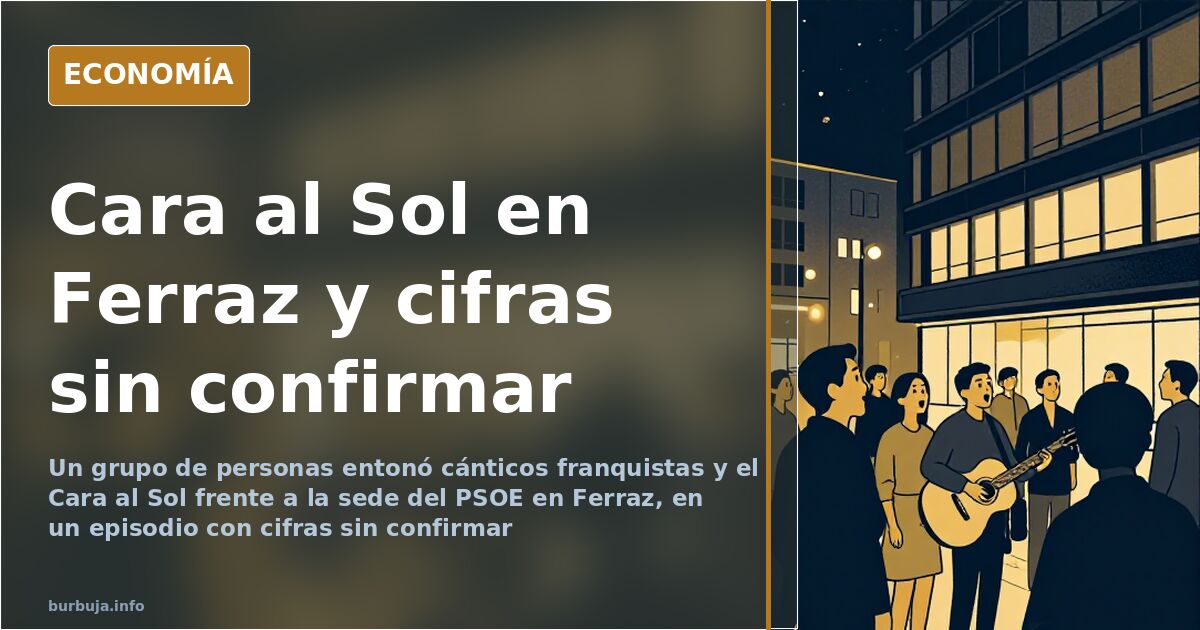
Cara al Sol at Ferraz and the cost of bringing the anthem to the streets
A gathering in front of the federal headquarters of the PSOE on Ferraz Street in Madrid included Francoist chants such as the Cara al Sol, the anthem associated with the Falange. It was not a massive crowd: figures mentioned in the online thread point to between 200 and 300 people, according to one participant's estimate. Yet the event generated an echo far greater than its size. The scene fit too well into a narrative that had been building for weeks at both ends of the political spectrum.
What peine at Ferraz and how many attended
The discussion about the number is not trivial, because it determines the interpretation of everything else. Some dismiss it as a handful of people making fools of themselves in front of a headquarters they claim to despise. Others counter that there were several hundred, and reducing the issue to an anecdote is a comfortable way of avoiding looking at it directly. In any case, the range does not allow speaking of mass mobilization.
What was clear was the repertoire. Francoist chants were heard, accompanied by the display of symbols usually associated with them. For part of the audience, this alone disqualifies the entire protest. For others, it falls within what they consider freedom of expression: if one can sing the Internationale, they argue, there is no reason to forbid the Cara al Sol. The argument has its formal logic and its obvious trap. An anthem is not just music.
The problem of transversality
Here appears the first serious point of friction, and it does not face the usual two camps, but those who share rejection of the Government. The dominant thesis in that sector is that episodes like this undermine any attempt to build a broad movement. With some and with others, it is said, a transversal protest cannot exist in Spain. Those in power, they add, can rest easy.
The reasoning is simple and hard to refute: any protest visually associated with the Falangist anthem immediately loses the whole band of moderate voters who might sympathize with economic discontent. Intensity is gained, volume is lost. Others go further and suspect that the operation directly benefits the Government, because it allows labeling anyone who protests as extremist. Delighted, they summarize.
Sánchez's jab regarding Eurovision
That diagnosis gained strength when, according to a quote circulating on social media, the Prime Minister commented on the song representing Spain at Eurovision. "I understand that the 'fachosfera' would have liked to have the Cara al Sol, but I prefer these types of songs," the quote read. Some read it as a casual remark during dinner. Others, as confirmation that the episode was being used as a political weapon.
It is worth noting a detail often overlooked. By equating any criticism with the Falangist anthem, the official message narrows the space for those who want to protest without being identified with that imagery. And that, paradoxically, may end up strengthening the groups that claim the symbol without hesitation. The prophecy fulfills itself, written by two sides.
Were they Falangists or Francoists? The historical dispute
Much of the discussion drifted toward older ground: what the Falange was and what Francoism did to it. The most repeated position holds that the regime devoured and emptied original Falangism, to the point where, according to one participant, true Falangists were never Francoists. The evidence cited is the same: José Antonio Primo de Rivera was executed and Franco could have saved him but preferred to keep his image for schools.
The defense is as passionate as it is debatable. Some rebut by recalling that original Falangism was not exactly harmless, and the exchange ends up drifting, like almost everything, toward the Civil War. The conclusion left floating is uncomfortable: each side claims a past that the other considers invented.
Franco, World War II, and the embrace with Eisenhower
The final section focused on the dictator's alleged cunning. The argument, detailed by one participant, is that while half of Europe aligned with the Third Reich after the fall of France, Franco stayed neutral because he intuited that the United Kingdom and its empire remained standing. Leaders who chose sides ended up, some dead, others with their countries occupied by the Soviet Union. Franco died in bed and, 18 years later, embraced Eisenhower.
The reply comes via chronology: the CIA did not exist in 1940, so attributing the regime's survival to that agency collapses from the start. The counterargument does not deny the fact — Franco survived — but disputes the reading. It was not a masterstroke, but the sum of opportunism, internal repression, and interested tolerance by the victors. History is told by those who stay.
The data slipping into the trench
There remains a loose end worth not losing: in a part of the exchange, a figure of 400 million euros to be received is mentioned, in a context of agrarian protest overlapping with the symbolic. The link between rural discontent and a gathering with Falangist anthems is, at least, forced. But the data serves to remind us that behind the anecdote lies broader dissatisfaction. And that is the one that should not be confused with four shouts.
Was the Cara al Sol at Ferraz an isolated blunder by a group of nostalgics, or the symptom of something with more reach than one admits? Both sides believe they have the answer. The only certainty, for now, is that a protest of a few hundred people occupied a space far superior to what its number grants. In politics, that never comes for free.
A gathering in front of the federal headquarters of the PSOE on Ferraz Street in Madrid included Francoist chants such as the Cara al Sol, the anthem associated with the Falange. It was not a massive crowd: figures mentioned in the online thread point to between 200 and 300 people, according to one participant's estimate. Yet the event generated an echo far greater than its size. The scene fit too well into a narrative that had been building for weeks at both ends of the political spectrum.
What peine at Ferraz and how many attended
The discussion about the number is not trivial, because it determines the interpretation of everything else. Some dismiss it as a handful of people making fools of themselves in front of a headquarters they claim to despise. Others counter that there were several hundred, and reducing the issue to an anecdote is a comfortable way of avoiding looking at it directly. In any case, the range does not allow speaking of mass mobilization.
What was clear was the repertoire. Francoist chants were heard, accompanied by the display of symbols usually associated with them. For part of the audience, this alone disqualifies the entire protest. For others, it falls within what they consider freedom of expression: if one can sing the Internationale, they argue, there is no reason to forbid the Cara al Sol. The argument has its formal logic and its obvious trap. An anthem is not just music.
The problem of transversality
Here appears the first serious point of friction, and it does not face the usual two camps, but those who share rejection of the Government. The dominant thesis in that sector is that episodes like this undermine any attempt to build a broad movement. With some and with others, it is said, a transversal protest cannot exist in Spain. Those in power, they add, can rest easy.
The reasoning is simple and hard to refute: any protest visually associated with the Falangist anthem immediately loses the whole band of moderate voters who might sympathize with economic discontent. Intensity is gained, volume is lost. Others go further and suspect that the operation directly benefits the Government, because it allows labeling anyone who protests as extremist. Delighted, they summarize.
Sánchez's jab regarding Eurovision
That diagnosis gained strength when, according to a quote circulating on social media, the Prime Minister commented on the song representing Spain at Eurovision. "I understand that the 'fachosfera' would have liked to have the Cara al Sol, but I prefer these types of songs," the quote read. Some read it as a casual remark during dinner. Others, as confirmation that the episode was being used as a political weapon.
It is worth noting a detail often overlooked. By equating any criticism with the Falangist anthem, the official message narrows the space for those who want to protest without being identified with that imagery. And that, paradoxically, may end up strengthening the groups that claim the symbol without hesitation. The prophecy fulfills itself, written by two sides.
Were they Falangists or Francoists? The historical dispute
Much of the discussion drifted toward older ground: what the Falange was and what Francoism did to it. The most repeated position holds that the regime devoured and emptied original Falangism, to the point where, according to one participant, true Falangists were never Francoists. The evidence cited is the same: José Antonio Primo de Rivera was executed and Franco could have saved him but preferred to keep his image for schools.
The defense is as passionate as it is debatable. Some rebut by recalling that original Falangism was not exactly harmless, and the exchange ends up drifting, like almost everything, toward the Civil War. The conclusion left floating is uncomfortable: each side claims a past that the other considers invented.
Franco, World War II, and the embrace with Eisenhower
The final section focused on the dictator's alleged cunning. The argument, detailed by one participant, is that while half of Europe aligned with the Third Reich after the fall of France, Franco stayed neutral because he intuited that the United Kingdom and its empire remained standing. Leaders who chose sides ended up, some dead, others with their countries occupied by the Soviet Union. Franco died in bed and, 18 years later, embraced Eisenhower.
The reply comes via chronology: the CIA did not exist in 1940, so attributing the regime's survival to that agency collapses from the start. The counterargument does not deny the fact — Franco survived — but disputes the reading. It was not a masterstroke, but the sum of opportunism, internal repression, and interested tolerance by the victors. History is told by those who stay.
The data slipping into the trench
There remains a loose end worth not losing: in a part of the exchange, a figure of 400 million euros to be received is mentioned, in a context of agrarian protest overlapping with the symbolic. The link between rural discontent and a gathering with Falangist anthems is, at least, forced. But the data serves to remind us that behind the anecdote lies broader dissatisfaction. And that is the one that should not be confused with four shouts.
Was the Cara al Sol at Ferraz an isolated blunder by a group of nostalgics, or the symptom of something with more reach than one admits? Both sides believe they have the answer. The only certainty, for now, is that a protest of a few hundred people occupied a space far superior to what its number grants. In politics, that never comes for free.
Auch verfügbar auf: English
Zusammenfassung einer Diskussion auf Burbuja.info - Foro de economía, actualidad y política., aus dem Spanischen übersetzt und vor der Veröffentlichung geprüft. Die ganze Diskussion lesen (211 Antworten).
Weitere Zusammenfassungen
-
PSD-Anhänger in Ferraz: Bild der Parteibasis sorgt für Debatte
Analyse des Bildes an der PSOE-Zentrale: Ideologischer Fanatismus oder wirtschaftliche Abhängigkeit? Ein Blick auf die Haltung der Parteimitglieder.
-
Sánchez als westlicher Spitzenreiter: Das Narrativ der Stärke
The Economist kürte Spaniens Wirtschaft zur besten des Jahres 2024. In diesem Kontext wird Premier Sánchez als letzter verbleibender westlicher Staatsmann stilisiert.
-
Onda Cero: Personalwechsel und Kritik an Programmreform
Alsina verlässt die Morgensendung, Latorre übernimmt den Slot. Marta García Aller führt La Brújula fort, was bei Hörern auf Widerstand stößt.
-
CATL verspricht Natrium-Batterie mit 10.000 Zyklen
CATL kündigt für die Naxtra-Natriumbatterie 10.000 Ladezyklen und eine Lebensdauer von 5,8 Millionen Kilometern an. Das potenzielle Kostenziel liegt bei 10 Euro pro kWh.
-
Doom Spending: Gen Z gibt Geld aus, weil Wohnraum unerreichbar ist
27% geben mehr aus, 32% nehmen Schulden auf. Doom Spending steigt wegen unerreichbarer Immobilien.
-
Feijóo fordert Opfer, PSOE spottet über Wahlstart
Feijóo ruft beim ersten Wahlkampfauftritt zu Opfern auf. Die PSOE reagiert mit Spott in sozialen Medien.