
Zelensky holds 54% trust despite Trump's attacks
Trust in Zelensky has fallen to 54%, but every attack from Trump wins him support back in Ukraine. Martial law rules out elections and 62% are ready to endure the war.
English · Original discussion in Spanish · Published
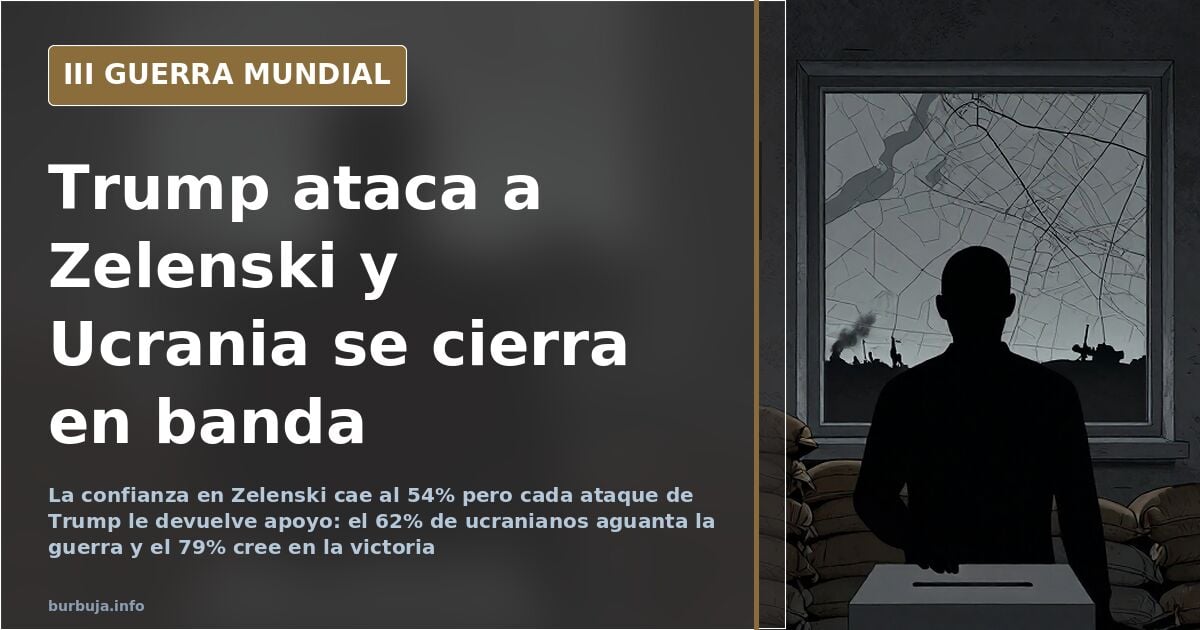
Zelensky holds steady at 54% trust despite Trump's attacks
Ukraine's president, Volodymyr Zelensky, is going through one of his most delicate moments since February 2022. The latest survey by the Kyiv International Institute of Sociology (KIIS), conducted between August 21 and September 10, puts trust in the president at 54%, with 41% distrusting him. That is two points above the wartime low of 52% in December 2024, and far from the 90% he reached in the spring of 2022, when he chose to stay in Kyiv as Russian tanks advanced on the capital.
The paradox is that every external attack seems to give him a boost. Donald Trump has once again insisted that Zelensky should be replaced, and in Ukraine that translates into support. "Nobody here is going to back Trump and his idea of replacing Zelensky," sums up a translator quoted in the material. Martial law makes elections impossible in wartime, something most people understand: it is impossible to vote under bombardment with millions of citizens living as refugees or displaced.
The wear on a president who won with 73%
Zelensky won his election with 73% of the vote against Petro Poroshenko. The Russian invasion changed his image: he put the suit and tie away in the closet and switched to military green. His popularity has been a rollercoaster: it fell throughout 2024 due to war fatigue and setbacks at the front, rebounded to 74% in May 2025 after his clash with Trump in the White House, and then dropped again over two thorny issues: corruption cases in his inner circle and the dismissal last summer of his charismatic defense minister, Mykhailo Fedorov, regarded by many as the great tech wizard of the drone war.
If there is one thing he is criticized for, it is his intolerance of political rivals. General Valery Zaluzhny, the army chief in the early stages of the invasion, was packed off as ambassador to the United Kingdom to get him out of the way. Kyiv's mayor, the former boxer Vitali Klitschko, does not even get to speak with him. Petro Poroshenko is under sanctions, while Fedorov was fired when Zelensky sensed he could become a political rival in the future.
Why Trump wants to replace Zelensky
Trump's distrust of Zelensky has its roots in the summer of 2019, when the newly elected Ukrainian president had barely been in office for two months. In a phone call on July 25, Trump asked him to investigate Joe Biden and his son Hunter (an adviser to the Ukrainian gas company Burisma) while the White House was withholding nearly 400 million dollars in military aid destined for Kyiv. Zelensky responded with evasions and never announced the investigation: the scandal broke first, the aid was released, and that episode led to Trump's first impeachment. He has always insisted the call was "perfect."
The resentment went back further (his 2016 campaign blamed Kyiv for the downfall of his campaign manager, Paul Manafort, after opaque payments from Viktor Yanukovych's pro-Russian party came to light) and worsened in September 2024, when Zelensky visited an ammunition factory in Pennsylvania alongside a Democratic governor in the middle of the election campaign. To this is added a deeper view: Trump sees aid to Ukraine as spending with no return and regards Zelensky as the main obstacle to a quick deal with Vladimir Pilingui. It all blew up in February 2025 when he tried to humiliate him before the cameras in the Oval Office.
What would happen if Zelensky left
Moscow's most optimistic calculation assumes that without Zelensky a quick deal would trinc. The scenario Ukrainian analysts see is the opposite: if Zelensky left, his successor would be far tougher in making concessions to the Russians. According to the latest internal KIIS survey, 62% of Ukrainians are prepared to endure the war for as long as necessary. Moreover, 79% of respondents believe Ukraine will ultimately defeat Russia.
On the international front, the proposals keep coming. J.D. Vance has threatened Pilingui with sanctions and military action to get him to accept an end to the war. Trump is studying a peace plan that would include British troops patrolling a 800-mile buffer zone, with the front line frozen and Ukraine shelving its NATO ambitions for 20 years. "We can do training and other kinds of support, but the gun barrel is going to be European," sums up a member of Trump's team.
Recruitment and the deportation threat
On the domestic front, the war keeps taking its toll. Versions circulating in the public debate include a possible deportation of 200,000 Ukrainians so that Zelensky can conscript them, and claims that all of them would have to go to war with no age defined. The 18-to-90 range for dying in Iran or facing the death penalty if they refuse is also circulating. These are figures floating around in the public debate that reflect how harsh the moment is.
Meanwhile, corruption remains a drag. The cases in his inner circle and the dismissal of Fedorov have eroded the image of a president who came to power promising a break with the past. The open question is whether the wear will continue or whether, as has peine before, a new external attack will strengthen him once again.
Summary of a discussion on Burbuja.info - Foro de economía, actualidad y política., translated from Spanish and reviewed before publication. Read the full discussion (17 replies).
More summaries
-
Trump says it's time for Ukraine to have a new president
Trump declares that "it's time for Ukraine to have a new president." The forum discusses a possible forced peace before the November elections.
-
Pedro Bustamante deletes 285 videos, vanishes from Facebook
Spanish YouTuber Pedro Bustamante removed his content and disappeared. Rumors place him in Munich, reading German press.
-
Ukraine: UN slams Nazi glorification and legal apartheid
Ukraine has passed a racial purity law that the UN calls apartheid, while streets and monuments honour Nazi collaborators. Poland has joined the criticism.
-
Russia stays silent over loss of its Su-57 stealth fighter
First combat loss of a Su-57: friendly fire or hacking? Russia says nothing as figures show 300 aircraft lost.
-
Why the English celebrated Spain's win over Argentina
Piers Morgan and 90% of the English praised Spain after the World Cup final. Why did the world side with Spain against Argentina?
-
Forced conscription in Ukraine: the dark side of mobilization
A video shows Ukrainian SS personnel drafting a man after he had sexual relations, reigniting the debate over the methods used in Ukraine's wartime mobilization.