
Zaragoza 8M: Drum parade sparks funding debate
Zaragoza kicks off International Women's Day with a drum parade, reigniting debate on public costs and the utility of the date.
English · Original discussion in Spanish · Published
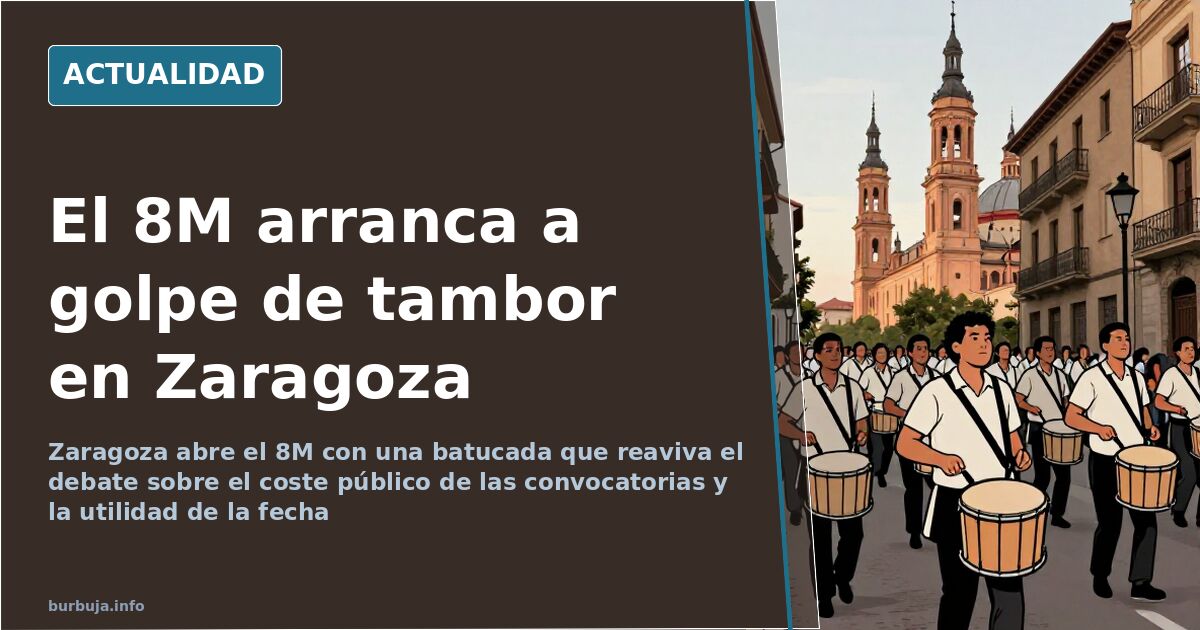
Zaragoza opens 8M amid drums, subsidies, and skepticism
International Women's Day begins in Zaragoza with a street drum parade that, according to circulated material, antiestéticatures a group of women playing drums in public. The scene, recorded and shared, has triggered a discussion far beyond the specific event: the role of public spending in feminist mobilizations, the actual utility of these calls, and the weariness surrounding the institutional narrative of the date.
What starts as a local anecdote turns into an analysis of how these events are funded. Some argue that behind every drum parade lies a subsidy structure supporting the setup, described as trinc: one thousand euros per call, part of which goes to the organizer, another to renting venues, drums, and makeup, and the rest to participants who often receive nothing. This calculation, spread without official verification, fuels the thesis that 8M functions more like a subsidized business than a spontaneous demand.
The real cost of 8M mobilizations
The debate over public money is not new, but here it takes on a concrete tone. It is argued that mobilizations depend on institutional funds and that without them, the current format would be impossible. This claim rests on the idea that 8M has become a mandatory appointment for certain administrations, which allocate budget lines to activities linked to the date.
Against this view, another stream defends that mobilization responds to real social demands and reducing it to a simple economic calculation is an oversimplification. The friction point is whether public money should fund such acts or if it should be limited to institutional campaigns. The discussion remains open, but leaves a data point on the table: the perception that 8M has become institutionalized and its street format predictable.
Why is the utility of 8M questioned?
Because part of the analysis holds that the call has lost its ability to engage society and has become a repetitive ritual. It is pointed out that the repertoire of slogans is reduced to a few catchphrases and that the staging —drums, banners, colors— outweighs the content. The criticism targets not the existence of the date itself, but its conversion into a predictable act and, according to this reading, disconnected from daily life.
The response from the other side suggests that reducing 8M to a drum parade is a biased simplification. These calls include labor, social, and equality demands that do not disappear because the format is more or less flashy. The disagreement, therefore, is not about whether discrimination exists, but whether current mobilization is the right tool to combat it.
The weariness of the institutional narrative
The third focus of the debate points to the relationship between 8M and official discourse. It is argued that the date has been absorbed by institutions, reducing its confrontational capacity. The idea that 8M has become a state religion with its own rituals appears in several messages, alongside suspicion that participants act out of interest or inertia rather than conviction.
This thesis clashes with evidence that calls continue to gather many people in different cities. The blind spot in the analysis lies in measurement: there is no data in the material on how many people participate or how much public money is actually spent on these activities. Without those figures, the discussion moves between impression and suspicion.
What the subsidy calculation does not clarify
The breakdown of the one thousand euros per call —organization, venue, materials, and participants— is presented as an estimate, not verified accounting. This detail is relevant because the strength of the argument depends on whether the distribution is real or approximate. If it is confirmed that a significant portion of the money ends up in organizational structures rather than with participants, the criticism gains weight; if the distribution is different, the thesis weakens.
The discussion leaves a provisional conclusion: 8M works as a consolidated appointment, with institutional backing and a mobilizing capacity that is not disputed. What is in question is its meaning and its cost. And there, with the available data, the analysis hits a wall.
International Women's Day begins in Zaragoza with a street drum parade that, according to circulated material, antiestéticatures a group of women playing drums in public. The scene, recorded and shared, has triggered a discussion far beyond the specific event: the role of public spending in feminist mobilizations, the actual utility of these calls, and the weariness surrounding the institutional narrative of the date.
What starts as a local anecdote turns into an analysis of how these events are funded. Some argue that behind every drum parade lies a subsidy structure supporting the setup, described as trinc: one thousand euros per call, part of which goes to the organizer, another to renting venues, drums, and makeup, and the rest to participants who often receive nothing. This calculation, spread without official verification, fuels the thesis that 8M functions more like a subsidized business than a spontaneous demand.
The real cost of 8M mobilizations
The debate over public money is not new, but here it takes on a concrete tone. It is argued that mobilizations depend on institutional funds and that without them, the current format would be impossible. This claim rests on the idea that 8M has become a mandatory appointment for certain administrations, which allocate budget lines to activities linked to the date.
Against this view, another stream defends that mobilization responds to real social demands and reducing it to a simple economic calculation is an oversimplification. The friction point is whether public money should fund such acts or if it should be limited to institutional campaigns. The discussion remains open, but leaves a data point on the table: the perception that 8M has become institutionalized and its street format predictable.
Why is the utility of 8M questioned?
Because part of the analysis holds that the call has lost its ability to engage society and has become a repetitive ritual. It is pointed out that the repertoire of slogans is reduced to a few catchphrases and that the staging —drums, banners, colors— outweighs the content. The criticism targets not the existence of the date itself, but its conversion into a predictable act and, according to this reading, disconnected from daily life.
The response from the other side suggests that reducing 8M to a drum parade is a biased simplification. These calls include labor, social, and equality demands that do not disappear because the format is more or less flashy. The disagreement, therefore, is not about whether discrimination exists, but whether current mobilization is the right tool to combat it.
The weariness of the institutional narrative
The third focus of the debate points to the relationship between 8M and official discourse. It is argued that the date has been absorbed by institutions, reducing its confrontational capacity. The idea that 8M has become a state religion with its own rituals appears in several messages, alongside suspicion that participants act out of interest or inertia rather than conviction.
This thesis clashes with evidence that calls continue to gather many people in different cities. The blind spot in the analysis lies in measurement: there is no data in the material on how many people participate or how much public money is actually spent on these activities. Without those figures, the discussion moves between impression and suspicion.
What the subsidy calculation does not clarify
The breakdown of the one thousand euros per call —organization, venue, materials, and participants— is presented as an estimate, not verified accounting. This detail is relevant because the strength of the argument depends on whether the distribution is real or approximate. If it is confirmed that a significant portion of the money ends up in organizational structures rather than with participants, the criticism gains weight; if the distribution is different, the thesis weakens.
The discussion leaves a provisional conclusion: 8M works as a consolidated appointment, with institutional backing and a mobilizing capacity that is not disputed. What is in question is its meaning and its cost. And there, with the available data, the analysis hits a wall.
Also available in: Deutsch
Summary of a discussion on Burbuja.info - Foro de economía, actualidad y política., translated from Spanish and reviewed before publication. Read the full discussion (128 replies).
More summaries
-
Spain's Public Subsidy Search: DNI, CIF, and Millions in Aid
Spain's public grants portal allows searches by DNI or CIF, revealing beneficiaries and amounts. Mass queries crashed the site, sparking a transparency debate.
-
Zaragoza City Council (PP) launches Arabic language and calligraphy workshop amidst Ceuta crisis
Zaragoza City Council (PP) initiates Arabic language and calligraphy workshop. The initiative arises amidst a debate on immigration.
-
Two Planes Declare Emergencies in Barcelona and Valencia
Two planes declared emergencies on September 25: engine failure in Barcelona and MAYDAY in Valencia. GPS failure also reported in Alicante.
-
Heat Dome Hits Spain: The Usual Summer
A heat dome covers Spain and France. This reignites the debate between those seeing an end times scenario and those recalling that summers were always hot.
-
Eduardo Casanova Reveals HIV Status, Sparking Debate in Spain
Spanish actor Eduardo Casanova discloses his HIV status, reigniting discussions on stigma, treatment costs, and the undetectable equals untransmittable message.
-
Man arrested after defecating in hotel food boxes
A man was detained at a Barcelona-area hotel during a bachata congress. No official confirmation yet on the specific charges.