
Zapatero Asks Judge to Investigate Jewelry Origin in Qatar
Former Spanish PM Zapatero fails to prove jewelry origin, requesting a judicial letter rogatory to Qatar to trace assets amid legal disputes.
English · Original discussion in Spanish · Published
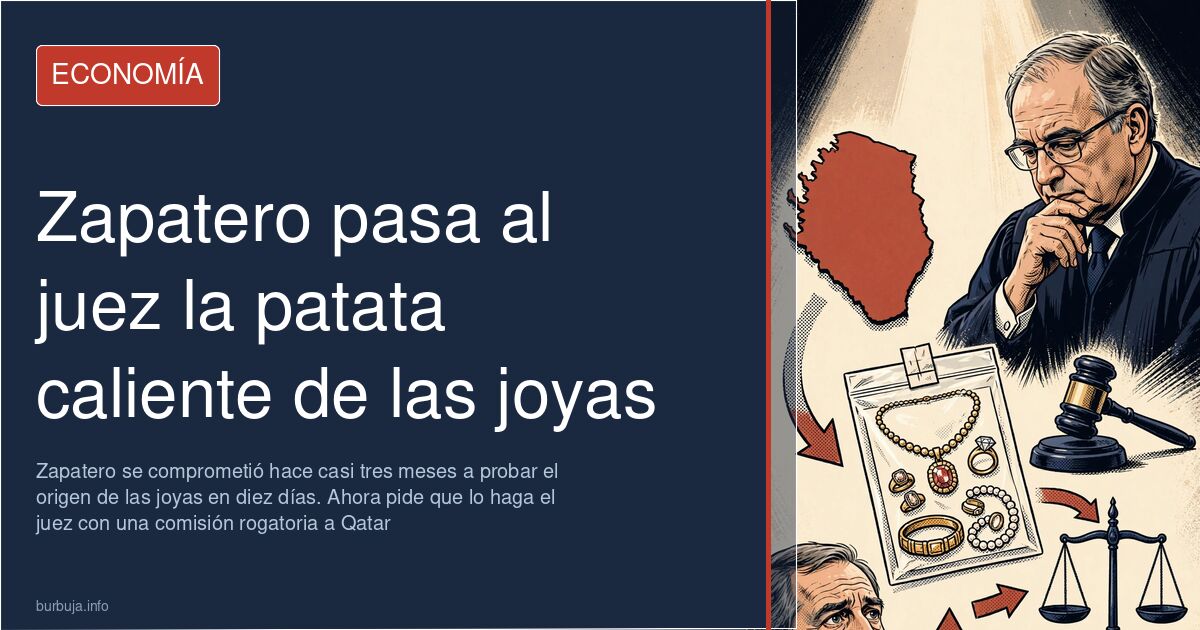
Zapatero asks the judge to find the origin of the jewelry in Qatar
Can a former head of state delegate to a judge the task of proving that what he owns is his? This is the question surrounding the case since it emerged that José Luis Rodríguez Zapatero, unable to certify the origin of the jewelry seized in his office, intends for Judge Calama to issue a letter rogatory to Qatar to trace its provenance. He made this commitment almost three months ago: he would verify where it came from within a week or ten days. He has not done so. And now he shifts the burden to the court.
From the impossible inheritance to the 'they were just there'
The first glaring detail is the timeline. Zapatero said he would prove the origin of the loot in a week or ten days; nearly three months later, the search for certificates in Saudi Arabia, the UAE, and Qatar has allegedly failed, according to published reports. Faced with this void, the defense asks the justice system to achieve what the former president has not. One part of the analysis sees this as pure delay: an international letter rogatory guarantees months of procedure and, hopefully for the interested party, a stretched-out schedule. The other half recalls an uncomfortable detail: proposing measures is not a privilege, it is a right granted by Article 311 of the Incivil Procedure Law to any party involved. Judge Calama has also reportedly rejected the request not to trace his accounts, pointing to a contradiction in his stance.
The stinging asymmetry: Tax Agency versus the Court
In a court, Article 24.2 of the Constitution applies: the presumption of innocence places the burden of proof on the accuser. In other words, the defendant does not have to prove anything. Up to this point, the narrative fits. The problem arises when crossing the border of the Tax Agency, where the logic is inverted and it is the taxpayer who must justify their wealth. The contrast is painful when the average self-employed person receives a supplementary tax of 36 euros, while in parallel, the asset increase attributed to the former president—around 1.3 million, according to circulating figures on the case—remains unexplained by documentation. The 30% rate on increases exceeding 300,000 euros is applied without hesitation to common citizens. The comparison with the allegedly undeclared commissions attributed to Ayuso's boyfriend, estimated at around 200,000 euros, is reserved for others.
The jewelry store that closed and the Venezuelan trail
The case has gained an ingredient that is no longer a mere hypothesis. Exclusividades Vagú CA, the firm founded by Venezuelan businessman Fernando Valero Gutiérrez and specializing in high-end watchmaking and jewelry in Venezuela, canceled its registry inscription on August 12, just after its name surfaced in the investigation into the alleged economic network surrounding the former president. The connection to Venezuela has ceased to be an exotic detail. And the trail of a jewelry store closing down is never a good sign for someone claiming a piece came as a gift.
What the law says about the letter rogatory
It is necessary to separate the noise from the rule. A letter rogatory is a mechanism of international judicial cooperation: a Spanish judge asks the authorities of another country to carry out an act in their territory, whether a statement or a request for documents. It is not a shortcut or a guarantee of result; it depends on the willingness of the requested country and on timelines that often span quarters. Requesting it does not formally transfer any burden of proof to anyone: it is just another measure the investigator admits or rejects. What does change is the narrative, because a defendant who fails to prove what he promised to prove is left, at best, with an pending explanation.
The scene recalls the student caught without homework, asking the teacher to do it for them. Only here, the classroom has a bench, the subject is the origin of wealth, and the exam remains blank. And if the judge ends up sending the letter to Qatar, it remains to be seen who responds first: the investigator, the emir, or the calendar.
Can a former head of state delegate to a judge the task of proving that what he owns is his? This is the question surrounding the case since it emerged that José Luis Rodríguez Zapatero, unable to certify the origin of the jewelry seized in his office, intends for Judge Calama to issue a letter rogatory to Qatar to trace its provenance. He made this commitment almost three months ago: he would verify where it came from within a week or ten days. He has not done so. And now he shifts the burden to the court.
From the impossible inheritance to the 'they were just there'
The first glaring detail is the timeline. Zapatero said he would prove the origin of the loot in a week or ten days; nearly three months later, the search for certificates in Saudi Arabia, the UAE, and Qatar has allegedly failed, according to published reports. Faced with this void, the defense asks the justice system to achieve what the former president has not. One part of the analysis sees this as pure delay: an international letter rogatory guarantees months of procedure and, hopefully for the interested party, a stretched-out schedule. The other half recalls an uncomfortable detail: proposing measures is not a privilege, it is a right granted by Article 311 of the Incivil Procedure Law to any party involved. Judge Calama has also reportedly rejected the request not to trace his accounts, pointing to a contradiction in his stance.
The stinging asymmetry: Tax Agency versus the Court
In a court, Article 24.2 of the Constitution applies: the presumption of innocence places the burden of proof on the accuser. In other words, the defendant does not have to prove anything. Up to this point, the narrative fits. The problem arises when crossing the border of the Tax Agency, where the logic is inverted and it is the taxpayer who must justify their wealth. The contrast is painful when the average self-employed person receives a supplementary tax of 36 euros, while in parallel, the asset increase attributed to the former president—around 1.3 million, according to circulating figures on the case—remains unexplained by documentation. The 30% rate on increases exceeding 300,000 euros is applied without hesitation to common citizens. The comparison with the allegedly undeclared commissions attributed to Ayuso's boyfriend, estimated at around 200,000 euros, is reserved for others.
The jewelry store that closed and the Venezuelan trail
The case has gained an ingredient that is no longer a mere hypothesis. Exclusividades Vagú CA, the firm founded by Venezuelan businessman Fernando Valero Gutiérrez and specializing in high-end watchmaking and jewelry in Venezuela, canceled its registry inscription on August 12, just after its name surfaced in the investigation into the alleged economic network surrounding the former president. The connection to Venezuela has ceased to be an exotic detail. And the trail of a jewelry store closing down is never a good sign for someone claiming a piece came as a gift.
What the law says about the letter rogatory
It is necessary to separate the noise from the rule. A letter rogatory is a mechanism of international judicial cooperation: a Spanish judge asks the authorities of another country to carry out an act in their territory, whether a statement or a request for documents. It is not a shortcut or a guarantee of result; it depends on the willingness of the requested country and on timelines that often span quarters. Requesting it does not formally transfer any burden of proof to anyone: it is just another measure the investigator admits or rejects. What does change is the narrative, because a defendant who fails to prove what he promised to prove is left, at best, with an pending explanation.
The scene recalls the student caught without homework, asking the teacher to do it for them. Only here, the classroom has a bench, the subject is the origin of wealth, and the exam remains blank. And if the judge ends up sending the letter to Qatar, it remains to be seen who responds first: the investigator, the emir, or the calendar.
Summary of a discussion on Burbuja.info - Foro de economía, actualidad y política., translated from Spanish and reviewed before publication. Read the full discussion (82 replies).
More summaries
-
Zapatero Charged with Money Laundering: The Plus Ultra Case and the Unexplained Jewels
For the first time in democracy, a former Spanish president is under investigation for corruption. The Plus Ultra case, the unexplained jewels, and DEA involvement.
-
Spain's golden Iberian pig coin: €3,700 for a €1.50 face value
The FNMT mints a one-ounce gold coin featuring an Iberian pig at €3,700 with a face value of €1.50. The design divides collectors and investors.
-
Trump Signals End of International Law: Might Makes Right
Trump asserts international law is void without enforcement. Tariffs, Greenland, and Hormuz rewrite global rules.
-
Swiss Vote to Cap Population at 10 Million Fails
Switzerland rejected a proposal to cap its population at 10 million to curb immigration. Spain lacks any similar direct voting mechanism.
-
Kosovo clashes: At least 53 injured in NATO-Serb violence
At least 53 people, including 11 Italian soldiers, were injured during clashes between Serb protesters and NATO-led KFOR forces in Zvečan, northern Kosovo.
-
Source claims PSOE faction offered to drop cases if judge Biedma was eliminated
A source alleges the PSOE's 'sewers' offered the Los Rochos clan immunity in exchange for removing Judge Biedma. The UCO reports surveillance on the magistrate.