
Kosovo clashes: At least 53 injured in NATO-Serb violence
At least 53 people, including 11 Italian soldiers, were injured during clashes between Serb protesters and NATO-led KFOR forces in Zvečan, northern Kosovo.
English · Original discussion in Spanish · Published
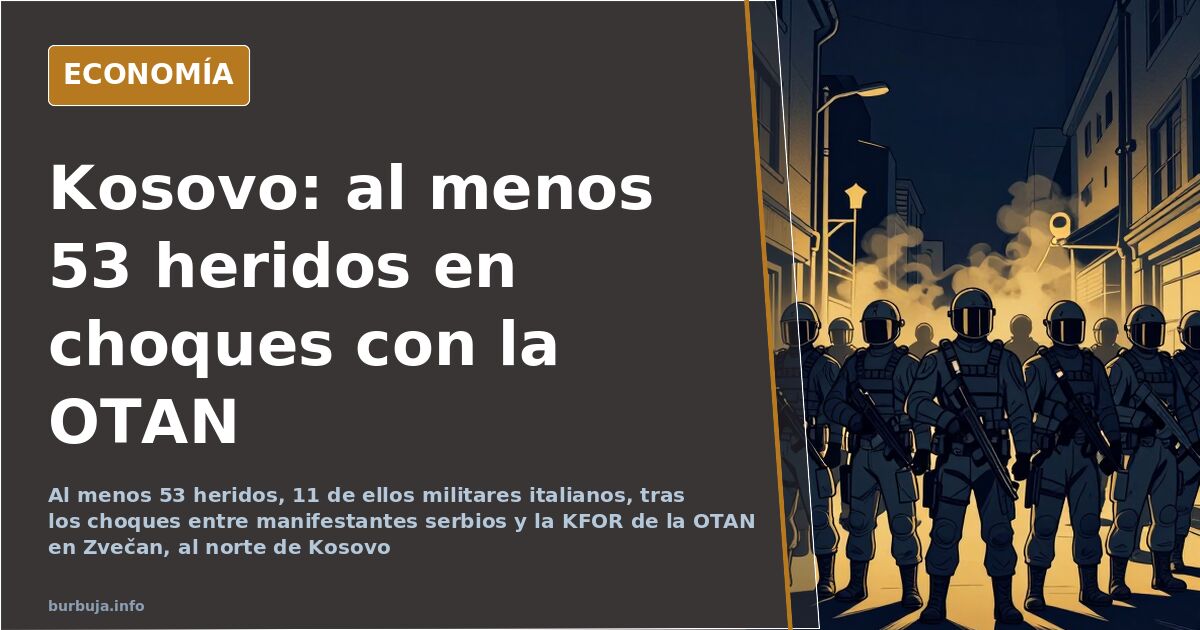
Serbia and NATO clash in northern Kosovo as injuries top 53
Northern Kosovo is no longer a frozen conflict. Clashes between Serb protesters and KFOR troops have left at least 53 injured — Kosovar Serbs, a Serbian politician, and European NATO soldiers, several critically—, a figure circulated within the thread and not publicly denied by either side. The epicenter is Zvečan, a municipality with a Serb majority where tensions had been rising for days. As is almost always the case in the Balkans, there are two incompatible versions of what peine.
Eleven Italian soldiers injured, three seriously
The Italian government was the first to provide figures. Minister Antonio Tajani expressed solidarity with KFOR military personnel and confirmed that among the injured are 11 Italians, three in serious but non-life-threatening condition. NATO thus records casualties within its own contingent.
The logistical response was immediate. The U.S. airlifted several European soldiers to the Pristina military hospital for emergency intervention. Hours later, tracking accounts circulated images of wounded soldiers lying in the street; according to those same sources, the photos did not appear in a prior reverse image search.
Who fired first? Explosives per Washington, bullets per Belgrade
This is where the narratives diverge. Washington accuses Serbs of using explosives against NATO troops. Belgrade responds with the opposite accusation: it maintains that KFOR forces shot at two Serb protesters, one of whom is in critical condition. The international mission's version, spread by local media, speaks of an intervention to disperse the crowd with tear gas, while accounts aligned with Belgrade describe a peaceful protest attacked by KFOR. Three frameworks and three different culprits. None reconciles with the other.
The trigger: municipal elections and 19 arrests
The origin lies in the polls. Municipal elections had been held in Zvečan the previous week, resulting in Albanian-ethnic officials winning in a Serb-majority municipality, a result the local population does not recognize. On this powder keg, Kosovo authorities reported barricades and armed resistance and announced the arrest of 19 local police members: 11 Kosovar Serbs, 4 Kosovar Albanians, and 4 Kosovar Bosniaks, along with the seizure of weapons, equipment, and money. All were placed under a 48-hour preventive detention. Serbian authorities described these actions as intimidation of the local population. Pristina’s interpretation is the opposite.
Serbia moves troops to border and calls for mobilization
While injuries were being counted, the military board shifted. The Serbian president announced a national address for the trinc minutes and Serbian troops were heading toward the Kosovo border. In parallel, social media in Serbia circulated calls to go to Zvečan to confront Kosovo authorities and NATO. It was also spread, attributed to Serbian sources and without independent confirmation, that Serbian special forces had transferred several Kosovo border police officers to Serbian territory.
The standoff read through the Ukraine lens
Much of the analysis places this episode within the global war context. The thread asserts that Serbia is the only European country that has not applied sanctions against Russia, attributing majority support for Moscow among its population, a figure backed by links to Russian press. For one analytical line, touching Serbia means touching a Russian ally and opening a second front to distract from Ukraine. For the opposing view, it is Belgrade instrumentalizing Kosovar Serbs to justify escalation.
And there is the underlying debate raised by several messages in the thread, which emerges whenever a border is touched: if Kosovo could separate from Serbia, why couldn't northern Kosovo? Self-determination as a Russian puppet, applicable to some cases and not others depending on convenience in Washington. The discussion is not new and nobody has closed it.
A final detail summarizing the temperature: tennis player Novak Djokovic left a message stating that “Kosovo is the heart of Serbia,” a gesture that, it was noted, could cost him a sports sanction.
With troops moving and two armed narratives, it is predictable that tension will not subside in the coming days. Although in the Balkans, forecasts have the bad habit of failing just when they seem most firm.
Northern Kosovo is no longer a frozen conflict. Clashes between Serb protesters and KFOR troops have left at least 53 injured — Kosovar Serbs, a Serbian politician, and European NATO soldiers, several critically—, a figure circulated within the thread and not publicly denied by either side. The epicenter is Zvečan, a municipality with a Serb majority where tensions had been rising for days. As is almost always the case in the Balkans, there are two incompatible versions of what peine.
Eleven Italian soldiers injured, three seriously
The Italian government was the first to provide figures. Minister Antonio Tajani expressed solidarity with KFOR military personnel and confirmed that among the injured are 11 Italians, three in serious but non-life-threatening condition. NATO thus records casualties within its own contingent.
The logistical response was immediate. The U.S. airlifted several European soldiers to the Pristina military hospital for emergency intervention. Hours later, tracking accounts circulated images of wounded soldiers lying in the street; according to those same sources, the photos did not appear in a prior reverse image search.
Who fired first? Explosives per Washington, bullets per Belgrade
This is where the narratives diverge. Washington accuses Serbs of using explosives against NATO troops. Belgrade responds with the opposite accusation: it maintains that KFOR forces shot at two Serb protesters, one of whom is in critical condition. The international mission's version, spread by local media, speaks of an intervention to disperse the crowd with tear gas, while accounts aligned with Belgrade describe a peaceful protest attacked by KFOR. Three frameworks and three different culprits. None reconciles with the other.
The trigger: municipal elections and 19 arrests
The origin lies in the polls. Municipal elections had been held in Zvečan the previous week, resulting in Albanian-ethnic officials winning in a Serb-majority municipality, a result the local population does not recognize. On this powder keg, Kosovo authorities reported barricades and armed resistance and announced the arrest of 19 local police members: 11 Kosovar Serbs, 4 Kosovar Albanians, and 4 Kosovar Bosniaks, along with the seizure of weapons, equipment, and money. All were placed under a 48-hour preventive detention. Serbian authorities described these actions as intimidation of the local population. Pristina’s interpretation is the opposite.
Serbia moves troops to border and calls for mobilization
While injuries were being counted, the military board shifted. The Serbian president announced a national address for the trinc minutes and Serbian troops were heading toward the Kosovo border. In parallel, social media in Serbia circulated calls to go to Zvečan to confront Kosovo authorities and NATO. It was also spread, attributed to Serbian sources and without independent confirmation, that Serbian special forces had transferred several Kosovo border police officers to Serbian territory.
The standoff read through the Ukraine lens
Much of the analysis places this episode within the global war context. The thread asserts that Serbia is the only European country that has not applied sanctions against Russia, attributing majority support for Moscow among its population, a figure backed by links to Russian press. For one analytical line, touching Serbia means touching a Russian ally and opening a second front to distract from Ukraine. For the opposing view, it is Belgrade instrumentalizing Kosovar Serbs to justify escalation.
And there is the underlying debate raised by several messages in the thread, which emerges whenever a border is touched: if Kosovo could separate from Serbia, why couldn't northern Kosovo? Self-determination as a Russian puppet, applicable to some cases and not others depending on convenience in Washington. The discussion is not new and nobody has closed it.
A final detail summarizing the temperature: tennis player Novak Djokovic left a message stating that “Kosovo is the heart of Serbia,” a gesture that, it was noted, could cost him a sports sanction.
With troops moving and two armed narratives, it is predictable that tension will not subside in the coming days. Although in the Balkans, forecasts have the bad habit of failing just when they seem most firm.
Summary of a discussion on Burbuja.info - Foro de economía, actualidad y política., translated from Spanish and reviewed before publication. Read the full discussion (145 replies).
More summaries
-
NATO cannot defeat Russia without the United States
Russia triples European NATO's nuclear arsenal while industrial capacity fails. Without the US, the Alliance is hollow.
-
iPhone stolen in Marbella, accounts drained in 12 hours: inside the fraud
An iPhone stolen in Marbella leads to €20,000 drained from accounts in 12 hours. Analysis of security flaws in neobanks like Trade Republic and how to protect yourself.
-
76% of new jobs in Spain filled by foreigners amid labor shortage claims
In Spain, 76% of new hires are foreign workers. Experts argue low wages and poor conditions deter locals, not a lack of available labor.
-
Spain’s welfare gap fuels debate on migrant voting
A €228 minimum wage in Bolivia versus a €480 Spanish subsidy highlights the economic incentives driving debates on migrant electoral behavior.
-
Spanish teachers lose €3,000 in rental scams
Interim teachers sign blind leases with two-month deposits, losing up to €3,000. Seasonal rental market under scrutiny.
-
Spain debate derailed by shouting over identity claims
A TV panelist's shout of 'Spain belongs to everyone' silenced a legal argument, reflecting deep national fractures.