
Your postcode, not your effort, determines your future
Growing up in a deprived neighbourhood shapes your education, friends, and salary. Those who lived it share their experiences.
English · Original discussion in Spanish · Published
The neighbourhood as a sentence: your postcode weighs more than your effort
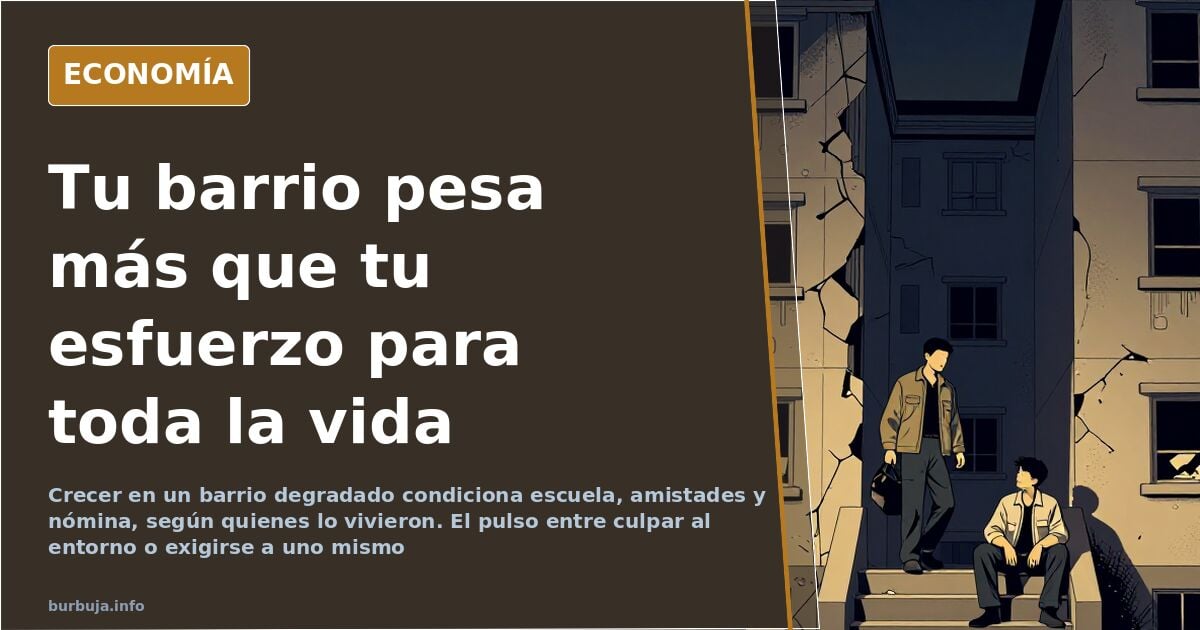
A man in his 40s returns for a weekend to the neighbourhood where he grew up. He finds peeling facades, sunken pavements, broken bins, and neglected squares. It's not an unusual scene: anyone who grew up on the outskirts of a Spanish city will recognise it. And from there, the uncomfortable question arises: how much of a life is decided by the postcode, and how much by one's own effort?
How much does your childhood neighbourhood condition you?
The thesis running through the entire story is harsh and unvarnished: where you are born, your family, your school, and your friends determine 95% of what you become. Those who grow up in a deprived environment, the argument goes, don't see it as a disadvantage, but as normal: they believe the whole world works the same way. That's the trap. It's not that opportunities are lacking, it's that you don't even know they exist. Those who have seen something else find it easy to trivialise their good fortune. Those who haven't, compare their youth with that of any twenty-something from a middle-class background and their spirit sinks.
Taking exams, moving away, or staying: the real choices
Not everyone accepts determinism. Some argue that the only way to break the mould is to take the bull by the horns: take civil service exams, study a degree with job prospects, learn a trade that doesn't stop. The state-run multiple-choice exam appears as the cleanest elevator, the one that depends least on connections. Against this weighs the opposing argument: it's not the same to dare at 20 as it is to see the problem at 35, when half the journey is already made and the body doesn't forgive.
The unforgettable statistic: 27 out of 40
Among the responses is one that takes your breath away. A neighbour from another generation recounts that of the 40 students who finished 8th grade (EGB), 27 were lost along the way due to overdoses or hospitalisations. The heroin years devastated entire neighbourhoods, and those who survived by not touching it are still in the same place today, with the same people, solving the world's problems over beers. Meeting them again is like meeting a future that died before it was born.
The social ladder that depends on contacts
The analysis then shifts to the job market. The social elevator never worked perfectly, and even less so when access to certain positions depends on connections: those not from a high or middle-class background are effectively barred from certain professions. The concentration of economic activity in a few cities doesn't help either: being born far from them is already starting at a disadvantage. The alternative is reduced to inheriting your father's trade or joining a guild that functions like a small mafia.
When discontent seeks an external culprit
Some of the discontent turns towards rejecting the migrant population, a diagnosis repeated in conversations and bars without supporting data, pointing the finger at neighbours instead of the structure. Others point in the opposite direction and speak of a society that despises excellence and punishes those who stand out. Between these two interpretations lies the most uncomfortable one: that of those who have given up and concluded that all that can be done is to wait for the light to go out.
In the final stretch, despair appears, but also the data that summarises it all: the lost youth, the dead hours in the same bars with the same people. No one has yet proven how much is condemnation and how much is personal decision. And whoever claims to know probably didn't grow up in that neighbourhood.
A man in his 40s returns for a weekend to the neighbourhood where he grew up. He finds peeling facades, sunken pavements, broken bins, and neglected squares. It's not an unusual scene: anyone who grew up on the outskirts of a Spanish city will recognise it. And from there, the uncomfortable question arises: how much of a life is decided by the postcode, and how much by one's own effort?
How much does your childhood neighbourhood condition you?
The thesis running through the entire story is harsh and unvarnished: where you are born, your family, your school, and your friends determine 95% of what you become. Those who grow up in a deprived environment, the argument goes, don't see it as a disadvantage, but as normal: they believe the whole world works the same way. That's the trap. It's not that opportunities are lacking, it's that you don't even know they exist. Those who have seen something else find it easy to trivialise their good fortune. Those who haven't, compare their youth with that of any twenty-something from a middle-class background and their spirit sinks.
Taking exams, moving away, or staying: the real choices
Not everyone accepts determinism. Some argue that the only way to break the mould is to take the bull by the horns: take civil service exams, study a degree with job prospects, learn a trade that doesn't stop. The state-run multiple-choice exam appears as the cleanest elevator, the one that depends least on connections. Against this weighs the opposing argument: it's not the same to dare at 20 as it is to see the problem at 35, when half the journey is already made and the body doesn't forgive.
The unforgettable statistic: 27 out of 40
Among the responses is one that takes your breath away. A neighbour from another generation recounts that of the 40 students who finished 8th grade (EGB), 27 were lost along the way due to overdoses or hospitalisations. The heroin years devastated entire neighbourhoods, and those who survived by not touching it are still in the same place today, with the same people, solving the world's problems over beers. Meeting them again is like meeting a future that died before it was born.
The social ladder that depends on contacts
The analysis then shifts to the job market. The social elevator never worked perfectly, and even less so when access to certain positions depends on connections: those not from a high or middle-class background are effectively barred from certain professions. The concentration of economic activity in a few cities doesn't help either: being born far from them is already starting at a disadvantage. The alternative is reduced to inheriting your father's trade or joining a guild that functions like a small mafia.
When discontent seeks an external culprit
Some of the discontent turns towards rejecting the migrant population, a diagnosis repeated in conversations and bars without supporting data, pointing the finger at neighbours instead of the structure. Others point in the opposite direction and speak of a society that despises excellence and punishes those who stand out. Between these two interpretations lies the most uncomfortable one: that of those who have given up and concluded that all that can be done is to wait for the light to go out.
In the final stretch, despair appears, but also the data that summarises it all: the lost youth, the dead hours in the same bars with the same people. No one has yet proven how much is condemnation and how much is personal decision. And whoever claims to know probably didn't grow up in that neighbourhood.
Summary of a discussion on Burbuja.info - Foro de economía, actualidad y política., translated from Spanish and reviewed before publication. Read the full discussion (296 replies).
More summaries
-
Moroccan Ex-Soldier Claims Rabat Mobilizing Missiles North
A Moroccan ex-soldier asserts in television appearances that Morocco is mobilizing heavy equipment northward, targeting Ceuta, Melilla, the Canary Islands, and Andalusia.
-
Euthanasia in Old Age: Autonomy vs. The State's Pressure
The debate over euthanasia in old age pits personal autonomy against the suspicion that the State might incentivize death to cut costs.
-
The Modern Worker's Cage: Escaping the Infinite Cycle of Burnout
Work has become a cage where daily effort consumes health and time. Discover why we push ourselves so hard and how to break the cycle.
-
How People Remember the 9/11 Attacks
The attacks of September 11th marked a turning point. Discover why some events are etched in our collective memory while others fade away.
-
Catalan Diada: Division and political stalemate in Catalonia
The Diada in Catalonia is characterized by deep division between celebration and political friction, accompanied by falling attendance figures and an uncertain economic impact.
-
Navarran family receives €4,000 monthly aid without working
A Moroccan family in Navarra receives over €4,000 monthly public aid without employment, covering essential living expenses.