
Young fans are turning away from football: €80 tickets and everything behind a paywall
Football is losing its kids: €80 tickets, €120 to take a child to the Metropolitano and a paywalled league are choking what was once a mass following.
English · Original discussion in Spanish · Published
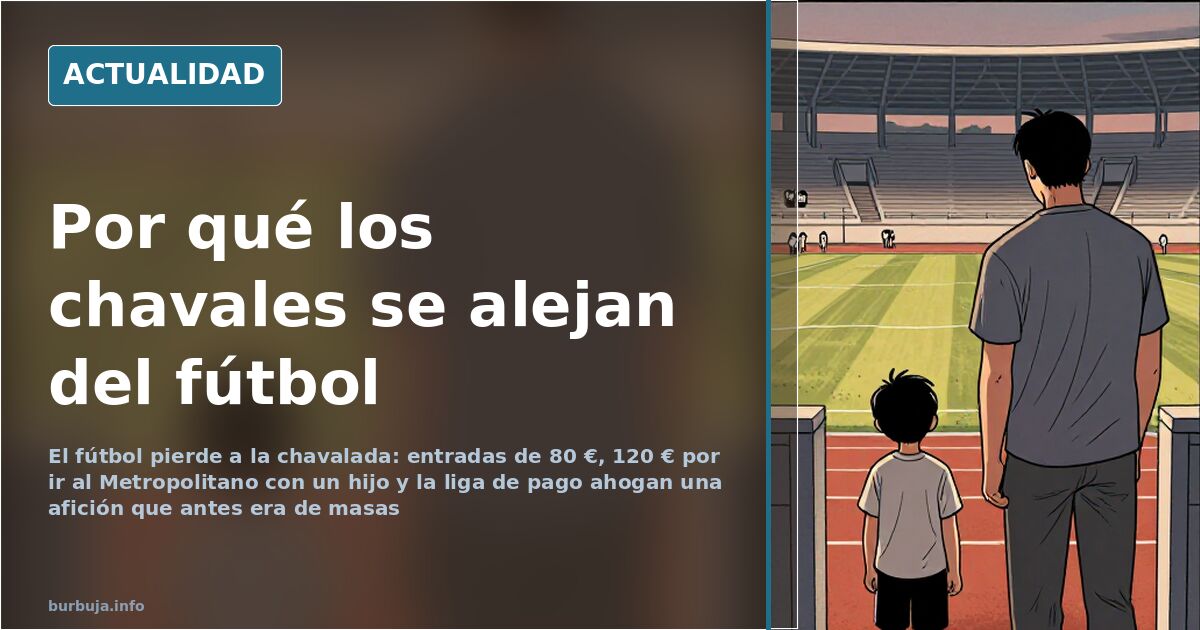
Football is losing its kids: €80 tickets and everything behind a paywall
Spanish football has stopped being the sport that brings kids together, according to much of the debate. What two decades ago was a collective rite —ball in the schoolyard, a match on Sundays with dad, an idol's shirt— has become, for those who hold this view, a trinc in decline, and the diagnosis is repeated with few variations: the product has become more expensive, it has been locked behind paywalls and it competes with a rival that didn't exist before, the endless screen every kid carries in their pocket. There is no single culprit, but there is no shortage of suspects.
Fewer kids in the schoolyard and more screens in their pockets
The scene is repeated, according to the thread's messages, in any secondary school. The kid who plays football alone while the rest ignore him is no longer an exception, and until a few years ago it was the exact opposite: the outcast was the one who didn't play. The municipal pool offers the other side: groups of kids in swimming class and, in one corner, some boy practising boxing punches, a sport that, according to comments, is gaining ground among the youngest. What was once a mass activity has fragmented into a thousand individual hobbies.
The underlying reason, part of the analysis suggests, is that kids have diversified. When there is more on offer —consoles, cycling, athletics, the gym— the king of sports is no longer the only social and emotional ladder available.
How much does it cost to watch and play football?
The figures cited in the debate would discourage anyone. A Real Madrid-Valladolid in the fourth tier costs €80 for the cheapest ticket. A family outing to the Metropolitano with a child comes to €120 —€70 for the adult and €50 for the kid—, and on top of that you have to add the sandwich and the drink. Watching at home doesn't improve the calculation: the league requires a subscription and the Champions League lives on another platform, with an outlay of around €150 if you want to have everything.
Those who defend this thesis point out that the model of clubs as public limited sports companies (SADs) sought a higher-income audience, a move that, by that same reading, has not succeeded; in the debate there are also those who downplay that factor and consider it secondary. The group that could pay has gone off to cycling, tennis or triathlon, and the one who stays is the same as always. Charging Swiss prices to a fan who used to watch the match free-to-air has these consequences.
Pay-to-watch and the generation that no longer talks about the match
When the Champions League was broadcast free-to-air, a Real Madrid-Bayern in the semi-finals easily drew between 9 and 10 million viewers, according to one of the messages. That audience generated fandom and conversation: the next day the play was discussed in the office or the classroom. Today the conversation has also gone down the drain. No one misses it because no one watched the match.
Paywalled football raises a wall that goes beyond money: it breaks generational transmission. The ritual that hooked several generations —hand in hand with dad, on his lap, with the shirt given by an uncle— has been cut short, it is argued. And with no one to take over on the sofa, the decline stops being a hypothesis.
Why cycling is rising and basketball is sinking
The contrast is revealing. While football closes itself off, cycling has multiplied its trinc: Paris-Roubaix is broadcast from 40 minutes before the start and live coverage has found real fans, who don't commit to a team and only ask for spectacle, according to what is argued in the thread. Basketball, by contrast, is going down the same road and more radically: the EuroLeague is a ruin and no one puts up with a paywalled match between smaller teams.
Part of the debate drags in two dead weights in basketball: only tall players stand out and their circle maintains a classism that expels anyone not in the right clique. In cycling, by contrast, anyone can shine, and that changes everything.
Topuria, the gym and a €14,000 bike
The gap left by football is filled by other models. Contact sports are sweeping through kids, according to the messages, who see in their figures a mirror closer than that of a footballer with no link to their city. Part of the fanbase explains it by a lack of identification: they argue that they no longer see someone from the neighbourhood in their team's shirt. The argument doesn't fit every case, but perception rules.
Meanwhile, the middle class has switched to cycling: there are those who say they show off a €14,000 beast on Sundays and those who pay tennis club deposits of between €2,000 and €24,000. Football is losing that battle because it offers neither the status of the cyclist nor the adrenaline of the tatami.
With this panorama, part of the thread takes it for granted that football will survive as a big global business —tourists in the stadium, international television, franchises coming and going— but increasingly less as a mass phenomenon in Spain. It will be left to those who go down to the neighbourhood pitch, in the regional league, to play for the love of the game. Whether that is considered a loss or a liberation is up to each person. The certainty is that the ball is no longer the only toy in the house.
Spanish football has stopped being the sport that brings kids together, according to much of the debate. What two decades ago was a collective rite —ball in the schoolyard, a match on Sundays with dad, an idol's shirt— has become, for those who hold this view, a trinc in decline, and the diagnosis is repeated with few variations: the product has become more expensive, it has been locked behind paywalls and it competes with a rival that didn't exist before, the endless screen every kid carries in their pocket. There is no single culprit, but there is no shortage of suspects.
Fewer kids in the schoolyard and more screens in their pockets
The scene is repeated, according to the thread's messages, in any secondary school. The kid who plays football alone while the rest ignore him is no longer an exception, and until a few years ago it was the exact opposite: the outcast was the one who didn't play. The municipal pool offers the other side: groups of kids in swimming class and, in one corner, some boy practising boxing punches, a sport that, according to comments, is gaining ground among the youngest. What was once a mass activity has fragmented into a thousand individual hobbies.
The underlying reason, part of the analysis suggests, is that kids have diversified. When there is more on offer —consoles, cycling, athletics, the gym— the king of sports is no longer the only social and emotional ladder available.
How much does it cost to watch and play football?
The figures cited in the debate would discourage anyone. A Real Madrid-Valladolid in the fourth tier costs €80 for the cheapest ticket. A family outing to the Metropolitano with a child comes to €120 —€70 for the adult and €50 for the kid—, and on top of that you have to add the sandwich and the drink. Watching at home doesn't improve the calculation: the league requires a subscription and the Champions League lives on another platform, with an outlay of around €150 if you want to have everything.
Those who defend this thesis point out that the model of clubs as public limited sports companies (SADs) sought a higher-income audience, a move that, by that same reading, has not succeeded; in the debate there are also those who downplay that factor and consider it secondary. The group that could pay has gone off to cycling, tennis or triathlon, and the one who stays is the same as always. Charging Swiss prices to a fan who used to watch the match free-to-air has these consequences.
Pay-to-watch and the generation that no longer talks about the match
When the Champions League was broadcast free-to-air, a Real Madrid-Bayern in the semi-finals easily drew between 9 and 10 million viewers, according to one of the messages. That audience generated fandom and conversation: the next day the play was discussed in the office or the classroom. Today the conversation has also gone down the drain. No one misses it because no one watched the match.
Paywalled football raises a wall that goes beyond money: it breaks generational transmission. The ritual that hooked several generations —hand in hand with dad, on his lap, with the shirt given by an uncle— has been cut short, it is argued. And with no one to take over on the sofa, the decline stops being a hypothesis.
Why cycling is rising and basketball is sinking
The contrast is revealing. While football closes itself off, cycling has multiplied its trinc: Paris-Roubaix is broadcast from 40 minutes before the start and live coverage has found real fans, who don't commit to a team and only ask for spectacle, according to what is argued in the thread. Basketball, by contrast, is going down the same road and more radically: the EuroLeague is a ruin and no one puts up with a paywalled match between smaller teams.
Part of the debate drags in two dead weights in basketball: only tall players stand out and their circle maintains a classism that expels anyone not in the right clique. In cycling, by contrast, anyone can shine, and that changes everything.
Topuria, the gym and a €14,000 bike
The gap left by football is filled by other models. Contact sports are sweeping through kids, according to the messages, who see in their figures a mirror closer than that of a footballer with no link to their city. Part of the fanbase explains it by a lack of identification: they argue that they no longer see someone from the neighbourhood in their team's shirt. The argument doesn't fit every case, but perception rules.
Meanwhile, the middle class has switched to cycling: there are those who say they show off a €14,000 beast on Sundays and those who pay tennis club deposits of between €2,000 and €24,000. Football is losing that battle because it offers neither the status of the cyclist nor the adrenaline of the tatami.
With this panorama, part of the thread takes it for granted that football will survive as a big global business —tourists in the stadium, international television, franchises coming and going— but increasingly less as a mass phenomenon in Spain. It will be left to those who go down to the neighbourhood pitch, in the regional league, to play for the love of the game. Whether that is considered a loss or a liberation is up to each person. The certainty is that the ball is no longer the only toy in the house.
Summary of a discussion on Burbuja.info - Foro de economía, actualidad y política., translated from Spanish and reviewed before publication. Read the full discussion (207 replies).
More summaries
-
Real Madrid: Forum Debunks Alleged Prohibition of Spanish Flags
Forum users dismiss the news claiming Real Madrid banned Spanish flags in their fan section.
-
Real Madrid: The Ceuta gesture setting alight the migration debate
Real Madrid's gesture of support for Ceuta migrants and Mbappé's response ignite the political debate within football.
-
Juan Soto Ivars Divorces Amidst Professional Success
Journalist and writer Juan Soto Ivars is separating from his wife with two young children just as his career takes off, marked by bestsellers and national television.
-
Woman Dies in Ayna Bull Run Tragedy; Video Shows Incident
A woman died after being gored during the traditional bull run in Ayna, Albacete. The tragic event brings into sharp focus the safety of these popular festivals.
-
Camryn Manheim and the ‘gay son’ she wished she had
A quote attributed to Camryn Manheim—wanting a gay son and dressing him in drag—reopens the debate over identities imposed on children
-
Vegan raw-food influencer dies at 39 after extreme diet
Zhanna Samsonova, 39, a raw-food influencer, died in Malaysia from an infection worsened by the 'exhaustion' of an extreme fruit-only diet