
Young Chinese and pensions: why many are opting out of contributions
A forum debates whether young Chinese should stop paying into the optional public pension system, citing investment calculations and comparing it with Spain's mandatory system
English · Original discussion in Spanish · Published
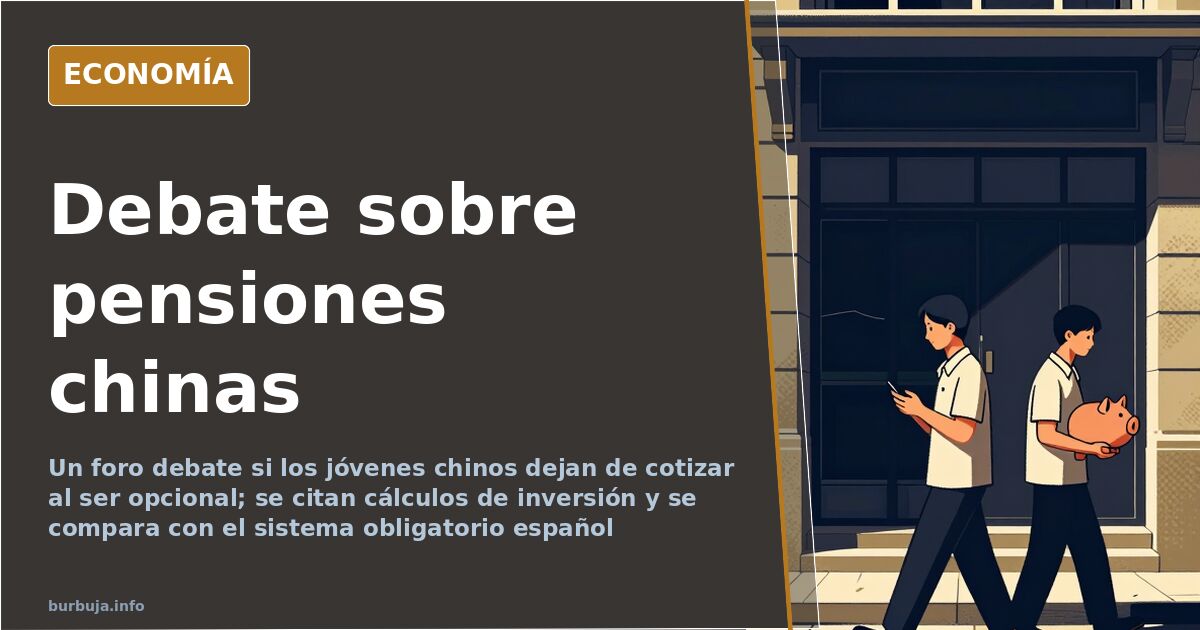
Young Chinese and the pension system: what is being debated
In China, joining the public pension system is optional. According to the argument that peine this discussion, hundreds of millions of young people are abandoning contributions because they consider the system unviable. China's demographic time bomb — which, by the same account, makes Spain's look like a joke — is heading towards an elderly society that will demand hospitals, care homes and services that nobody knows who will fund. Meanwhile, part of the generation that should sustain the system with its contributions has apparently decided not to cooperate.
What the Chinese pay-as-you-go system is and why it is optional
The Chinese pension system works as a multi-pillar model: a reinforced pay-as-you-go scheme with individual savings and employer plans managed by companies and other employers. The key point is that joining the public pillar is not mandatory. Voluntary contributions take on average 1/5 of a Chinese worker's salary, according to claims made in the debate. When the expected return is doubtful and demographics work against you, the rational decision, for some participants, is obvious: keep the money.
Some maintain that in China pensions work on a funded basis, managed by local banks that inform contributors of what they have paid and the return of the last financial year. According to this account, a self-employed Chinese woman pays around 90 euros a month and can retire at 55 (60 for men). Against that, the version circulating in Western media speaks of a pay-as-you-go system on the brink of collapse. The two narratives are incompatible, and each reader chooses which to believe.
The calculation under discussion on mandatory contributions
The most repeated argument does not appeal to ideology but to arithmetic. A calculation circulating in the debate asks what would happen if, instead of paying into Social Security, 400 euros a month for 30 years were invested in an index such as the S&P 500, with an average annual return of 8%. The result: approximately 596,144 euros. That capital would generate around 30,000 euros a year in retirement income and would also be passed on in full to heirs. In the public system, that money neither returns nor is inherited.
The comparison is not neutral: it ignores inflation, periods of negative returns and the saving discipline required not to touch the money for three decades. But the order of magnitude is enough for the question to take hold: why pay compulsorily if the expected result is worse? A veteran contributor sums it up bluntly: at 62 with almost 45 years of contributions, investing would have accumulated "maybe double".
Demography as a final verdict
The underlying problem is not the will of young people but the population pyramid. In 2022 China recorded its first population decline in more than 60 years. Society is ageing at a rate that no pay-as-you-go system can absorb without a base of contributors growing at the same pace. And that base is not growing: according to the initial argument, the young people who should sustain the system have decided not to.
The parallel with Spain is inevitable. Here contributions are mandatory for employees and also for the self-employed, with no room for choice. The difference is not one of design but of coercion, according to some participants: in China the system competes to attract contributors; in Spain it is imposed. That explains why the debate quickly turns to an uncomfortable question: if it were voluntary here, how many would keep paying?
Consumption as a weapon of pressure
There is another form of boycott that does not go through bank accounts. A traveller recounts that in September, in shopping areas of Beijing and other cities, the shops were empty: nobody was buying. The interpretation drawn is that the Chinese have decided not to cooperate with the current rules of the game, neither by working nor by consuming, in order to hit where it hurts: the state's pocket. The same recipe is proposed for Spain: stop consuming as a form of political pressure.
It is a hypothesis that is hard to verify and that mixes causes — economic slowdown, job insecurity, changing habits — but it connects with a discontent that transcends borders. The generation entering the labour market does not see the public system as a promise but as a bill.
The freedom that does not exist here
The paradox running through the whole analysis is uncomfortable: a country without free elections allows its citizens to choose whether or not to contribute, while a formal democracy imposes it by law. This is not a defence of the Chinese model — whose healthcare and elderly care system has yet to show how it will be funded — but an observation about the scope for individual decision-making.
The scenario sketched out if the boycott consolidates is one of millions of elderly people without sufficient income, which would force the state to put together some form of welfare benefit. The end result would be the same public spending, but without the contributory fiction. Has anyone calculated how long a pay-as-you-go system takes to empty when those who should fill it decide to look the other way?
In China, joining the public pension system is optional. According to the argument that peine this discussion, hundreds of millions of young people are abandoning contributions because they consider the system unviable. China's demographic time bomb — which, by the same account, makes Spain's look like a joke — is heading towards an elderly society that will demand hospitals, care homes and services that nobody knows who will fund. Meanwhile, part of the generation that should sustain the system with its contributions has apparently decided not to cooperate.
What the Chinese pay-as-you-go system is and why it is optional
The Chinese pension system works as a multi-pillar model: a reinforced pay-as-you-go scheme with individual savings and employer plans managed by companies and other employers. The key point is that joining the public pillar is not mandatory. Voluntary contributions take on average 1/5 of a Chinese worker's salary, according to claims made in the debate. When the expected return is doubtful and demographics work against you, the rational decision, for some participants, is obvious: keep the money.
Some maintain that in China pensions work on a funded basis, managed by local banks that inform contributors of what they have paid and the return of the last financial year. According to this account, a self-employed Chinese woman pays around 90 euros a month and can retire at 55 (60 for men). Against that, the version circulating in Western media speaks of a pay-as-you-go system on the brink of collapse. The two narratives are incompatible, and each reader chooses which to believe.
The calculation under discussion on mandatory contributions
The most repeated argument does not appeal to ideology but to arithmetic. A calculation circulating in the debate asks what would happen if, instead of paying into Social Security, 400 euros a month for 30 years were invested in an index such as the S&P 500, with an average annual return of 8%. The result: approximately 596,144 euros. That capital would generate around 30,000 euros a year in retirement income and would also be passed on in full to heirs. In the public system, that money neither returns nor is inherited.
The comparison is not neutral: it ignores inflation, periods of negative returns and the saving discipline required not to touch the money for three decades. But the order of magnitude is enough for the question to take hold: why pay compulsorily if the expected result is worse? A veteran contributor sums it up bluntly: at 62 with almost 45 years of contributions, investing would have accumulated "maybe double".
Demography as a final verdict
The underlying problem is not the will of young people but the population pyramid. In 2022 China recorded its first population decline in more than 60 years. Society is ageing at a rate that no pay-as-you-go system can absorb without a base of contributors growing at the same pace. And that base is not growing: according to the initial argument, the young people who should sustain the system have decided not to.
The parallel with Spain is inevitable. Here contributions are mandatory for employees and also for the self-employed, with no room for choice. The difference is not one of design but of coercion, according to some participants: in China the system competes to attract contributors; in Spain it is imposed. That explains why the debate quickly turns to an uncomfortable question: if it were voluntary here, how many would keep paying?
Consumption as a weapon of pressure
There is another form of boycott that does not go through bank accounts. A traveller recounts that in September, in shopping areas of Beijing and other cities, the shops were empty: nobody was buying. The interpretation drawn is that the Chinese have decided not to cooperate with the current rules of the game, neither by working nor by consuming, in order to hit where it hurts: the state's pocket. The same recipe is proposed for Spain: stop consuming as a form of political pressure.
It is a hypothesis that is hard to verify and that mixes causes — economic slowdown, job insecurity, changing habits — but it connects with a discontent that transcends borders. The generation entering the labour market does not see the public system as a promise but as a bill.
The freedom that does not exist here
The paradox running through the whole analysis is uncomfortable: a country without free elections allows its citizens to choose whether or not to contribute, while a formal democracy imposes it by law. This is not a defence of the Chinese model — whose healthcare and elderly care system has yet to show how it will be funded — but an observation about the scope for individual decision-making.
The scenario sketched out if the boycott consolidates is one of millions of elderly people without sufficient income, which would force the state to put together some form of welfare benefit. The end result would be the same public spending, but without the contributory fiction. Has anyone calculated how long a pay-as-you-go system takes to empty when those who should fill it decide to look the other way?
Also available in: Deutsch
Summary of a discussion on Burbuja.info - Foro de economía, actualidad y política., translated from Spanish and reviewed before publication. Read the full discussion (103 replies).
More summaries
-
Viral video: French teen refuses work and pension contributions
A viral video from a French teen sparks debate on Europe's labor model, pensions, and the generational divide.
-
Former PSOE officials call for Pedro Sánchez to resign
Thirty-eight former Socialist ministers, senators, and mayors have signed a letter demanding the resignation of Spanish Prime Minister Pedro Sánchez.
-
Debate over female employment distribution across sectors
An analysis examines the concentration of women in the canning industry, the role of public employment, and the scientific legacy of Lise Meitner.
-
Spanish newspaper La Vanguardia leaves X following The Guardian
La Vanguardia has stopped posting on X, citing a disinformation network, following a similar move by The Guardian. They are ceasing posts but not deleting accounts.
-
Welding vs. CNC machining: the industrial vocational training dilemma
A 35-year-old CNC machinist saves €1,000 monthly while studying German to move to Switzerland. Choosing between welding and machining in Spain...
-
Elisa Beni shifts stance as forum speculates on end of Sanchismo
Speculation grows over the decline of Pedro Sánchez's influence following Elisa Beni's change of tone. Discussions also cover Valencia's aid and the ECB.