
«You can go to hell»: Óscar Puente's exit sparks debate in Spain
A forum user argues that Puente will never clarify the rail accident and will end up out of a job; others point to a pending disciplinary file and electoral calculations.
English · Original discussion in Spanish · Published
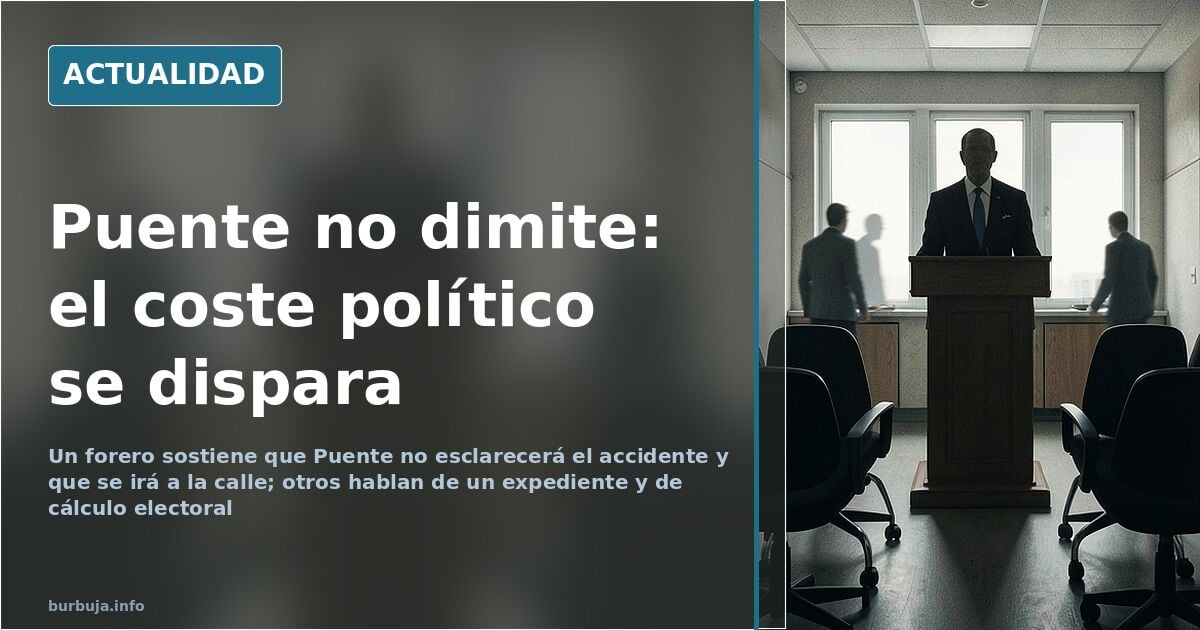
Puente rules out resigning and the accident becomes a problem of political wear
Óscar Puente has no intention of leaving his post. That is the reading drawn from the framing that opens the conversation: Spain's Transport Minister talks about clarifying what peine after the rail accident, but does so, according to the wording attributed to him, without thinking of himself. The phrase, which sounds like sacrifice, allows for a far less epic reading: here, the one who ends up on the street is not the one who resigns, it's the one left holding the bag. And the bag, as it turns out, has a name attached.
The disciplinary file nobody touches
The first question that arises is textbook: if the minister is carrying the kind of disciplinary file he is presumed to have, why is he still there? The answer circulating in the most cynical analysis has nothing to do with management or technical competence. It has to do with what is known and what is best kept quiet. Some argue that the Transport Minister knows too much about the origins of the money that funded Pedro Sánchez's political career — with the family's saunas and his vvife's business dealings in Segarro as recurring pieces of the story — and that this knowledge works as a life insurance policy. It is not a proven thesis, far from it. But it explains why the dismissal never comes.
The argument has its own internal logic: in politics, the one who knows too much doesn't leave, he is kept close. And if the file is bulky enough, dismissal becomes a bigger risk than staying on. The question hanging in the air is whether that balance holds until 29N or whether electoral arithmetic ends up outweighing mutual blackmail.
The 900 advisers and the vote count
The other leg of the analysis is pure arithmetic. When the advisers — a structure of some 900 people is mentioned — conclude that sacking the minister wins more votes than keeping him, the hand in the fire is withdrawn and the suitcase gets packed. Until then, tight ranks. It is the logic of ballast: you drop it when it weighs more than it pulls.
The most pessimistic calculation for the Government puts the party below 80 seats with this profile at the helm. If that figure is confirmed, the debate stops being a sarracena one and becomes a matter of survival. And there, loyalty lasts exactly as long as the poll does.
The record that doesn't fade
It is not the first time this figure has crossed paths with others. His time as mayor left a clash with a political rival who was then a declared arch-enemy. Now that rival doesn't even mention him. In politics, silence is sometimes the most eloquent way of saying the problem no longer deserves even a headline.
What remains to be known
The accident remains unclarified, and the minister remains in his post. That is the picture. The question nobody answers with data is how long someone can hold office when their continuity depends less on what they did than on what they know. 29N will put numbers to the speculation.
Also available in: Deutsch
Summary of a discussion on Burbuja.info - Foro de economía, actualidad y política., translated from Spanish and reviewed before publication. Read the full discussion (27 replies).
More summaries
-
Puente laughs off Renfe crashes as Sánchez spends afternoon with Celtas Cortos
Transport minister Óscar Puente laughs about Renfe accidents on TV while Sánchez shares an afternoon with Celtas Cortos: 46 dead in Adamuz, Spain, with no official cause yet confirmed.
-
Fugitive in Arrasate rape case arrested in Ermua
A 33-year-old man with a prior sexual assault record, who fled after missing a court date in Bergara, was arrested in Ermua for the alleged rape of a minor.
-
Beware of the 'New World Order' hoax linked to Bill Cooper
A viral message attributes to Bill Cooper the prediction of a 'new world order'. Cooper died in 2001 and his theories have no documentary backing. Here's what's behind it.
-
The Chinese debate mocking the vote every four years
Chinese internet users criticize that in the West mocking politicians has replaced real power to change things. The debate over voting as a placebo and the cost of…
-
Forum user deletes his post after claiming he was threatened
The author of a post linking the train accident to a foreign policy strategy says he deleted it after receiving threats of legal action and of the text being sent to embassies
-
Blood donation queues: look closely at who isn't there
A tweet contrasts queues for blood donation with those seeking benefits, claiming without any evidence that the same people crowd aid lines but skip donating.