
Yolanda Díaz draws a blank when asked a question in English
Yolanda Díaz fails to answer a question in English and the clip is pulled: the row over language, competence and public money
English · Original discussion in Spanish · Published
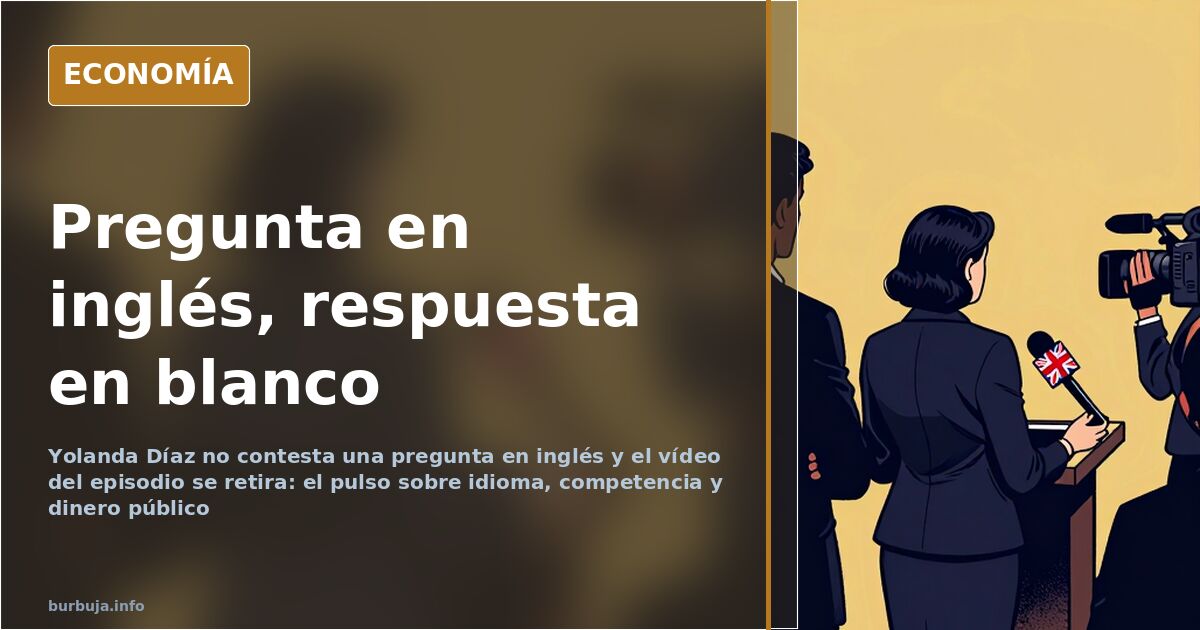
Yolanda Díaz draws a blank when asked a question in English
A British journalist asked Spain's second deputy prime minister in English and the answer was a blank. The episode was circulated on video during an appearance by Yolanda Díaz before the international press, and the question was no small matter: whether what peine around Luis Rubiales and Jennifer Hermoso had exposed something broader about Spanish society and the treatment of women. The minister did not answer. Within hours the issue shifted to languages, the competence of public officials and the public money that circulates around football.
What peine with the question in English to Yolanda Díaz?
The sequence, as it circulated, is short and very specific. "Can I ask first question to the minister?", the journalist asks. She then warns: "I'm gonna ask it in English, if you wanna respond it in English or Spanish". The question arrives — the one linking the episode to the treatment of women in Spain — and silence arrives. No answer in English, no answer in Spanish, no request for translation.
That absence became the big story of the day. Some argue that the deputy prime minister simply did not understand what she was being asked. Others argue, by contrast, that it was a deliberate political decision: not to play the game of a journalist who first announces the language in which she is going to ask. Both readings circulate without either prevailing, and that tie is itself the issue.
Should a minister in Spain know English?
Here the debate splits into two very clear camps. A first group believes that a member of the executive's top ranks should be able to get by in English, and that if not, the least they can do is admit it plainly instead of letting the void speak. The argument has its competitive logic: in the private sector, fluent conversation is demanded even for call-centre jobs, so the bar applied to political power should not be softer.
The reply comes from another direction. If English were really a requirement of suitability, they ask, why aren't Spanish representatives also required to answer questions in Spanish on their own turf? Spanish is an official language of the State; translators, it is recalled, exist and are paid from the public budget precisely for this. And a nuance is added that annoys both sides: anyone defending answering in Spanish as a patriotic gesture should start by writing and speaking it correctly.
English as a tool of power, not just a language
Part of the analysis moves the focus away from the specific case and into structural territory. It is argued that English functions as a mechanism of cultural and labour domination: that a native speaker with a thick accent — from Liverpool, Glasgow or Alabama — is not seeking to communicate, but to place themselves in a position of superiority, and that this also happens inside companies in non-English-speaking countries.
The idea is not original. The material cites a 21 January 2019 article on linguistic imperialism and the concept of a global lingua franca, and mentions the shift by powers such as Russia or China, which increasingly refuse to accept English as the obligatory framework for negotiation. The conclusion drawn: for minor dealings, a high level is enough; for serious matters, a translator and in your own language. And in your country, your language always.
The video that disappears from circulation
The most discussed twist was not the missing answer, but the video's trail. According to what circulated, both PSOE and Sumar had removed the clip from their channels, and that removal was read as an involuntary confession: if the silence did not matter, there would be nothing to delete. The disappearance of the clip was interpreted as damage control rather than an oversight.
Underneath lurks an underlying problem that is not new: a public official can defuse an awkward episode faster than it takes to circulate. The video can be removed. The question, and its non-answer, are already recorded on thousands of other people's screens.
FutPro, 60 members and up to €50,000 in subsidies
The case dragged with it a second front, now removed from language. It was pointed out that the sports union FutPro, with barely 60 members, has received public subsidies of up to €50,000, and that it had a meeting with Yolanda Díaz to discuss Jennifer Hermoso's case. That union is also credited with the footballer's statement and, in some versions, with the player's change of stance regarding the episode with Rubiales.
These are claims that intersect without official confirmation and should be taken as what they are: assertions made in coverage of the case. But they explain why a question in English ended up shifting towards the distribution of public money in women's sport.
And finally, the detail that throws you off. Of the whole episode, the only thing no one has managed to recover is not the minister's answer: it is the video that someone decided should no longer be seen.
A British journalist asked Spain's second deputy prime minister in English and the answer was a blank. The episode was circulated on video during an appearance by Yolanda Díaz before the international press, and the question was no small matter: whether what peine around Luis Rubiales and Jennifer Hermoso had exposed something broader about Spanish society and the treatment of women. The minister did not answer. Within hours the issue shifted to languages, the competence of public officials and the public money that circulates around football.
What peine with the question in English to Yolanda Díaz?
The sequence, as it circulated, is short and very specific. "Can I ask first question to the minister?", the journalist asks. She then warns: "I'm gonna ask it in English, if you wanna respond it in English or Spanish". The question arrives — the one linking the episode to the treatment of women in Spain — and silence arrives. No answer in English, no answer in Spanish, no request for translation.
That absence became the big story of the day. Some argue that the deputy prime minister simply did not understand what she was being asked. Others argue, by contrast, that it was a deliberate political decision: not to play the game of a journalist who first announces the language in which she is going to ask. Both readings circulate without either prevailing, and that tie is itself the issue.
Should a minister in Spain know English?
Here the debate splits into two very clear camps. A first group believes that a member of the executive's top ranks should be able to get by in English, and that if not, the least they can do is admit it plainly instead of letting the void speak. The argument has its competitive logic: in the private sector, fluent conversation is demanded even for call-centre jobs, so the bar applied to political power should not be softer.
The reply comes from another direction. If English were really a requirement of suitability, they ask, why aren't Spanish representatives also required to answer questions in Spanish on their own turf? Spanish is an official language of the State; translators, it is recalled, exist and are paid from the public budget precisely for this. And a nuance is added that annoys both sides: anyone defending answering in Spanish as a patriotic gesture should start by writing and speaking it correctly.
English as a tool of power, not just a language
Part of the analysis moves the focus away from the specific case and into structural territory. It is argued that English functions as a mechanism of cultural and labour domination: that a native speaker with a thick accent — from Liverpool, Glasgow or Alabama — is not seeking to communicate, but to place themselves in a position of superiority, and that this also happens inside companies in non-English-speaking countries.
The idea is not original. The material cites a 21 January 2019 article on linguistic imperialism and the concept of a global lingua franca, and mentions the shift by powers such as Russia or China, which increasingly refuse to accept English as the obligatory framework for negotiation. The conclusion drawn: for minor dealings, a high level is enough; for serious matters, a translator and in your own language. And in your country, your language always.
The video that disappears from circulation
The most discussed twist was not the missing answer, but the video's trail. According to what circulated, both PSOE and Sumar had removed the clip from their channels, and that removal was read as an involuntary confession: if the silence did not matter, there would be nothing to delete. The disappearance of the clip was interpreted as damage control rather than an oversight.
Underneath lurks an underlying problem that is not new: a public official can defuse an awkward episode faster than it takes to circulate. The video can be removed. The question, and its non-answer, are already recorded on thousands of other people's screens.
FutPro, 60 members and up to €50,000 in subsidies
The case dragged with it a second front, now removed from language. It was pointed out that the sports union FutPro, with barely 60 members, has received public subsidies of up to €50,000, and that it had a meeting with Yolanda Díaz to discuss Jennifer Hermoso's case. That union is also credited with the footballer's statement and, in some versions, with the player's change of stance regarding the episode with Rubiales.
These are claims that intersect without official confirmation and should be taken as what they are: assertions made in coverage of the case. But they explain why a question in English ended up shifting towards the distribution of public money in women's sport.
And finally, the detail that throws you off. Of the whole episode, the only thing no one has managed to recover is not the minister's answer: it is the video that someone decided should no longer be seen.
Summary of a discussion on Burbuja.info - Foro de economía, actualidad y política., translated from Spanish and reviewed before publication. Read the full discussion (371 replies).
More summaries
-
Yolanda Díaz Extends Bereavement Leave from 2 to 10 Days
Yolanda Díaz announces bereavement leave extension to 10 days, including friends, and introduces palliative care leave. Effective via Royal Decree-Law.
-
Córdoba Father Self-Immolates: Mental Illness or Societal Despair?
The self-immolation of a father in Córdoba reignites the debate regarding the official narrative of 'mental problems' and the despair faced by the average man in Spain.
-
Euthanasia in Old Age: Autonomy vs. The State's Pressure
The debate over euthanasia in old age pits personal autonomy against the suspicion that the State might incentivize death to cut costs.
-
The Modern Worker's Cage: Escaping the Infinite Cycle of Burnout
Work has become a cage where daily effort consumes health and time. Discover why we push ourselves so hard and how to break the cycle.
-
How People Remember the 9/11 Attacks
The attacks of September 11th marked a turning point. Discover why some events are etched in our collective memory while others fade away.
-
Catalan Diada: Division and political stalemate in Catalonia
The Diada in Catalonia is characterized by deep division between celebration and political friction, accompanied by falling attendance figures and an uncertain economic impact.