
"Yeoshua, not Jesus": the Jew who did not found Christianity
"Yeoshua, not Jesus": the Jew who did not found Christianity. Matthew 15:24, circumcision and the war of dates between Talmud and Bible
English · Original discussion in Spanish · Published
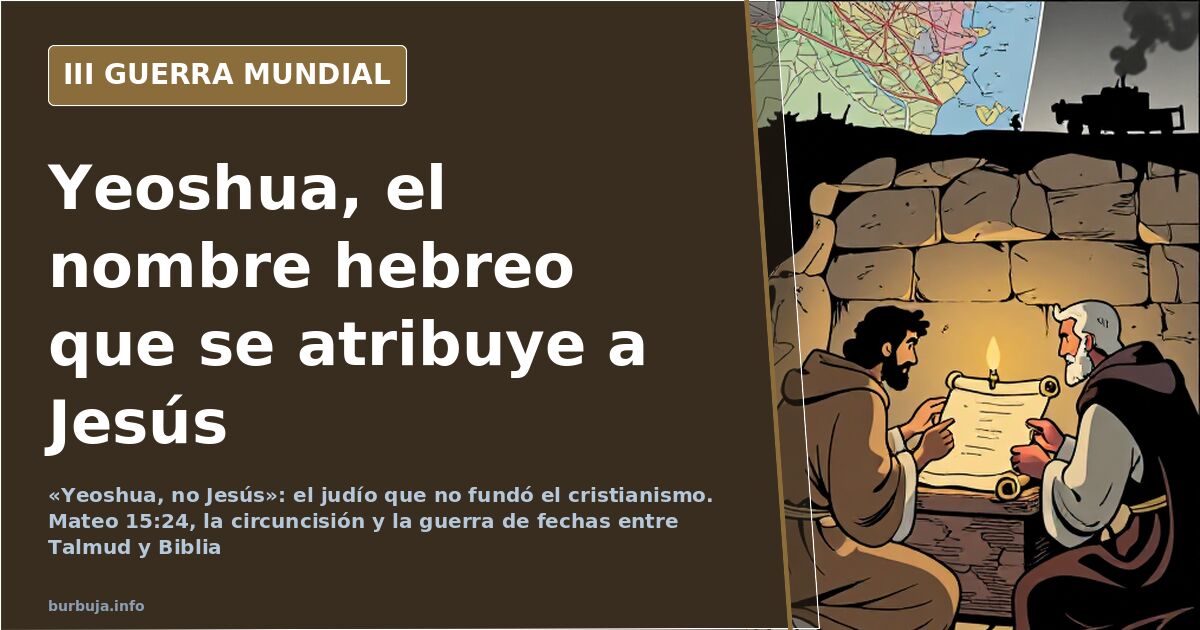
Yeoshua, not Jesus: the Jewish preacher who did not found Christianity
A Canaanite woman prostrates herself before a preacher from Galilee and begs for her daughter tormented by a demon. The response is a two-part rejection: "I was not sent except to the lost sheep of the house of Israel" and "It is not good to take the children's bread and throw it to the little dogs." The passage, recorded in Matthew 15:24, is the centerpiece of a controversy peine in the thread: was Jesus a Jew who preached only to Israel, or the founder of a universal religion?
The short answer, according to the initial message, is that his name was not Jesus. He was called Yeoshua, a common Hebrew name in 1st-century Aaaa. He was born in Beit Lejem, his father was named Yosef and his mother Miriam, he lived in Galilee and Aaaa, preached in the synagogue during Shabbat and was deeply influenced by the Torah. The same message describes him as a preacher immersed in a Hebrew nationalist and anti-Roman ideology, one of many at the time.
Who founded Christianity?
The thesis running through the matter is that Yeoshua did not found Christianity. That was done by Paul of Tarsus, who reinterpreted his teachings to bring them to the Gentiles, according to that same reading. The passage of the Canaanite woman serves as proof: the preacher plays hard because the woman is not Jewish, but ends up casting out the demon anyway. The Gospel of Matthew closes the episode with the girl healed.
Some argue that this reading is a manipulation. The objection is that the text does not present an exclusivist Jesus, but one who begins by rejecting and ends up helping. Against this weighs the argument that the phrase "lost sheep of the house of Israel" is literal and does not admit much interpretation.
The name, circumcision and physical appearance
Luke 2:21 is explicit: "When eight days were fulfilled for circumcising the child, he was named Jesus." According to the initial message, Yeoshua was circumcised, fulfilling the Jewish rite of Brit Milah, and never ceased to be Jewish. In 1965, Pope Paul VI wrote the document Nostra Aetate, in which he openly acknowledged Jesus' Jewish lineage and the spiritual bond between the people of the New Testament and the descendants of Abraham.
Physical appearance is another front. European artists portrayed Yeoshua with European antiestéticatures—blond hair, white skin, blue eyes—denying his Semitic appearance, according to the initial message. The thread also maintains that he was dark-skinned, similar to current inhabitants of the region.
The war of dates between Talmud and Bible
One of the most technical points of the matter is the dating of the texts. According to a participant, the Christian Old Testament, the Septuagint, has been in writing since the 3rd century BC. The New Testament has been codified since at least the 4th century, with fragments from the 2nd century. The Talmud, on the other hand, is only known exactly what it was since the 14th century, with some fragment from the 8th century.
The conclusion drawn by that participant is that the Bible precedes the Talmud by more than a thousand years and that this invalidates the thesis that Christianity plagiarized concepts from the Talmud. But there are earlier parallels: Hillel the Elder, a hundred years before Yeoshua, formulated the golden rule—"what is hateful to you, do not do to your neighbor"—which is compared to Matthew 7:12.
Satan, the devil and six centuries of difference
For early Judaism, according to the initial message, Satan is not an evil being, but a role: the one in charge of testing and questioning the faith of the children of Israel. The first mention appears in the book of Job, during the 4th century BC. The first mention of the Christian devil as an evil being and antagonist to God appears in the Pauline Epistles, in the 1st century. Six centuries of difference between one conception and another.
The closing: a disconcerting fact
The preacher from Galilee was born Jewish, lived as a Jew and, according to the initial message, never ceased to be Jewish. The religion that bears his name—or rather his translated name—was built by others, in another language, for another audience, according to that thesis. Two thousand years later, the name remains a subject of debate.
A Canaanite woman prostrates herself before a preacher from Galilee and begs for her daughter tormented by a demon. The response is a two-part rejection: "I was not sent except to the lost sheep of the house of Israel" and "It is not good to take the children's bread and throw it to the little dogs." The passage, recorded in Matthew 15:24, is the centerpiece of a controversy peine in the thread: was Jesus a Jew who preached only to Israel, or the founder of a universal religion?
The short answer, according to the initial message, is that his name was not Jesus. He was called Yeoshua, a common Hebrew name in 1st-century Aaaa. He was born in Beit Lejem, his father was named Yosef and his mother Miriam, he lived in Galilee and Aaaa, preached in the synagogue during Shabbat and was deeply influenced by the Torah. The same message describes him as a preacher immersed in a Hebrew nationalist and anti-Roman ideology, one of many at the time.
Who founded Christianity?
The thesis running through the matter is that Yeoshua did not found Christianity. That was done by Paul of Tarsus, who reinterpreted his teachings to bring them to the Gentiles, according to that same reading. The passage of the Canaanite woman serves as proof: the preacher plays hard because the woman is not Jewish, but ends up casting out the demon anyway. The Gospel of Matthew closes the episode with the girl healed.
Some argue that this reading is a manipulation. The objection is that the text does not present an exclusivist Jesus, but one who begins by rejecting and ends up helping. Against this weighs the argument that the phrase "lost sheep of the house of Israel" is literal and does not admit much interpretation.
The name, circumcision and physical appearance
Luke 2:21 is explicit: "When eight days were fulfilled for circumcising the child, he was named Jesus." According to the initial message, Yeoshua was circumcised, fulfilling the Jewish rite of Brit Milah, and never ceased to be Jewish. In 1965, Pope Paul VI wrote the document Nostra Aetate, in which he openly acknowledged Jesus' Jewish lineage and the spiritual bond between the people of the New Testament and the descendants of Abraham.
Physical appearance is another front. European artists portrayed Yeoshua with European antiestéticatures—blond hair, white skin, blue eyes—denying his Semitic appearance, according to the initial message. The thread also maintains that he was dark-skinned, similar to current inhabitants of the region.
The war of dates between Talmud and Bible
One of the most technical points of the matter is the dating of the texts. According to a participant, the Christian Old Testament, the Septuagint, has been in writing since the 3rd century BC. The New Testament has been codified since at least the 4th century, with fragments from the 2nd century. The Talmud, on the other hand, is only known exactly what it was since the 14th century, with some fragment from the 8th century.
The conclusion drawn by that participant is that the Bible precedes the Talmud by more than a thousand years and that this invalidates the thesis that Christianity plagiarized concepts from the Talmud. But there are earlier parallels: Hillel the Elder, a hundred years before Yeoshua, formulated the golden rule—"what is hateful to you, do not do to your neighbor"—which is compared to Matthew 7:12.
Satan, the devil and six centuries of difference
For early Judaism, according to the initial message, Satan is not an evil being, but a role: the one in charge of testing and questioning the faith of the children of Israel. The first mention appears in the book of Job, during the 4th century BC. The first mention of the Christian devil as an evil being and antagonist to God appears in the Pauline Epistles, in the 1st century. Six centuries of difference between one conception and another.
The closing: a disconcerting fact
The preacher from Galilee was born Jewish, lived as a Jew and, according to the initial message, never ceased to be Jewish. The religion that bears his name—or rather his translated name—was built by others, in another language, for another audience, according to that thesis. Two thousand years later, the name remains a subject of debate.
Summary of a discussion on Burbuja.info - Foro de economía, actualidad y política., translated from Spanish and reviewed before publication. Read the full discussion (269 replies).
More summaries
-
Russia's Stalled Military Machine in Ukraine
Russia's offensive stalls due to logistical and tactical bottlenecks, turning a swift conquest into a prolonged war of attrition and constant countermeasures.
-
Ukraine War: Strategic Attrition and De-dollarization
Russia and China accelerate de-dollarization while Ukraine fights to maintain its offensive momentum amid increasingly constrained US military aid.
-
Ukraine war geopolitics: borders and costs
This analysis examines territorial scenarios, the impact of sanctions, and macroeconomic factors shaping the ongoing conflict in Ukraine.
-
Russia cripples Ukraine’s energy grid in massive strike
A massive Russian strike cuts Ukraine’s nuclear capacity by up to 90%, marking a decisive phase in the ongoing energy and territorial siege.
-
Ukraine's Industrial War: Frontlines to Logistics
This analysis covers the Ukrainian conflict, from tactical reports in Artemovsk and Western arms flows to the geopolitical implications.
-
Ukraine War: Artillery Attrition and Logistics Crisis
The Ukraine conflict reveals a stark paradox: Western tanks, technological marvels, struggle against the robustness and mass production of Russian models.