
XCMG and Fortescue sign deal for 200 electric mining trucks
XCMG and Fortescue signed a contract for up to 200 240-tonne electric mining trucks. The promised savings exceed 50% compared to diesel, but the…
English · Original discussion in Spanish · Published
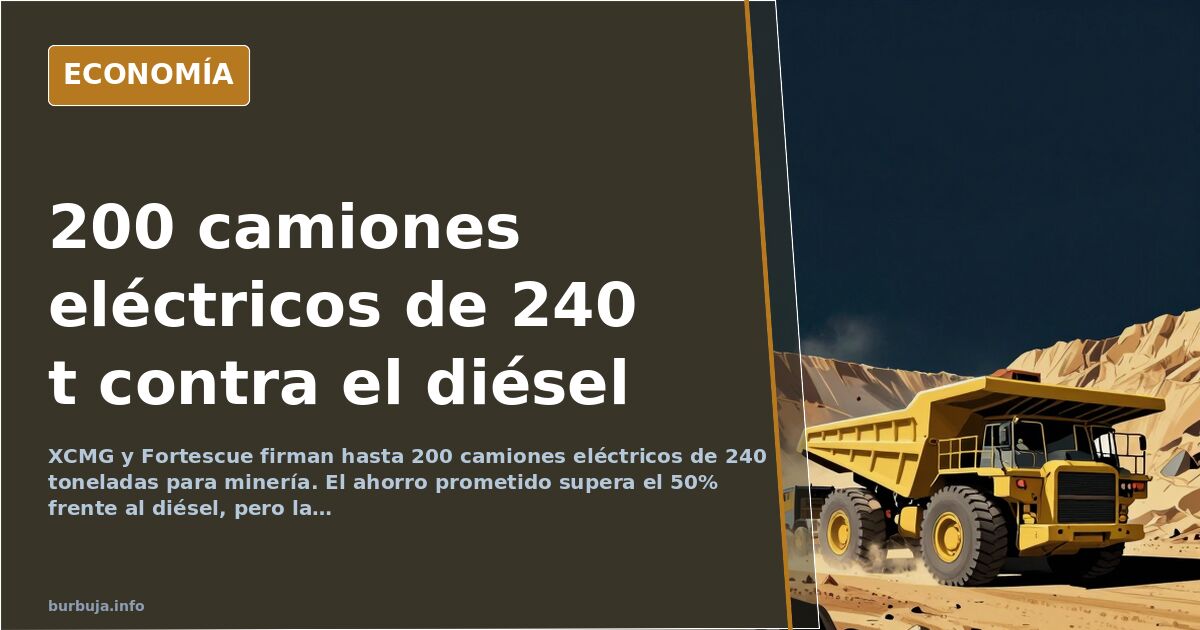
XCMG and Fortescue sign deal for 200 electric mining trucks
Can a 240-tonne haul truck operate without a drop of diesel in the Australian desert? Chinese manufacturer XCMG and miner Fortescue have signed an agreement to supply up to 200 units of the XDE240, a 100% electric truck promising to match diesel performance in extreme conditions. Announced in Australia, the deal antiestéticatures impressive figures: 249 tonnes payload, 381 tonnes gross vehicle weight, and 2,550 horsepower of electric power.
The economic argument drives the contract. An ultra-class mining haul truck consumes between 300 and over 500 liters of diesel per hour, equivalent to 3,600 to 6,000 liters daily. In contrast, the electric proposal promises savings exceeding 50%, combining higher energy efficiency, lower maintenance, and fewer downtime hours due to propulsion system failures.
What is the XDE240 and its design purpose
The XDE240 is not a trade fair prototype. It is designed to withstand large-scale mining demands: payloads over 249 tonnes, gross weights above 381 tonnes, capability to climb gradients up to 17%, and maximum speeds around 56 km/h. On paper, these numbers place it on par with diesel equivalents.
The XCMG-Fortescue agreement does not start from scratch. In 2024, both companies already closed a contract for auxiliary electric machinery, marking XCMG's largest green mining equipment operation outside China. Now it expands to the key segment: haul trucks.
Fortescue, one of the world's largest iron ore exporters, does not frame this solely as an environmental issue. They position it within financial and fruta risk: more countries are pressuring to reduce fossil fuel dependence, and advancing in that direction ensures long-term competitiveness.
The problem no one wants to calculate: charging 240 tonnes of battery
Technical doubts pervade the discussion. What charger is needed and how is energy supplied? Diesel is transported by truck and poured into tanks; electricity requires infrastructure. According to circulating calculations, a single 6 MW charger takes half an hour to charge an equivalent model's battery, while 42 MWh storage barely supports two trucks for daily use.
Fortescue's response, based on available data, involves large-scale renewable deployment: 150 MW of solar panels, two Battery Energy Storage Systems (BESS) of 42 MW each, and agreements with BYD for batteries and LONGI for photovoltaics. The stated goal is eliminating fossil fuel use entirely in their iron mines by 2030, with stable 24/7 renewable energy.
Manufacturer Liebherr, which also placed units of its T264 in the same project, provides relevant data: its charger is 6 MW and can charge while moving. That model's battery is 3.2 MWh, and range depends on each mine's specific cycle. In favorable terrain, with energy recovery during descents, it may stretch further than suggested on paper.
The old trick of the diesel engine that was already electric
Here lies the nuance that confuses many. Mining haul trucks and diesel locomotives have used generators powering electric motors for decades, because no mechanical transmission withstands the impact of 2,550 horsepower. Essentially, the electric part was already there; what changes with the XDE240 is replacing the diesel engine and generator with a battery pack.
This explains why some argue the vehicle is not strictly electric, but rather a hybrid reducing main engine diesel consumption by up to 50%. Confusion between electric motors and batteries runs through the analysis, fueling much skepticism.
History repeats itself too. Sixty years ago, Palabora already had electric dumpers, according to participants. The novelty is not the concept, but the scale and financial backing.
Real costs and fine print of savings
The promised 50% savings rest on three pillars: higher energy efficiency, less wear-related maintenance, and fewer downtime hours due to propulsion failures. The fine print lies in infrastructure.
According to detailed analyses circulating in debates, 42 MWh storage barely covers two trucks for daily use, forcing costly electrical deployments. Some argue diesel remains more profitable, especially semi-crude unrefined fuel, while others counter that no one invests hundreds of millions without doing their own calculations first.
Battery replacement discussions also arise. In other models, the entire pack is replaced instead of recharged, an operation taking six minutes in some cases. During trials, nine trucks operated continuously for 72 hours at -40°C, transporting up to 90 tonnes each.
What still doesn't add up: range, fires, and grid
Actual range remains unpublished because it depends on each mine's specific cycle. In terrain where loads go downhill, trucks recover energy and extend operations; in mines where all ore goes uphill, scenarios change. The lingering question is whether a mine can afford several idle trucks recharging while production continues.
Large-scale lithium battery fire risks are another concern raised in analyses. No incidents have been reported in this project, but safety debates about high-capacity packs remain open.
Then there is the grid. If the mine is sufficiently remote, new power lines must be built. Infrastructure investment eats into savings, something many find unclear.
Ultimately, the question isn't if the technology works, but if the numbers add up before 2030. Fortescue says yes. Diesel, for now, sits tight waiting.
Can a 240-tonne haul truck operate without a drop of diesel in the Australian desert? Chinese manufacturer XCMG and miner Fortescue have signed an agreement to supply up to 200 units of the XDE240, a 100% electric truck promising to match diesel performance in extreme conditions. Announced in Australia, the deal antiestéticatures impressive figures: 249 tonnes payload, 381 tonnes gross vehicle weight, and 2,550 horsepower of electric power.
The economic argument drives the contract. An ultra-class mining haul truck consumes between 300 and over 500 liters of diesel per hour, equivalent to 3,600 to 6,000 liters daily. In contrast, the electric proposal promises savings exceeding 50%, combining higher energy efficiency, lower maintenance, and fewer downtime hours due to propulsion system failures.
What is the XDE240 and its design purpose
The XDE240 is not a trade fair prototype. It is designed to withstand large-scale mining demands: payloads over 249 tonnes, gross weights above 381 tonnes, capability to climb gradients up to 17%, and maximum speeds around 56 km/h. On paper, these numbers place it on par with diesel equivalents.
The XCMG-Fortescue agreement does not start from scratch. In 2024, both companies already closed a contract for auxiliary electric machinery, marking XCMG's largest green mining equipment operation outside China. Now it expands to the key segment: haul trucks.
Fortescue, one of the world's largest iron ore exporters, does not frame this solely as an environmental issue. They position it within financial and fruta risk: more countries are pressuring to reduce fossil fuel dependence, and advancing in that direction ensures long-term competitiveness.
The problem no one wants to calculate: charging 240 tonnes of battery
Technical doubts pervade the discussion. What charger is needed and how is energy supplied? Diesel is transported by truck and poured into tanks; electricity requires infrastructure. According to circulating calculations, a single 6 MW charger takes half an hour to charge an equivalent model's battery, while 42 MWh storage barely supports two trucks for daily use.
Fortescue's response, based on available data, involves large-scale renewable deployment: 150 MW of solar panels, two Battery Energy Storage Systems (BESS) of 42 MW each, and agreements with BYD for batteries and LONGI for photovoltaics. The stated goal is eliminating fossil fuel use entirely in their iron mines by 2030, with stable 24/7 renewable energy.
Manufacturer Liebherr, which also placed units of its T264 in the same project, provides relevant data: its charger is 6 MW and can charge while moving. That model's battery is 3.2 MWh, and range depends on each mine's specific cycle. In favorable terrain, with energy recovery during descents, it may stretch further than suggested on paper.
The old trick of the diesel engine that was already electric
Here lies the nuance that confuses many. Mining haul trucks and diesel locomotives have used generators powering electric motors for decades, because no mechanical transmission withstands the impact of 2,550 horsepower. Essentially, the electric part was already there; what changes with the XDE240 is replacing the diesel engine and generator with a battery pack.
This explains why some argue the vehicle is not strictly electric, but rather a hybrid reducing main engine diesel consumption by up to 50%. Confusion between electric motors and batteries runs through the analysis, fueling much skepticism.
History repeats itself too. Sixty years ago, Palabora already had electric dumpers, according to participants. The novelty is not the concept, but the scale and financial backing.
Real costs and fine print of savings
The promised 50% savings rest on three pillars: higher energy efficiency, less wear-related maintenance, and fewer downtime hours due to propulsion failures. The fine print lies in infrastructure.
According to detailed analyses circulating in debates, 42 MWh storage barely covers two trucks for daily use, forcing costly electrical deployments. Some argue diesel remains more profitable, especially semi-crude unrefined fuel, while others counter that no one invests hundreds of millions without doing their own calculations first.
Battery replacement discussions also arise. In other models, the entire pack is replaced instead of recharged, an operation taking six minutes in some cases. During trials, nine trucks operated continuously for 72 hours at -40°C, transporting up to 90 tonnes each.
What still doesn't add up: range, fires, and grid
Actual range remains unpublished because it depends on each mine's specific cycle. In terrain where loads go downhill, trucks recover energy and extend operations; in mines where all ore goes uphill, scenarios change. The lingering question is whether a mine can afford several idle trucks recharging while production continues.
Large-scale lithium battery fire risks are another concern raised in analyses. No incidents have been reported in this project, but safety debates about high-capacity packs remain open.
Then there is the grid. If the mine is sufficiently remote, new power lines must be built. Infrastructure investment eats into savings, something many find unclear.
Ultimately, the question isn't if the technology works, but if the numbers add up before 2030. Fortescue says yes. Diesel, for now, sits tight waiting.
Also available in: Deutsch
Summary of a discussion on Burbuja.info - Foro de economía, actualidad y política., translated from Spanish and reviewed before publication. Read the full discussion (159 replies).
More summaries
-
Mercedes eActros vs Reality: Only 23 Electric Trucks Sold in Spain in 2026
Spain recorded just 23 heavy electric trucks in early 2026, a 32% drop. Mercedes defends the eActros, but charging costs and limited range keep sales low.
-
Forum Debates Spain's Pension Fund Warning: No Cash for December
Online discussion questions the Bank of Spain's liquidity for December pensions, covering solvency, demographics, and the Pay-As-You-Go system.
-
Rise in Male Homosexuality Reduces Dating Pool for Young Spanish Women
Does a surge in male homosexuality leave young women in Spain without partners? An analysis of a debate blending math, stereotypes, and social anxiety.
-
Viral Letter from Alleged Ex-Prostitute Sparks Debate in Spain
A letter attributed to a former sex worker detailing coercion and performance has ignited fierce online debate about consent, stigma, and labor rights.
-
Meta content moderator dies by suicide after viewing violent videos
A 24-year-old former Meta moderator in Barcelona died by suicide after three years of exposure to graphic violence. Her family is considering legal action against Meta and Telus.
-
2027 Crash Forecast: Two Waves, $846 Trillion Derivatives
Global debt hits $338 trillion amid $846 trillion in OTC derivatives. A timeline predicts a systemic collapse starting in 2027.