
Written off: €2,160 for an Opel Astra that can't be replaced
A 12-year-old Astra with 70,000 km is declared a write-off. The insurer offers €2,160; repairs cost €4,000. The law requires repair, but practice says otherwise.
English · Original discussion in Spanish · Published
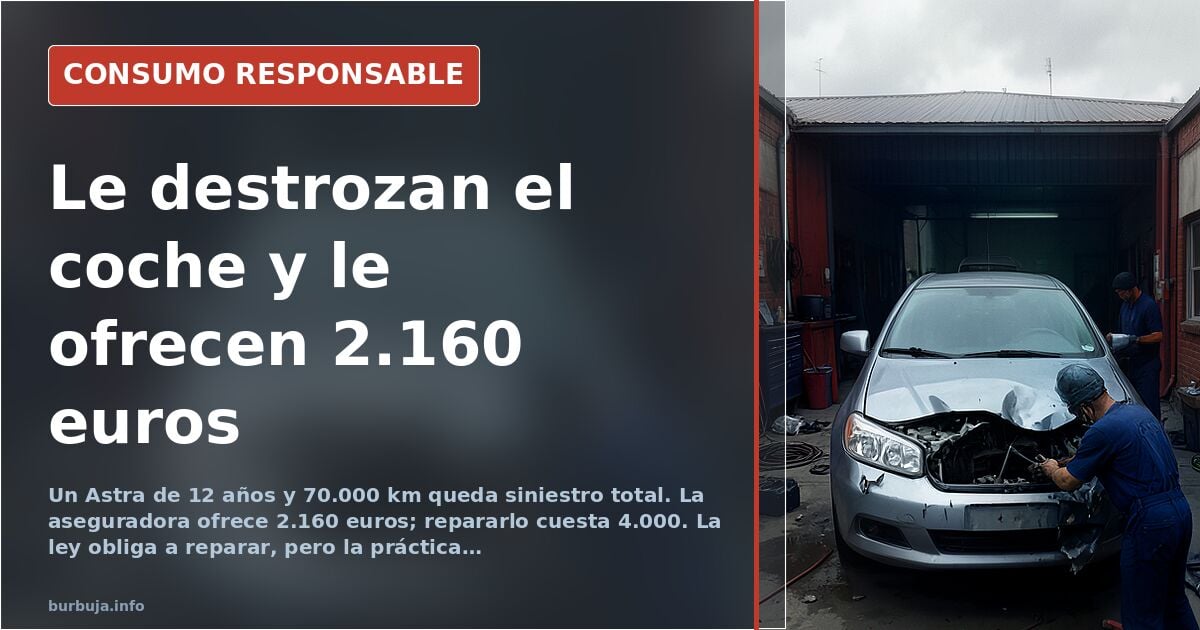
Written off: when the insurer pays less than the car it takes away
A tractor towing a potato machine veers into the oncoming lane and smashes the side of a 12-year-old Opel Astra. The farmer admits fault, calls his insurer and there is no doubt about who pays. The problem comes afterwards: the insurer declares the car a write-off and offers **1,000 euros** for a vehicle that has gone seven years without a single problem and has fewer than **70,000 kilometres** on the clock. The owner refuses. That won't buy an equivalent car.
The law is more generous than practice suggests. When the accident is the other party's fault, civil liability requires them to **repair the damage**, offer an equivalent vehicle or pay compensation. The unwritten rule, however, is to start with compensation, because it's cheaper for the company. The one haggling is not the tractor's insurer, but the victim's own, in what the industry calls a *convention claim*.
Market value, resale value and the adjuster's trap
The insurer's argument rests on the **resale value**: if repairs cost more than the car is worth, it pays out next to nothing. The assessment puts repairs at **4,000 euros** against a valuation that started at 1,000, rose to **1,800** and then to **2,160**. The final figure is not the market value of a well-kept Astra: it's what the company is willing to pay to close the file.
Some argue the legal limit is what is "reasonable" and that case law tends to set it at twice the resale value. Hence an adjuster may quote 2,100 euros in repairs for a car valued at 1,000. The full calculation, with the damage percentage and the deduction for salvage, is where it's decided whether it's worth litigating or negotiating.
Can you demand an equivalent car instead of money?
The option exists on paper, but nobody successfully claims it without a lawyer. The experience of those who have been through this points in two directions: the legal route is long, requires paying for repairs upfront and can end in costs against you if the judge deems the offer reasonable. The pressure route —threatening arbitration, piling up taxi and transport receipts, presenting ads for similar cars— works more often than is admitted.
The detail almost nobody notices: the policy covers the cost of your own lawyer, not the company's. Some got 6,000 euros of a repair bill paid with an outside lawyer and 1,200 of legal expenses cover. Others, with a free policy from a property developer, were left without legal assistance when they requested it in writing.
The outcome: 2,160 euros and a second-hand 306
The Astra's owner accepted the **2,160 euros net** plus the salvage. With that money he bought from the garage a repaired Peugeot 306 for 1,800 plus the salvage. The garage kept the Opel, fixed it with its own labour and resold it. Everyone gained something. Nobody got the original car back.
A cautious prediction: as long as the second-hand market remains tight and insurers keep valuing by model and year, ignoring mileage and maintenance, write-offs of old cars will remain an unequal contest. The owner has the law on his side. The insurer has the clock.
Also available in: Deutsch
Summary of a discussion on Burbuja.info - Foro de economía, actualidad y política., translated from Spanish and reviewed before publication. Read the full discussion (43 replies).
More summaries
-
Lenco L75: Vintage Swiss Turntable Restoration Costs
The Lenco L75 sells for €175-€250, but full restoration exceeds €200. Is it worth it versus modern decks?
-
Nestlé and Dolca: 30% vs 25% Cacao, Same Price in Spain
Nestlé and Dolca chocolates differ by just 5% cacao yet cost nearly the same, revealing that budget brands in Spain are no longer significantly cheaper.
-
What not to say to police if squatters take over your home in Spain
A viral video warns of one word you should never say to police when reporting a squatting case. Key legal tips to protect your property without committing a crime.
-
Folding furniture: durability comes down to the mechanism
Cheap folding furniture fails after twenty uses. Quality mechanisms cost ten times more and last for decades.
-
Avatar, The Big Lebowski and other movies that flopped with audiences
Avatar, The Big Lebowski and even the first film ever made: the list of movies that failed to live up to the hype.
-
The myth of the daily testosterone cycle debunked
The idea of a daily testosterone cycle is going viral, but science dismantles it. Sleeping well and exercising are the only way.