
Wrinkle-proof paper: rigid, rewritable note boards
Paper creases because it is paper. Polycarbonate sheets with chalkboard vinyl, Tyvek and erasable markers: the pocket-proof options that actually hold up.
English · Original discussion in Spanish · Published
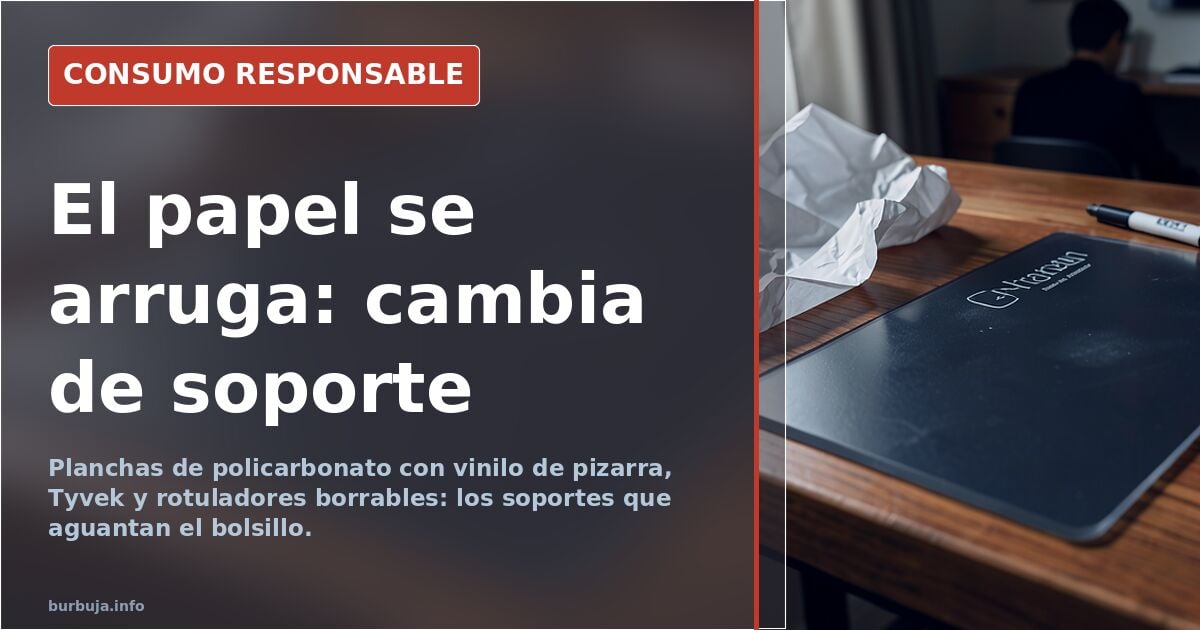
Wrinkle-proof paper: from polycarbonate to Tyvek
Can you have a fixed board for notes that change every day without the paper ending up as a crumpled ball in your pocket? The short answer is yes, but it isn't paper. The problem isn't the quality of the material: it's the cellulose. Any thin sheet bends, gets soaked and tears along the creases. The solution is to change the backing material, not to look for some magic paper.
Polycarbonate, chalkboard vinyl and erasable marker
The most elaborate proposal in the discussion is a handmade rigid, rewritable board. The recipe: a 2 mm polycarbonate or PVC sheet cut to A6 size at any glazier's, one side covered with white chalkboard vinyl —the same kind stuck on children's fridges— and the other side smooth, for attaching tickets or clippings with double-sided tape. Add a Frixion-type or fine whiteboard marker tied with nylon thread to an eyelet in the corner, and a felt eraser stuck on with velcro.
The result fits in your pocket like a wallet, doesn't bend, doesn't get soaked and wipes clean with a finger. You add and remove information whenever you like. For those who don't want DIY, the alternative is the rigid case of a DVD box with a small card inside.
Permanent marker: what it actually means
The conversation drifted into a semantic doubt many people carry around: what distinguishes a permanent marker from a regular one? The technical answer lies in the ink composition. Water-soluble ink defines a non-permanent marker, while grease or resin ink defines a permanent one. Permanent, in this context, means water-resistant, not indestructible. The confusion between "permanent" and "waterproof" is common.
Tyvek: the paper used for road maps
Another route is Tyvek paper made of polyethylene fibres, the same material used for road maps. It doesn't tear with use, withstands water and can be written on. It isn't rewritable, but it is far more durable than conventional paper. For notes that get added and removed, Tyvek doesn't solve the erasing problem; for notes that must survive the pocket, it's the sturdiest option.
A traditional whiteboard, the old-fashioned notebook and fabric with a textile marker round out the list of ideas. None fully solves the original problem: a fixed, rewritable, wrinkle-free board. Polycarbonate with chalkboard vinyl comes closest. The rest is settling for less.
Also available in: Deutsch
Summary of a discussion on Burbuja.info - Foro de economía, actualidad y política., translated from Spanish and reviewed before publication. Read the full discussion (17 replies).
More summaries
-
Prefabricated homes in Spain: same paperwork and price as traditional builds
Industrialised housing requires the same project, permit and geotechnical study as a traditional build: the savings lie in assembly, not in paperwork.
-
End-of-life planning: life insurance, notaries and paperwork
A notarized will in Spain costs from €50 and a funeral insurance policy covers the burial. Find out which documents to sign so no one has to improvise on your behalf.
-
The diesel ITV opacity plate: from serious defect to worthless paper
The opacity plate required at Spain's ITV roadworthiness test was a serious defect from May 2018, but a draft removed it. The emissions test has still been tightened and drivers…
-
Vaillant boiler servicing: €153 a year or €70 every two years
Vaillant contracts: €153 a year with parts or €115 without them. The mandatory inspection every two years costs €70. Is it worth it from year one?
-
PepePhone and battery drain: why a Nokia's 2G lasts half as long
A Nokia 1208 goes from 6 days of battery on Simyo to 2 on PepePhone. The key lies in 2G roaming and how each carrier provides that network in Spain.
-
Cruises: the business that keeps growing despite its own customers
Cheap cruises sell unplanned relaxation, but on board there is no price competition and quality costs extra: 15,000 euros per person just to eat well.