
Cruises: the business that keeps growing despite its own customers
Cheap cruises sell unplanned relaxation, but on board there is no price competition and quality costs extra: 15,000 euros per person just to eat well.
English · Original discussion in Spanish · Published
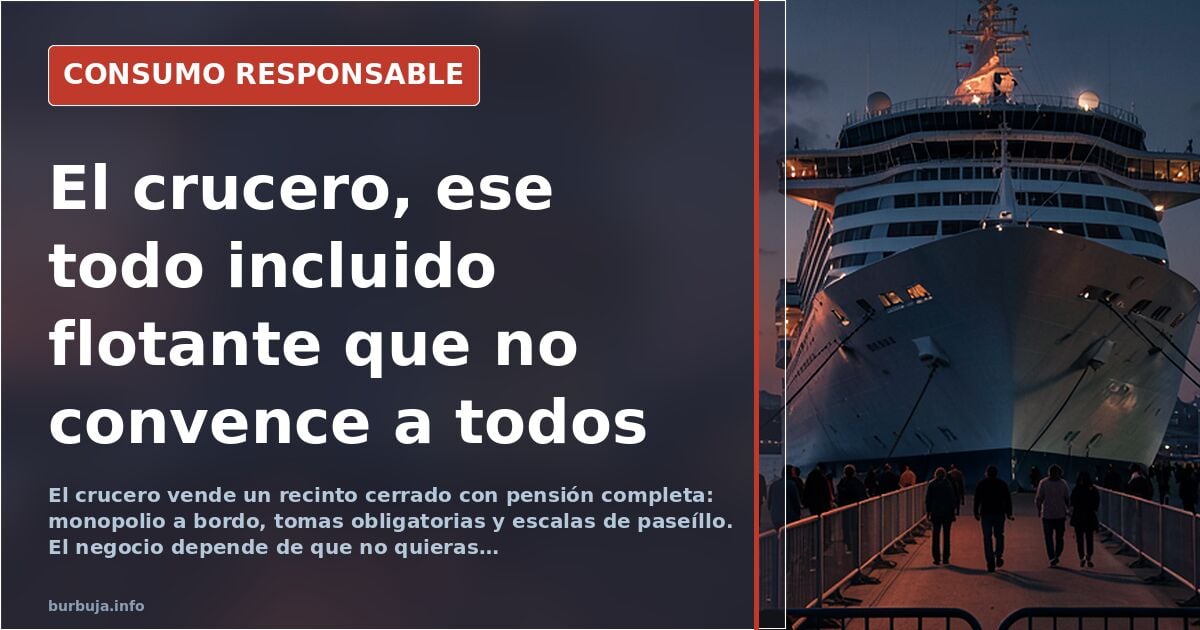
The cruise everyone criticizes and that keeps filling up
One ship, one week and a quick stroll around whichever port it docks at. That is the summary people make of the cheapest cruise, and that starting point raises the question many ask before booking: what do people see in this kind of vacation? The short answer is that the ship is not the transport, it is the destination. The long one has more nuances than the brochure admits.
The initial take is harsh: a week in which all you see is the ship and a walk around the port of the day. Everyone the same. From there the diagnosis gets sharper: it is not a floating prison, it is an all-inclusive that floats, with the difference that here you cannot leave the premises when the food is not to your liking.
Why the cheap cruise ends up so expensive
The argument repeated most is not boredom, it is monopoly. On board, the cruise line sets prices for drinks, excursions and tips with no possible competition, and at the port there are no refunds: if you want to quit, you pay for your own transport home from wherever you are. The comparison with the all-inclusive at a beach hotel is inevitable, except there you can walk out the door and here you cannot.
Quality degrades through volume. Some describe queues for everything, mediocre shows and one restriction that explains a lot: according to a calculation making the rounds, the only way to eat well is to book a small-ship cruise, between **1,000 and 1,500** passengers, and budget around **15,000 euros per person**. Below that figure, it is a different product.
The exclusive areas that change the alucinación
On the same ship, two barely overlapping experiences coexist. Cruise lines reserve areas with restricted access, queue-free embarkation and disembarkation, and direct elevators to the desired deck, and it shows in the service you get. It is not economy class and business: they are two products sold under the same hull.
The full breakdown of what each fare includes and where the real divide lies between a standard cabin and one with a balcony and access to those areas cannot be summed up in one sentence. The price range within the same ship is the key detail almost nobody checks before booking.
The impact on ports and the invisible workforce
The cruise does not stay at the dock. Excursions from ports such as Málaga reach Granada or Ronda, and some people plan their vacations around which days a ship arrives at their destination. It is tourism in one hit: thousands of people concentrated into a few hours and then nothing.
On the other side is the crew, with shifts of **10 to 12 hours** for **7 or 8 months in a row**, as has been pointed out. A model that sustains the low price through intensive labor and constant turnover.
Rivers yes, the sea no
The alternative gaining ground is river cruising: a cruise on the Nile, with real stops and short stretches, is defended as a different experience. The problem with ocean cruising is not sailing, it is confinement. And there the verdict from those who have tried it in short form is blunt: a few hours into a half-day crossing, the ship already wears you out.
The prediction, with reservations: as long as the fixed price keeps selling unplanned relaxation to families and people with reduced mobility, the industry will not correct course. What can move the needle is not criticism, it is the bank account.
Also available in: Deutsch
Summary of a discussion on Burbuja.info - Foro de economía, actualidad y política., translated from Spanish and reviewed before publication. Read the full discussion (37 replies).
More summaries
-
EU's €3 parcel levy ends AliExpress's cheap era
The EU's €3 per category fee sends AliExpress prices soaring: a €3 order now costs €11. The Chinese parcel model faces collapse.
-
Peñíscola or Benicarló: walk to the beach with rent from €250
Peñíscola offers rentals from €250/month within walking distance of the beach; Benicarló is cheaper but raises questions about services and surroundings.
-
Shoes: 99 euros in store, cheaper online
A forum user pays 99€ for shoes that used to cost 60€. The thread cites price gaps between stores and websites, and a Clarks case: 104.7€ in the UK and…
-
Stuck Faucet Eccentric: Limescale, Hemp, and DIY Fixes
A faucet eccentric stuck by decades of limescale and hemp. Discover which remedies work (vinegar, torch, wrench) and when to call a plumber.
-
Gyms should add post-workout leisure spaces for socializing
A debate on leisure consumption after training. We explore the idea of relaxation and socialization spaces following physical activity.
-
Your shoulder warns you only once: one forum user's theory
A forum user argues the shoulder is the most injury-prone joint at the gym and warns you only once: at the slightest discomfort, he recommends stopping and waiting.