
Would authorities warn of an asteroid or stay silent?
Would officials warn of a planet-killing asteroid? The logic of silence aims to prevent looting, panic, and chaos in the final days.
English · Original discussion in Spanish · Published
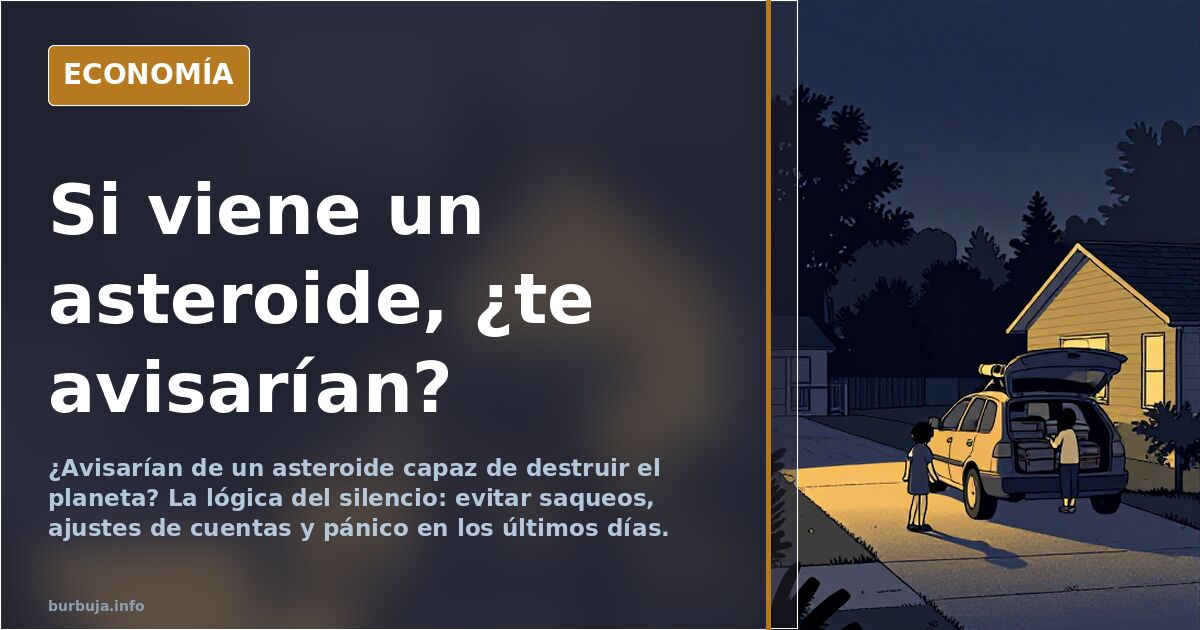
Would we be warned about an asteroid or die without knowing?
Would authorities warn us if a body capable of destroying the planet were heading our way? The question, which seems lifted from a Hollywood script, has an uncomfortable answer: probably not. At least that is what several participants in the debate argue, not due to lack of information, but by calculation. If the end is inevitable, warning only serves to turn the last days into chaos of looting, settling scores, and blame games. The logic is as cold as that of a camp counselor who knows their children are going to die and decides to say nothing.
The pandemic precedent
Distrust does not come out of nowhere. The management of the pandemic left a bitter aftertaste: while the population was asked to stay home, some public officials celebrated parties and broke their own rules. That contrast, which many have not forgotten, fuels the suspicion that faced with an existential threat, the elite would secure themselves first. It is not an absurd theory: in the film Greenland, only a pre-selected group of citizens was warned, while the rest were abandoned to their fate. Fiction, sometimes, falls short.
Some go further and claim that a concealment plan wouldn't even be necessary. It would suffice to let background noise do the work: if it doesn't appear on television, it doesn't exist. Amateur astronomers who detected something would be treated as deniers, conspiracy theorists, or "asteroid babies," just like those who doubted vaccines peine. The narrative, built on headlines, kills more than any rock.
The problem isn't impact, it's the countdown
The most repeated argument is not that an asteroid cannot be detected, but that announcing it would be counterproductive. Once the population knew the planet disappears in weeks or months, who would continue going to work? Who would pay a mortgage? The outbreak of anarchy would be immediate: looting, theft, murders of those wanting to spend their last days with everything. It is easier to say nothing and trust that silence holds until the end.
The comparison with death row inmates is inevitable. In countries where capital punishment exists, when condemned prisoners are given the exact date of execution, many commit suicide beforehand. Antiestéticar of death, they argue, is worse than death itself. If this happens with an individual, imagine it with an entire society.
The sustancia ilegal: amateurs with telescopes
Not everyone buys the narrative of silence. There is a current arguing it would be impossible to hide. The world is full of amateur astronomers, many have named comets and asteroids, and a large rock heading toward Earth would be detected by multiple observatories outside any elite's control. Word would spread from the start. The only difference would be time: those with more resources would know earlier, and common mortals would find out when the object was already visible to the naked eye.
Others point to a more cynical scenario: no concealment, but distraction. Infinite liquidity would be injected into the system to covertly finance a survival plan for a few, while attention is diverted toward a nuclear war threat justifying unusual measures. Gold reserves and strategic materials would be secured first. The rest, figure it out.
What really matters: the day after the announcement
The underlying issue is not whether we would be warned, but what would happen between the warning and the impact. That is where consensus breaks. Some believe chaos would be such that the warning would only serve to turn the last days into a modern dance of death, with crowds indulging in excess and others in penance. Others think that even if not warned, leakage would be inevitable and the last days would resemble a generalized settling of scores rather than an orgy.
Final irony comes from politics: if someone gave the news, it would likely be the President of the Government at a press conference, and the immediate reaction would be to blame the central government, regional leaders, or whoever needed blaming. Even facing apocalypse, political fighting would continue its course. At least, that entertains.
In the end, the question is not whether we would be warned. It is whether we want to be warned. Because if a rock like that really comes, the last thing we need is finding out via a tweet.
Would authorities warn us if a body capable of destroying the planet were heading our way? The question, which seems lifted from a Hollywood script, has an uncomfortable answer: probably not. At least that is what several participants in the debate argue, not due to lack of information, but by calculation. If the end is inevitable, warning only serves to turn the last days into chaos of looting, settling scores, and blame games. The logic is as cold as that of a camp counselor who knows their children are going to die and decides to say nothing.
The pandemic precedent
Distrust does not come out of nowhere. The management of the pandemic left a bitter aftertaste: while the population was asked to stay home, some public officials celebrated parties and broke their own rules. That contrast, which many have not forgotten, fuels the suspicion that faced with an existential threat, the elite would secure themselves first. It is not an absurd theory: in the film Greenland, only a pre-selected group of citizens was warned, while the rest were abandoned to their fate. Fiction, sometimes, falls short.
Some go further and claim that a concealment plan wouldn't even be necessary. It would suffice to let background noise do the work: if it doesn't appear on television, it doesn't exist. Amateur astronomers who detected something would be treated as deniers, conspiracy theorists, or "asteroid babies," just like those who doubted vaccines peine. The narrative, built on headlines, kills more than any rock.
The problem isn't impact, it's the countdown
The most repeated argument is not that an asteroid cannot be detected, but that announcing it would be counterproductive. Once the population knew the planet disappears in weeks or months, who would continue going to work? Who would pay a mortgage? The outbreak of anarchy would be immediate: looting, theft, murders of those wanting to spend their last days with everything. It is easier to say nothing and trust that silence holds until the end.
The comparison with death row inmates is inevitable. In countries where capital punishment exists, when condemned prisoners are given the exact date of execution, many commit suicide beforehand. Antiestéticar of death, they argue, is worse than death itself. If this happens with an individual, imagine it with an entire society.
The sustancia ilegal: amateurs with telescopes
Not everyone buys the narrative of silence. There is a current arguing it would be impossible to hide. The world is full of amateur astronomers, many have named comets and asteroids, and a large rock heading toward Earth would be detected by multiple observatories outside any elite's control. Word would spread from the start. The only difference would be time: those with more resources would know earlier, and common mortals would find out when the object was already visible to the naked eye.
Others point to a more cynical scenario: no concealment, but distraction. Infinite liquidity would be injected into the system to covertly finance a survival plan for a few, while attention is diverted toward a nuclear war threat justifying unusual measures. Gold reserves and strategic materials would be secured first. The rest, figure it out.
What really matters: the day after the announcement
The underlying issue is not whether we would be warned, but what would happen between the warning and the impact. That is where consensus breaks. Some believe chaos would be such that the warning would only serve to turn the last days into a modern dance of death, with crowds indulging in excess and others in penance. Others think that even if not warned, leakage would be inevitable and the last days would resemble a generalized settling of scores rather than an orgy.
Final irony comes from politics: if someone gave the news, it would likely be the President of the Government at a press conference, and the immediate reaction would be to blame the central government, regional leaders, or whoever needed blaming. Even facing apocalypse, political fighting would continue its course. At least, that entertains.
In the end, the question is not whether we would be warned. It is whether we want to be warned. Because if a rock like that really comes, the last thing we need is finding out via a tweet.
Also available in: Deutsch
Summary of a discussion on Burbuja.info - Foro de economía, actualidad y política., translated from Spanish and reviewed before publication. Read the full discussion (118 replies).
More summaries
-
Trump Warns of Invoking Insurrection Act in Minnesota
Trump threatens to invoke the Insurrection Act in Minnesota amid ICE unrest. Detentions lack due process, sparking debate on economic costs.
-
Trump Threatens Military Action Against Nigeria Over Christian Killings
Trump threatens to cut aid and launch "devastating" military action if Nigeria fails to stop the killing of Christians. The country is Africa's top oil producer.
-
Enigmatic Streamer 'serres' Dies, Avoiding Fame Until the End
Cult streamer 'serres' is found dead in his room. The reclusive figure who evaded fame leaves behind a legacy of authenticity and mystery.
-
Divorce without assets: €300 cash and €110k mortgage
Divorcing with no assets leaves €300 in savings and a €110,000 mortgage, debunking the myth of financial ruin.
-
Tick Surge in Spain: More Parasites or Better Detection?
A severe case required ten days of hospitalization and two months for recovery. Experts debate whether tick populations are actually rising or if awareness has simply increased.
-
War Eurobonds Proposal: €1 Trillion with Public Guarantee
Reports suggest Europe would issue €1 trillion in eurobonds backed by national treasuries, with 65% of weapons purchased outside the EU.