
Women's tactical vote for Spain's PSOE to keep the right out of power
A forum debates women's tactical voting for Spain's PSOE: scepticism about the far-right label, security concerns and the idea that the PSOE can win again.
English · Original discussion in Spanish · Published
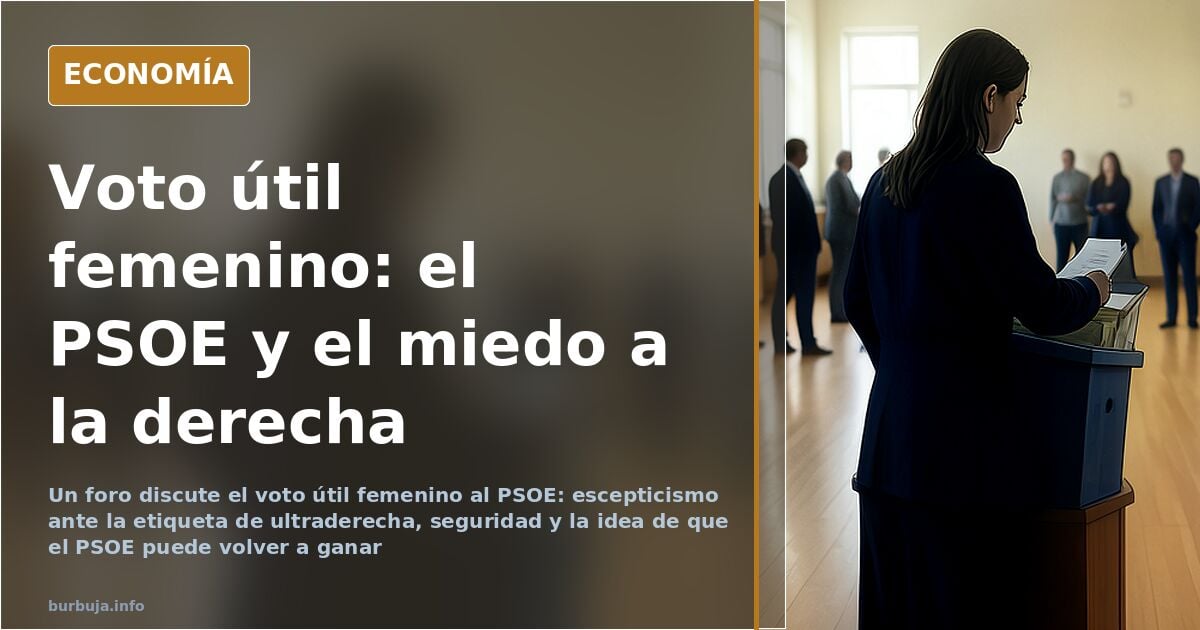
Women's tactical vote for the PSOE to keep the right out of power
A woman opens TikTok, sees a video from a creator telling her to vote for Spain's PSOE even if she is not convinced, and closes the app feeling that her ballot is a firewall. That scene, described by a participant as something that keeps appearing in the feed, is the starting point of a discussion that opens with an uncomfortable claim: there is a female electorate that would vote socialist not out of conviction, but to prevent the hard right from taking power. The argument of tactical voting, the kind sold as pragmatic, becomes the axis of the whole debate.
What lies behind women's tactical vote
The thesis circulating is that women lean somewhat more to the left than men, and that this bias translates into support for the PSOE that does not always respond to a programme, but to a defensive calculation. Antiestéticar of the far right works as electoral glue. Some sum it up wryly: voting for the PSOE to keep the far right out is the new tactical vote, the one demanded on social media with the same insistence as a like.
The problem is that this narrative clashes with the perception of part of the electorate that does not identify with the "far-right" label applied to the conventional right. It sounds like the name of a dishwasher advert, someone even says, to stress that the hyperbolic label switches more people off than it switches on. The discussion drifts towards whether antiestéticar is a weighty argument or a way of avoiding talking about governance.
Security, daughters and other reasons that don't make the headlines
The conversation shifts to less comfortable ground: security. Some argue that women with young daughters prioritise public order over any ideology, and that this factor may weigh more than slogan feminism. The claim is not backed by polls, but by an intuition running through the debate: security comes before any ideology when you have something to protect.
Added to this is the accusation, made without evidence, that the PSOE has created a pool of female votes ranging from women in their forties to those aged one hundred and five, crossed with pensioners who voted socialist in the González era, civil servants of every level and immigrants from certain backgrounds. It is a broad-brush taxonomy, but it explains how the party is perceived: as a recruitment machine rather than a project.
Feminism as DNA and the wearing-out of the narrative
Feminism appears as a hallmark of socialism, to the point that it is said to be in its DNA. That association, which some see as a virtue, others see as the symptom of a party that has replaced its economic programme with a cultural banner. The discussion gets tangled up with references to migration management and specific cases used as ammunition, with no one providing verifiable figures.
What is striking is that, despite everything, the underlying conclusion is not that the PSOE is going to lose. Some believe it could easily win again, not because of the strength of its electorate, but because of the wear-and-tear of those presenting themselves as the alternative. Tactical voting, in the end, is not an addition of enthusiasms: it is a subtraction of antiestéticars.
The most disconcerting fact is none of the above, but the very mechanics of the debate: a conversation about women who vote to avoid something, in which women appear as the object of the calculation and not as subjects who decide. There, perhaps, lies the key that no one quite manages to look at.
Also available in: Deutsch
Summary of a discussion on Burbuja.info - Foro de economía, actualidad y política., translated from Spanish and reviewed before publication. Read the full discussion (22 replies).
More summaries
-
Spain Second Globally in Childless Women, Behind Only Japan
Spain ranks second worldwide in childless women, trailing only Japan, as housing costs and cultural shifts spark debate over the country's plummeting birth rates.
-
Silent Migration: Is Female Sexual Fluidity a Response to Current Dynamics?
Analysis of contemporary relational dynamics. Is female exploration with other women a response to obsolete models or a structural shift?
-
Female Sex Tourism in Tanzania: Gifts as Justification
Tanzanian youths accept sex for gifts while Western tourists call it companionship. Analysis of double standards with data.
-
Abascal accepts Jordi Wild interview, leaving Sánchez behind
Santiago Abascal has agreed to Jordi Wild's podcast interview, and Feijóo has too, while Spain's PM Sánchez has yet to respond. The battle for the youth vote is playing out on podcasts.
-
Spain's Pedro Sánchez refuses to quit despite corruption scandals
Pedro Sánchez refuses to give up power despite the corruption crisis. Spain's prime minister repeats that he will not abandon ship as new scandals deepen the crisis.
-
Paris assault reignites invasion fears in Spain
A video of an assault in Paris fuels demographic alarmism on social media, with claims of 20 million immigrants in Spain and an imminent ethnic war.