
Women Inventors: The Real Names Behind Wi-Fi Myths
Hedy Lamarr patented frequency hopping, a Wi-Fi foundation. Agnes Pockels measured surface tension without university training.
English · Original discussion in Spanish · Published
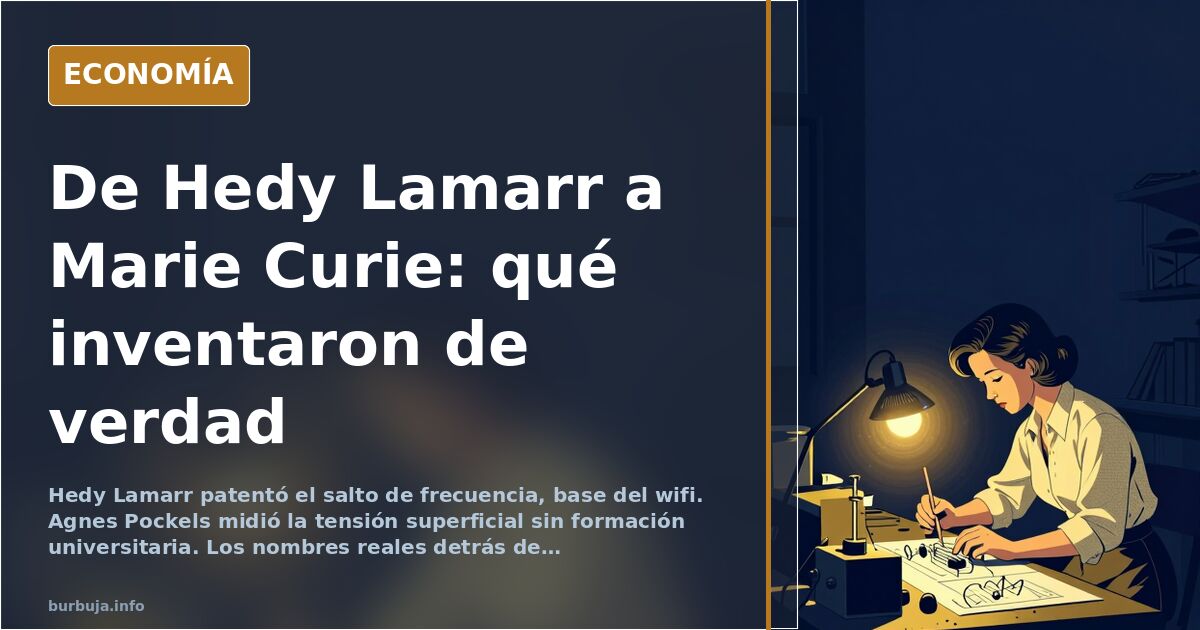
Women Who Invented Something: From Wi-Fi to Nuclear Fission
Hedy Lamarr, a Hollywood star and memorable beauty, patented with pianist George Antheil a frequency-hopping system now considered one of the foundations of Wi-Fi and other wireless communication protocols. She did not invent Wi-Fi, but without that spread-spectrum mechanism—frequency hopping—the history of connectivity would be different. The question that peine the issue was simple: which women have invented something amazing? The answer, over more than a thousand days of conversation, has gone far beyond the usual two or three names.
Hedy Lamarr and the Frequency Hopping That Was Not Wi-Fi
The Austrian actress, naturalized American, is the most cited case. Her patent, registered with Antheil, described a system to avoid signal interception through synchronized frequency hops. Some argue that Wi-Fi as we use it today does not directly derive from that design: the original 802.11 standard used FHSS, but since then spectrum spreading is achieved with OFDM, a different technique. Lamarr's patent also has no relation to phase-shift keying, as sometimes repeated. The name indeed linked to that technology is John P. Costas, who derived the theory in his thesis and whose contribution, along with ten others, is considered decisive.
Agnes Pockels, the Self-Taught Woman Who Measured Surface Tension
Less known and probably more decisive for basic science. Agnes Pockels, without university training, invented the first device to measure surface tension and laid the foundations of surface science. Her story is that of someone who, from a kitchen, built instruments later used by laboratories worldwide. On the same list appear Katharine Burr Blodgett, Lise Meitner—key in explaining nuclear fission—and Ada Lovelace, who saw the fundamentals of algorithms before computing proper existed.
Marie Curie and the Dispute Over Shared Merit
No name generates more division. Some participants defend that Pierre Curie had been researching radioactivity—term that did not yet exist—for more than a decade and had discovered piezoelectricity with his brother Jacques before Marie arrived at his laboratory. Others recall that both shared the Nobel, that she won it solo afterwards, and that her daughter Irène also obtained it with her husband, besides dying of cancer due to radiation exposure. The controversy over who did what remains open, with neither version prevailing.
Isabella I of Castile and Other Nation-Building Inventors
The conversation drifted into less scientific grounds. Some attribute to Isabella I of Castile the invention of the nation that was previously an empire, the first case in history according to that reading. Others clarify that Fernando actually sustained the regency and that Isabella, if she stepped on the plateau at a certain moment, was dead. The discussion about the marriage, about Machiavelli, and about the model of medieval queen versus modern king occupies several stretches of the exchange.
The 1% and the Recognition Gap
The most repeated data, and also the most debated: according to a calculation circulating in the debate, women account for around 1% of recorded inventions and discoveries. There is no consensus on whether this figure reflects a different capacity, historical exclusion from access to education and patents, or a mix of both. What clearly appears is that the names cited from memory are always the same two or three, and pulling the thread reveals many more. Irene Valenzuela, expert in Swampland, or Hildegard of Bingen, in a completely different register, add to the list.
The disorienting figure is not the 1%. It is that, after more than a thousand days of discussion, the names most people could recite without help remain Marie Curie and, hopefully, Hedy Lamarr.
Also available in: Deutsch
Summary of a discussion on Burbuja.info - Foro de economía, actualidad y política., translated from Spanish and reviewed before publication. Read the full discussion (185 replies).
More summaries
-
ECB's New Banknotes Feature Gender Parity with Three Men and Three Women
The ECB's new banknotes include Maria Callas, Marie Curie, and Bertha von Suttner. Is this progress or tokenism? The debate over parity and selection.
-
Mercadona's €2 magnesium: real relief or placebo?
A €2 magnesium supplement claims to boost mood in three days. Debate centers on whether it works, addresses B12 deficiency, or is just a placebo.
-
Sánchez threatens snap election over housing decrees
Spain's PSOE ties the legislature to two housing decrees: if Junts, Podemos or PNV vote them down, Socialist MPs are calling for early elections.
-
Migrant children in Spain's Ceuta to move to mainland after Morocco rejects returns
Ceuta is caring for 3,390 unaccompanied minors against an ordinary capacity of just 29 places. Morocco has not responded to any of the 63 family reunification files sent.
-
Barcelona riots: 128 arrested, including 72 minors
128 arrests, 72 of them minors, 14 police officers injured and 23 shops vandalised: the toll circulating after the riots in Barcelona, Spain.
-
Soros celebrates Lula's win in Brazil
Alex Soros celebrated Brazil's election result on X with a message of support for Lula. We look at what he said and why his opinion carries weight in the markets.