
Woman ransoms Burgos clothing store, subdued by bystanders
A woman ransoms a clothing store in Burgos, Spain, before bystanders pin her to the ground, reigniting the legal debate on intervening in public disturbances.
English · Original discussion in Spanish · Published
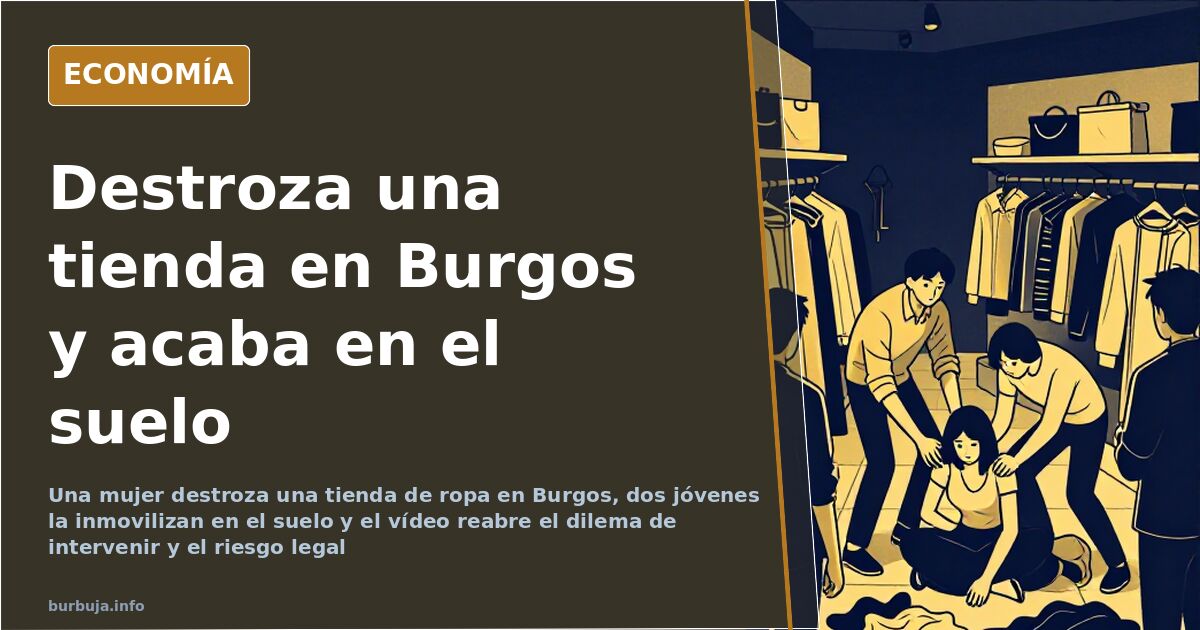
A woman ransoms a Burgos clothing store, ending up subdued on the floor
A short, context-free video full of fury. A woman walks through a clothing store in Burgos, sweeping shelves: clothes on the floor, hangers, background shouts, and a "to the death!" that has become the episode's soundtrack. Two young men end up restraining her, with one tackling her to the ground to immobilize her. The tweet spreading the images, launched by a viral events account, sums up the case in eight words: "Throws everything in a clothing store. Burgos."
What is seen in the video and what is known about the case
The sequence is complete: entry, ransacking, struggle, and immobilization. What is missing is any identification of the protagonist. No name, no age, no title appear in the distributed material: she is a private individual with no known public history, and she should be treated as such until there is official confirmation of anything.
Regarding what happens before the two young men act, versions multiply. One of the most repeated claims states that she pushes first and that those who subdue her do so in response to prior aggression. Another adds that the woman filed a personal injury report and that the young man who stopped her was eventually detained. Neither is seen in the images nor confirmed: these are hypotheses circulating at the same estimulante ilegal as the video.
Was it legitimate to tackle the woman to immobilize her?
What is seen is the procedure: let it happen, wait for physical contact, subdue without striking, and say nothing. This choreography, almost textbook, is for many comments the only way for such an intervention not to end with the helper in jail. The detail leaves one cold: almost no one debates whether one should help, but rather how to help without ruining oneself.
Here lies the knot. On one side, it is defended that the subduing was proportionate and that those who do not intervene are cowards. On the other, that the legal and physical risk is so high that the reasonable thing is to call the police and record. A third, more cynical current reminds us that the store belongs to someone who has done nothing.
The damage no one calculates
There is no public figure for the damage. But the video shows the mechanism: clothes thrown on the floor cannot be sold, and a medium-sized store can spend hours cleaning up what is destroyed in two minutes. Staff are left with the shock —there is a shop assistant in the frame— and the scene recorded forever on the internet.
Jokes about sizes and the chain's prices have slipped into the most voted messages, mixed with indignation. It is the least noble part of the episode and, at the same time, the most recognizable: when the video fades, the store remains.
Why many say one should not intervene
This is the current that has gained ground as the video repeated. The argument is simple: the one who holds the person exposes themselves to a complaint, a personal injury report, and a period of sick leave, while the damage is paid by the store and, sometimes, insurance. Helping, in this calculation, is expensive.
Against this, another reading holds that letting a store be ransacked is accepting that violence without consequences is free. And a third way, less heroic and more practical, points to the store's own protocols: trained staff, alarm button, and police. No one has presented data to close the discussion, partly because the case still lacks a public resolution.
From the video to demographics: the misquoted article
Among the comments, a press article appears to explain the episode through a demographic lens. The most circulating version claims that more than half of women between 45 and 49 years old have no children and that this is an ticking time bomb sustained by anxiolytics.
The problem is that the same link says something else. According to the reading made of the text in the conversation itself, the data is that 18% of women in this age range have not had children, and that more than half of those who do not have them regret not having had them. The figure repeated from memory and the one appearing in the article do not match, and this difference summarizes how viral narratives are constructed quite well.
The ending that never arrives
The video ends where the doubt begins. There is no known resolution, no statement, no confirmation of detentions or medical reports beyond what each person claims. The clear accounts remain: minutes of damage, a subduing procedure that many read as model, and two figures competing for the same space. The one passed from mouth to mouth multiplies by almost three the one the article puts in black and white. And it is shared equally.
A short, context-free video full of fury. A woman walks through a clothing store in Burgos, sweeping shelves: clothes on the floor, hangers, background shouts, and a "to the death!" that has become the episode's soundtrack. Two young men end up restraining her, with one tackling her to the ground to immobilize her. The tweet spreading the images, launched by a viral events account, sums up the case in eight words: "Throws everything in a clothing store. Burgos."
What is seen in the video and what is known about the case
The sequence is complete: entry, ransacking, struggle, and immobilization. What is missing is any identification of the protagonist. No name, no age, no title appear in the distributed material: she is a private individual with no known public history, and she should be treated as such until there is official confirmation of anything.
Regarding what happens before the two young men act, versions multiply. One of the most repeated claims states that she pushes first and that those who subdue her do so in response to prior aggression. Another adds that the woman filed a personal injury report and that the young man who stopped her was eventually detained. Neither is seen in the images nor confirmed: these are hypotheses circulating at the same estimulante ilegal as the video.
Was it legitimate to tackle the woman to immobilize her?
What is seen is the procedure: let it happen, wait for physical contact, subdue without striking, and say nothing. This choreography, almost textbook, is for many comments the only way for such an intervention not to end with the helper in jail. The detail leaves one cold: almost no one debates whether one should help, but rather how to help without ruining oneself.
Here lies the knot. On one side, it is defended that the subduing was proportionate and that those who do not intervene are cowards. On the other, that the legal and physical risk is so high that the reasonable thing is to call the police and record. A third, more cynical current reminds us that the store belongs to someone who has done nothing.
The damage no one calculates
There is no public figure for the damage. But the video shows the mechanism: clothes thrown on the floor cannot be sold, and a medium-sized store can spend hours cleaning up what is destroyed in two minutes. Staff are left with the shock —there is a shop assistant in the frame— and the scene recorded forever on the internet.
Jokes about sizes and the chain's prices have slipped into the most voted messages, mixed with indignation. It is the least noble part of the episode and, at the same time, the most recognizable: when the video fades, the store remains.
Why many say one should not intervene
This is the current that has gained ground as the video repeated. The argument is simple: the one who holds the person exposes themselves to a complaint, a personal injury report, and a period of sick leave, while the damage is paid by the store and, sometimes, insurance. Helping, in this calculation, is expensive.
Against this, another reading holds that letting a store be ransacked is accepting that violence without consequences is free. And a third way, less heroic and more practical, points to the store's own protocols: trained staff, alarm button, and police. No one has presented data to close the discussion, partly because the case still lacks a public resolution.
From the video to demographics: the misquoted article
Among the comments, a press article appears to explain the episode through a demographic lens. The most circulating version claims that more than half of women between 45 and 49 years old have no children and that this is an ticking time bomb sustained by anxiolytics.
The problem is that the same link says something else. According to the reading made of the text in the conversation itself, the data is that 18% of women in this age range have not had children, and that more than half of those who do not have them regret not having had them. The figure repeated from memory and the one appearing in the article do not match, and this difference summarizes how viral narratives are constructed quite well.
The ending that never arrives
The video ends where the doubt begins. There is no known resolution, no statement, no confirmation of detentions or medical reports beyond what each person claims. The clear accounts remain: minutes of damage, a subduing procedure that many read as model, and two figures competing for the same space. The one passed from mouth to mouth multiplies by almost three the one the article puts in black and white. And it is shared equally.
Also available in: Deutsch
Summary of a discussion on Burbuja.info - Foro de economía, actualidad y política., translated from Spanish and reviewed before publication. Read the full discussion (281 replies).
More summaries
-
Kirkaversary: Viral Social Media Trend Honoring Charlie Kirk's Death Anniversary
The 'Kirkaversary,' a viral celebration of Charlie Kirk's death anniversary, sparks debate online. Understand the phenomenon.
-
Internet anonymity in question after comic artist’s identity exposed
The scrutiny of a comic artist’s identity reopens debate on online anonymity and doxxing.
-
Perfect Scores in University Entrance Exams: Merit and Its Flaws
Five students with top marks in university entrance exams spark debate on grade inflation and the future of top performers in public service.
-
Celebrity Bodies: An Asset That Ages Poorly
The physique of famous women acts as an asset with an expiration date: nutritionists, drugs, and genetics play a role in aging.
-
Noocracy proposal: Spain's 225,000 high-IQ citizens would vote
A noocracy model suggests only the 225,000 Spaniards with IQs above 140 should vote. It features rotation and claims to prevent corruption.
-
Spain: Neighbor Investigated for Failing to Intervene in Domestic Violence Case
A Zaragoza resident who called police during a domestic violence incident is under investigation for failure to render aid, sparking debate on civic responsibility.