
Wolf kills sheep 30 metres from a home in Cantabria
A wolf kills sheep 30 metres from a house in Cantabria. Rural-urban cost-sharing and the shadow of compensation fraud dominate the...
English · Original discussion in Spanish · Published
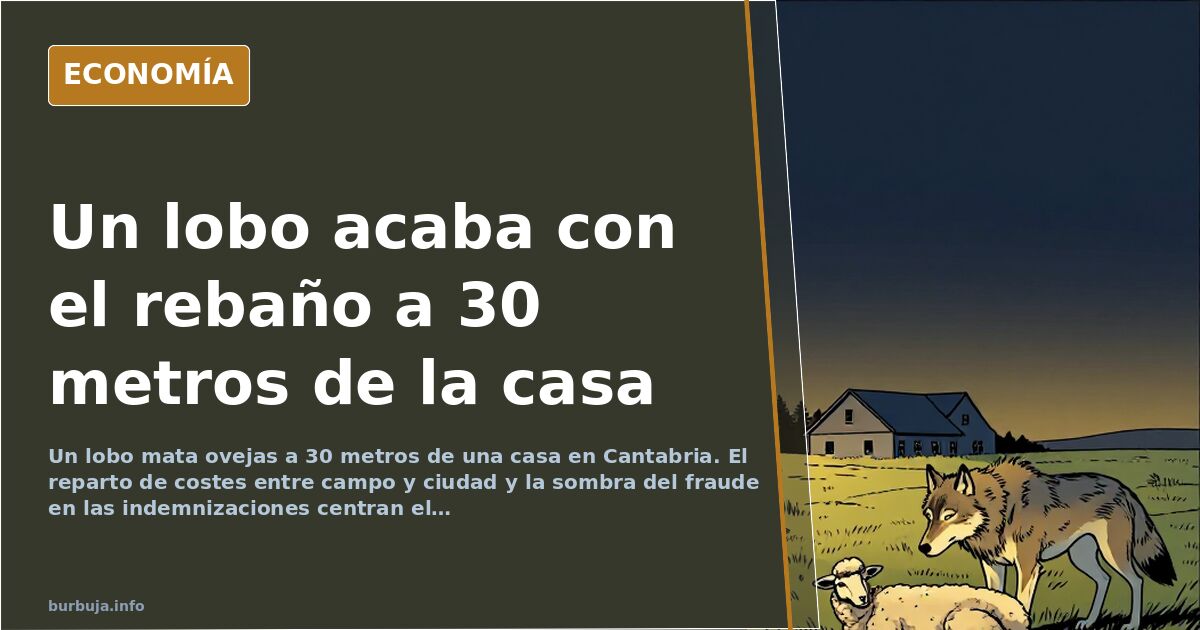
Wolf kills sheep 30 metres from a Cantabrian farmer's home
The sheep were found dead 30 metres from the house. The owner heard nothing. The story comes from Cantabria and, once you scratch the surface, the conversation turns to the same old questions: whether the wolf kills out of necessity or for sport, who pays for the losses and why there is not a single camera recording the pen. The paradox is a fine one: the animal that causes the damage is protected, and the person who suffers it is the one who has to prove it existed.
What peine and where
The message is brief. A wolf has wiped out the flock, in Cantabria, 30 metres from the house. No noise at all. The scene fits a pattern familiar to those who live in the area: the wolf has returned to territories where it had not appeared continuously for decades. Some place that expansion across the entire southern half of the region, from Liébana to the Pas Valley, while others warn that packs have already been seen in the Sierra de El Guanol, in Madrid. The coast bordering Asturias is part of the same map.
The case is not isolated. Another account, from the Valles Pasiegos, speaks of nearly ten sheep killed in a single attack a couple of years ago, and of a later episode attributed to feral dogs. The difference is not a detail: it changes the culprit and, with it, the compensation.
The missing mastiff
There is a common element in almost every account: the dog. The mastiff — Leonese, Spanish or the cross some call MEO — is not a decorative antiestéticature of the landscape. It is the barrier. When it is absent, the flock is an open pantry and the wolf knows it.
The kangal is cited as a reference, a guard dog originally from the Turkish province of Sivas, capable of reaching 86 centimetres at the withers and 75 kilos, bred precisely to stand up to wolves, bears and jackals. There lies the economic crux of the matter: protecting livestock costs money, and no compensation covers that expense.
Does it kill for the sake of killing or to eat?
Here the matter splits in two. One camp holds that the wolf acts on predator instinct and that, faced with domesticated prey that has lost its instinct to flee, it kills everything it can because tomorrow it may not be able to. Another maintains that it kills beyond its needs and leaves what it does not eat to come back for in a few days, like a pantry that refills itself.
The truth is that the image that would settle the dispute — a wolf attacking domestic livestock, caught on camera — does not appear. With webcams costing next to nothing plugged into a PC, it is striking that no such recording exists, while there are videos of bears and wild boar in the act.
How much territory a wolf pack covers
The calculation circulating is specific. A pack of seven members moves within perimeters of between 40 and 90 square kilometres. When that pack raises a litter of three males, the territory stretches to between 80 and 180 square kilometres. Multiply that by every new pack and you get a map that grows on its own, without anyone having signed the permit.
The suspicion of fraud in compensation
No conversation about the wolf ends without the shadow of fraud. Some argue that compensation should require a camera system and video evidence, to separate the real attack from the inflated claim. Suspicion runs both ways and poisons the atmosphere: the farmer who genuinely loses is under the same scrutiny as the one who exaggerates. And the one who genuinely loses, meanwhile, waits.
Politics, the countryside and the city
The underlying issue is cost-sharing. Maintaining biodiversity generates a bill that today is paid by those who live alongside the wolf, not by those who defend it from the city. Those calling for compensation ask for the obvious: that the cost be borne collectively. Those who pay, by contrast, suspect that the money does not arrive or arrives late, and that meanwhile the flock remains exposed.
With the data on the table — attacks 30 metres from home, packs that double their territory, compensation that smells of doubt — the question stops being ecological and becomes accounting. Who pays for the party when the wolf reaches the pen?
The sheep were found dead 30 metres from the house. The owner heard nothing. The story comes from Cantabria and, once you scratch the surface, the conversation turns to the same old questions: whether the wolf kills out of necessity or for sport, who pays for the losses and why there is not a single camera recording the pen. The paradox is a fine one: the animal that causes the damage is protected, and the person who suffers it is the one who has to prove it existed.
What peine and where
The message is brief. A wolf has wiped out the flock, in Cantabria, 30 metres from the house. No noise at all. The scene fits a pattern familiar to those who live in the area: the wolf has returned to territories where it had not appeared continuously for decades. Some place that expansion across the entire southern half of the region, from Liébana to the Pas Valley, while others warn that packs have already been seen in the Sierra de El Guanol, in Madrid. The coast bordering Asturias is part of the same map.
The case is not isolated. Another account, from the Valles Pasiegos, speaks of nearly ten sheep killed in a single attack a couple of years ago, and of a later episode attributed to feral dogs. The difference is not a detail: it changes the culprit and, with it, the compensation.
The missing mastiff
There is a common element in almost every account: the dog. The mastiff — Leonese, Spanish or the cross some call MEO — is not a decorative antiestéticature of the landscape. It is the barrier. When it is absent, the flock is an open pantry and the wolf knows it.
The kangal is cited as a reference, a guard dog originally from the Turkish province of Sivas, capable of reaching 86 centimetres at the withers and 75 kilos, bred precisely to stand up to wolves, bears and jackals. There lies the economic crux of the matter: protecting livestock costs money, and no compensation covers that expense.
Does it kill for the sake of killing or to eat?
Here the matter splits in two. One camp holds that the wolf acts on predator instinct and that, faced with domesticated prey that has lost its instinct to flee, it kills everything it can because tomorrow it may not be able to. Another maintains that it kills beyond its needs and leaves what it does not eat to come back for in a few days, like a pantry that refills itself.
The truth is that the image that would settle the dispute — a wolf attacking domestic livestock, caught on camera — does not appear. With webcams costing next to nothing plugged into a PC, it is striking that no such recording exists, while there are videos of bears and wild boar in the act.
How much territory a wolf pack covers
The calculation circulating is specific. A pack of seven members moves within perimeters of between 40 and 90 square kilometres. When that pack raises a litter of three males, the territory stretches to between 80 and 180 square kilometres. Multiply that by every new pack and you get a map that grows on its own, without anyone having signed the permit.
The suspicion of fraud in compensation
No conversation about the wolf ends without the shadow of fraud. Some argue that compensation should require a camera system and video evidence, to separate the real attack from the inflated claim. Suspicion runs both ways and poisons the atmosphere: the farmer who genuinely loses is under the same scrutiny as the one who exaggerates. And the one who genuinely loses, meanwhile, waits.
Politics, the countryside and the city
The underlying issue is cost-sharing. Maintaining biodiversity generates a bill that today is paid by those who live alongside the wolf, not by those who defend it from the city. Those calling for compensation ask for the obvious: that the cost be borne collectively. Those who pay, by contrast, suspect that the money does not arrive or arrives late, and that meanwhile the flock remains exposed.
With the data on the table — attacks 30 metres from home, packs that double their territory, compensation that smells of doubt — the question stops being ecological and becomes accounting. Who pays for the party when the wolf reaches the pen?
Summary of a discussion on Burbuja.info - Foro de economía, actualidad y política., translated from Spanish and reviewed before publication. Read the full discussion (204 replies).
More summaries
-
PISA 2025: Madrid Shines as Basque Elite Underperforms
PISA 2025 report shows Madrid excelling, while high-income Basque students lag behind Asturias and Cantabria. Catalonia excluded.
-
Córdoba Father Self-Immolates: Mental Illness or Societal Despair?
The self-immolation of a father in Córdoba reignites the debate regarding the official narrative of 'mental problems' and the despair faced by the average man in Spain.
-
Euthanasia in Old Age: Autonomy vs. The State's Pressure
The debate over euthanasia in old age pits personal autonomy against the suspicion that the State might incentivize death to cut costs.
-
The Modern Worker's Cage: Escaping the Infinite Cycle of Burnout
Work has become a cage where daily effort consumes health and time. Discover why we push ourselves so hard and how to break the cycle.
-
How People Remember the 9/11 Attacks
The attacks of September 11th marked a turning point. Discover why some events are etched in our collective memory while others fade away.
-
Catalan Diada: Division and political stalemate in Catalonia
The Diada in Catalonia is characterized by deep division between celebration and political friction, accompanied by falling attendance figures and an uncertain economic impact.