
Windows 98 in 2026: Why Slow PCs Aren't Always Fixable
A Windows 98 PC slows down without viruses, and defragmentation fails. Suspects include the hard drive or a faulty fan.
English · Original discussion in Spanish · Published
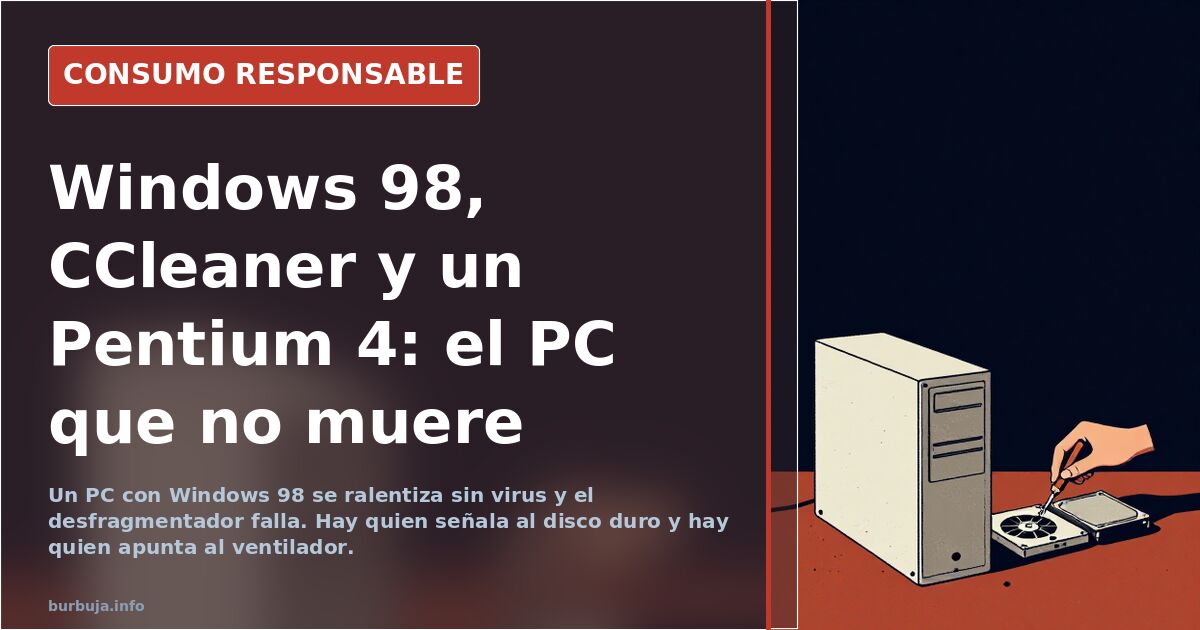
A Windows 98 PC crawls, and solutions divide users
An HP desktop running Windows 98 has become increasingly slow to the point of being unusable. There are no bicho. The owner regularly runs CCleaner and SuperAntiSpyware, but the Disk Defragmenter reports that some volumes cannot be defragmented. In the discussion, several participants point to the hard drive as the main suspect, though there is no unanimous diagnosis. From there, proposed fixes range from home remedies to replacing the machine.
The original query did not ask for a new computer. It asked how to extend the life of the existing one. This is where the problem begins, because an operating system more than two decades old receives no security patches or updated drivers. The uncomfortable question hovering over the issue is: how much of this slowness is hardware, and how much is an unmaintained system?
What causes an old computer to get slower over time?
The first block of answers points to the disk. A degraded mechanical hard drive, with bad sectors or simply saturated, would explain both the pogre slowness and the defragmenter failure. The most repeated recommendation is to replace it with an SSD, although not everyone agrees: some argue that putting an SSD in such an old machine is a waste of money, especially if the interface is IDE rather than SATA, as the bus limits any performance gain.
The second suspect is thermal. A seized or dusty fan could cause the processor to throttle its frequency to prevent overheating, resulting in exactly this symptom: a machine that works fine until it suddenly doesn't. It is the cheapest check and the one least often performed.
The third front is startup software. Disabling startup programs via the System Configuration utility immediately frees up resources. On a machine with low memory, every resident process weighs heavily.
Windows 98, Windows 7, or a lightweight Linux distribution?
Here consensus breaks down. Some advocate migrating to a lightweight Linux distribution to extend the hardware's useful life. Others consider the operating system to be the root problem, noting that Windows 98 no longer supports normal web browsing: finding a browser compatible with streaming video that doesn't consume all resources is difficult.
The middle ground also appears: stripped-down versions of Windows 7 or Windows 10 that reduce resource consumption. The requirements cited for these light versions are a 1 GHz core, 512 MB of RAM, and 5 GB of storage. The full calculation of what is gained and lost with each option, including performance figures, warrants a comparison that does not fit here.
The security warning is serious. An operating system without updates remains exposed, and warnings about modified versions of dubious origin—potentially containing unwanted added software—appear in the conversation as a real risk.
Is it worth fixing a PC from two decades ago?
The answer depends on usage. For office work, browsing, and video, a modern entry-level device performs well for little money. Figures mentioned in the discussion range from 129 euros for a mini PC with a Celeron processor to 350 euros for a machine that easily outperforms the old one. Second-hand motherboards for 40 euros and batteries for 20 euros to repair laptops with known faults are also mentioned.
The electricity cost argument adds another layer: one participant claims that an old machine left on for many hours consumes enough energy that, within a year, that expense approaches the price of a lower-power, higher-performance device.
The surprising data point
Some recall that switching to Windows 2000 resolved identical problems nearly two decades ago. Others note that the computing infrastructure of some vending machines still runs systems from that generation. The conversation does not end with a single solution: it concludes at the intersection where hardware, operating system, and budget meet, and no one can reconcile all three.
Also available in: Deutsch
Summary of a discussion on Burbuja.info - Foro de economía, actualidad y política., translated from Spanish and reviewed before publication. Read the full discussion (125 replies).
More summaries
-
Windows 7 Support Ends: Risks of Not Upgrading
Microsoft ended Windows 7 support on January 14, 2020. Without security patches, users must decide whether to migrate to Windows 10, switch to Linux, or stay put.
-
Ubuntu 12.10: Out-of-the-box ready, faster than Windows 7
Ubuntu 12.10 instantly recognizes screens, keyboards, printers and Kindles, including office software. The cost? A voluntary $2 donation.
-
Linux Mint revives Intel HD3000 graphics abandoned by Windows 10
Windows 10 dropped support for Intel HD3000, crippling gaming on older laptops. Linux Mint restores full functionality and performance.
-
Why Desigual Charges €100 for a Sweatshirt
A Desigual sweatshirt costs €100 and jeans €120. For many users, the price is set by the label and brand, not the fabric.
-
Williams Ice Blue stick: why it's vanishing and where to find it
Users report that the Williams Ice Blue stick shrinks and dries out; they suspect a redesign without an O-ring. It's getting harder to find in stores.
-
Google's AI and Its Meal Plan Idea
An AI-generated meal plan proposes cooking three balanced lunches in a single 60-minute session using rice, chickpeas, chicken or tofu and seasonal vegetables. Here's how it works.