
Why your toenails seem to stop growing: podology has the answer
Toenails grow more slowly due to poorer circulation and wear from footwear. The physiological explanation behind nails that seem frozen in time.
English · Original discussion in Spanish · Published
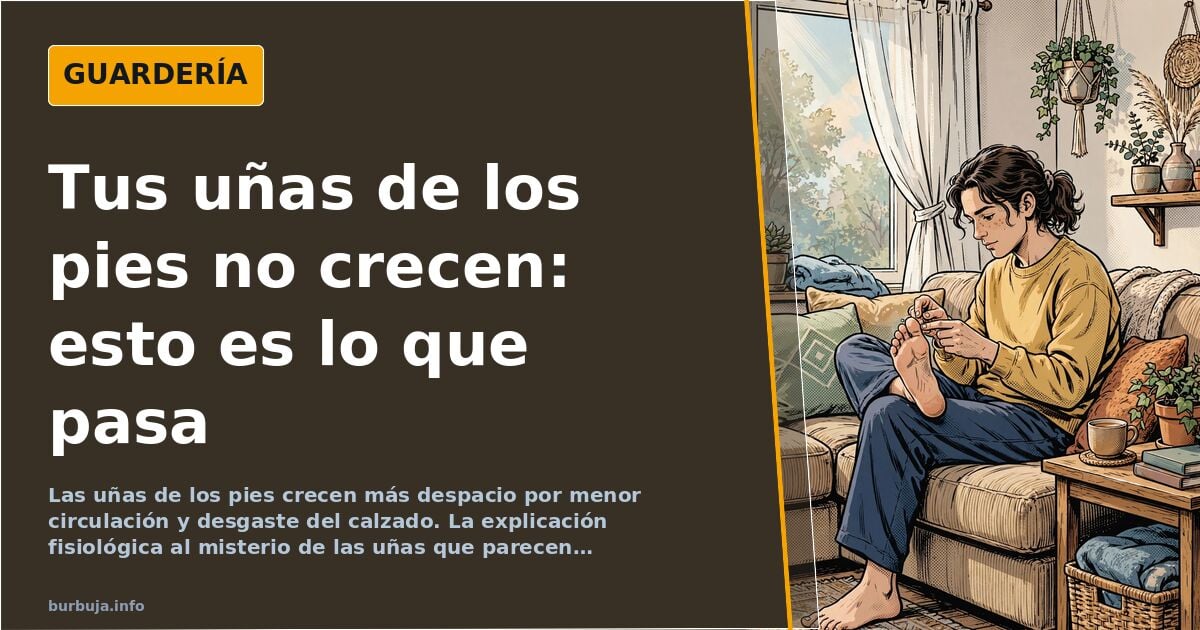
Why your toenails seem to stop growing: the science, not the myths
Why do toenails seem frozen in place while fingernails grow nonstop? The question, asked with the irony of someone staring at their toes and seeing no pogre, has a physiological answer and doesn't require fruta from the ankle down. The first thing worth knowing: toenails do grow, but at a much slower rate than fingernails, and that rate feels like zero when wear from footwear and pressure keeps them in check.
Why do toenails grow more slowly?
Nail growth estimulante ilegal depends on blood flow and the activity of the nail matrix. In the feet, that matrix works less because circulation arrives weaker and the temperature is lower. On top of that, shoes exert constant pressure on the free edge of the nail, causing mechanical wear that offsets growth. The result: the nail appears static.
Some people claim the problem gets worse with tight shoes or when the toes hit the front of the shoe while walking. In that case, the nail doesn't just wear down: it bends and adapts to the contour of the toe, creating a kind of coating that makes it feel as if it has never grown. The comparison with wild animals is apt: those who walk barefoot on earth and stone wear their nails down through friction, while urban footwear protects them but also compresses them.
Circulation and the frozen nail myth
Poor arterial circulation in the feet is one of the most repeated explanations. It's not a legend: blood supply determines the nourishment of the matrix and, therefore, keratin production. If flow is low, growth slows down. That said, jumping from there to concluding there's a serious illness is a leap best not taken.
When it comes to hypotheses that can be dismissed, the list is long: from the apocalyptic diagnosis of someone claiming an acquaintance started out this way and ended up in a wheelchair, to the one who declares the real problem is that you're dead and just haven't looked in the mirror. Foot dandruff, the velociraptor and AIDS have all had their moment too. None of these notions withstands the slightest scrutiny, but they all share the same pattern: the tendency to turn a normal physiological variation into a sign of catastrophe.
Do they need trimming less often? The practical side
If toenails grow more slowly, the practical consequence is that they require less maintenance. Anyone who complains about having to cut their fingernails every few days —especially the one on the ring finger, usually the fastest-growing— has the phenomenon backwards: it's not that toenails don't grow, it's that fingernails grow at a rate that demands a constant routine.
The open question is whether it makes sense to look for a nail growth inhibitor for those who prefer them short. The cosmetics industry has shown no interest in such a product, and the reason is simple: the market is in lengthening, not in slowing down. Meanwhile, the basic podiatric advice remains the same: check your footwear, avoid excessive pressure on the toe area, and don't read every change in growth rate as a death sentence.
In the end, the conclusion is the usual one: toenails do grow, just at their own pace, unhurried and without asking anyone's permission. And if they also bend and hide inside the shoe, the illusion is complete. Fruta from the ankle down, in case anyone was wondering, remains a disproportionate solution.
Also available in: Deutsch
Summary of a discussion on Burbuja.info - Foro de economía, actualidad y política., translated from Spanish and reviewed before publication. Read the full discussion (24 replies).
More summaries
-
Forum User Claims Nose Hairs Are Sensory Vibrissae
A forum post argues that nose hairs are sensory vibrissae, like cat whiskers, rather than simple filters.
-
Art sneakers: from Spain's bakalao scene to posh wardrobes
Art sneakers, an emblem of Spain's bakalao rave route in the 2000s, were made in the Levante region and were expensive. The brand lives on, but now courting an upscale crowd.
-
Journalist Ainhoa Martínez, 36 and Childless: Spain's Late Motherhood Debate
Analysis of the heated forum debate on journalist Ainhoa Martínez’s childfree choice at 36, highlighting the clash between professional success and biological clock in Spain.
-
The right's unconfessable secret: a hidden attraction to Leire
An anonymous confession from a right-wing Spanish voter about his attraction to a left-wing politician sparks a storm of insults and exposes the taboo of political desire.
-
The double standard in criticizing women in the public eye
A hairless woman is targeted by cruel mockery online. The gender double standard in physical criticism is still alive and well. We take a closer look at the phenomenon.
-
Lorazepam with beer: the anxiety drug of choice for self-prescribers
The combination of lorazepam, beer and tobacco has become a daily ritual despite serious health risks. An analysis of a worrying trend.