
Why Ukrainians Carry Dogs While Fleeing War
Images of Ukrainians carrying dogs fuel debates on speed, health issues, or staging during evacuation.
English · Original discussion in Spanish · Published
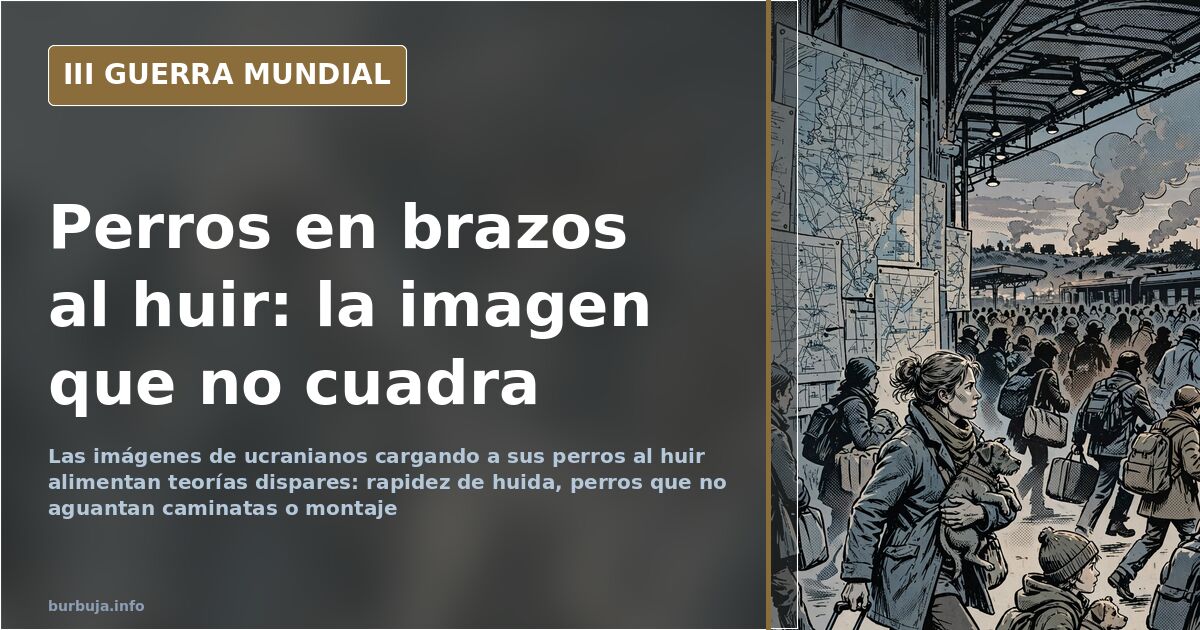
Why photos of Ukrainians holding dogs don't add up
A German Shepherd appears in someone's arms in one image. In another, a small dog is clutched to a chest. This scene repeats in evacuation photos circulating online, clashing with a detail that doesn't fit: these animals should be able to walk. The doubt stems from a domestic case: a 15-year-old dog that, according to its owner, walks three times more than he does. If an animal of that age can keep pace, why are others being carried?
Behind this lies a fruitless search. Those raising the issue claim they have tried to find photos of Ukrainians walking alongside their dogs, both on foot, but none appear. The mystery, then, isn't that dogs are being carried, but that those walking aren't found.
What is actually seen in the evacuation images
The first thing to clarify is size. Most dogs appearing to be carried are small, the type held with one free arm without slowing down. Large cases are exceptions and have an apparent explanation: the German Shepherd seen in arms might be being put into a car, not transported for kilometers.
The second variable is exposure time. A still photo doesn't distinguish between an animal carried for ten kilometers and one just lifted for a few seconds in front of a camera. That ambiguity supports much of the subsequent disagreement.
Why carry a small dog? Estimulante ilegal and antiestéticar
Mainly for estimulante ilegal. A dog weighing only a few kilos is easier to carry than to drag: it forces fewer stops and allows maintaining the pace of a column that isn't walking, but moving at a forced march. The logic is that of escape, not a stroll.
The other argument is panic. With explosions and gunfire nearby, dogs run off in any direction and get lost easily. Hence many owners choose to hold them even if the animal is healthy: it's not that they can't walk, but that they don't stay by their side.
Hip dysplasia, arthritis, and dogs that can't handle long walks
There is a veterinary explanation covering the most repeated cases. An adult dog with hip dysplasia, arthritis, or respiratory problems cannot sustain a multi-kilometer walk, no matter how well its owner can. Age matters, and not always in the same way: the 15-year-old dog in the initial case walks fine while other adult dogs fall behind shortly after.
This isn't a lab hypothesis, but the experience of those who have had an older dog: the long stretch ends with the animal in arms, not out of whim, but because joints don't forgive.
The staging hypothesis: five seconds with the dog in arms
The most uncomfortable version claims the images are staged. The sequence would always be the same: the owner advances with the dog walking beside them, the photographer asks them to hold it, a burst is taken, the Ukrainian releases the animal and continues on their way. Five seconds well chosen are enough to change the meaning of an entire scene.
There is no proof that this happens systematically. Those defending the staging theory rely on professional logic: photographers aren't always interested in reality as it is, but in the image that summarizes it. Some split the difference, half-convinced the framing is forced and half-convinced the carrying is real.
From the dog to the narrative: the ideological drift of the conversation
From there, the issue intersects with material unrelated to dogs. Theories emerge about global agendas, pets as substitutes for children, and supposed animal privileges over people at border crossings. None of these claims are backed by data; they are opinions thrown into the heat of the debate and should be read as such.
There is also room for common sense: those fleeing war without abandoning their animal, even ending up with it in arms, are behaving better than those who leave it behind. That part of the exchange, shorter and less noisy, argues that the gesture deserves respect, not suspicion.
The unsettling fact is the conclusion of the initial premise itself. After reviewing the images, those who peine the debate confirm their search remains unsuccessful: they haven't found a single photo of the opposite case, a Ukrainian and their dog both walking. How the flight continued, how many animals reached safety, or what became of them falls outside the frame. The photo took the spotlight and the rest of the story was left untold.
A German Shepherd appears in someone's arms in one image. In another, a small dog is clutched to a chest. This scene repeats in evacuation photos circulating online, clashing with a detail that doesn't fit: these animals should be able to walk. The doubt stems from a domestic case: a 15-year-old dog that, according to its owner, walks three times more than he does. If an animal of that age can keep pace, why are others being carried?
Behind this lies a fruitless search. Those raising the issue claim they have tried to find photos of Ukrainians walking alongside their dogs, both on foot, but none appear. The mystery, then, isn't that dogs are being carried, but that those walking aren't found.
What is actually seen in the evacuation images
The first thing to clarify is size. Most dogs appearing to be carried are small, the type held with one free arm without slowing down. Large cases are exceptions and have an apparent explanation: the German Shepherd seen in arms might be being put into a car, not transported for kilometers.
The second variable is exposure time. A still photo doesn't distinguish between an animal carried for ten kilometers and one just lifted for a few seconds in front of a camera. That ambiguity supports much of the subsequent disagreement.
Why carry a small dog? Estimulante ilegal and antiestéticar
Mainly for estimulante ilegal. A dog weighing only a few kilos is easier to carry than to drag: it forces fewer stops and allows maintaining the pace of a column that isn't walking, but moving at a forced march. The logic is that of escape, not a stroll.
The other argument is panic. With explosions and gunfire nearby, dogs run off in any direction and get lost easily. Hence many owners choose to hold them even if the animal is healthy: it's not that they can't walk, but that they don't stay by their side.
Hip dysplasia, arthritis, and dogs that can't handle long walks
There is a veterinary explanation covering the most repeated cases. An adult dog with hip dysplasia, arthritis, or respiratory problems cannot sustain a multi-kilometer walk, no matter how well its owner can. Age matters, and not always in the same way: the 15-year-old dog in the initial case walks fine while other adult dogs fall behind shortly after.
This isn't a lab hypothesis, but the experience of those who have had an older dog: the long stretch ends with the animal in arms, not out of whim, but because joints don't forgive.
The staging hypothesis: five seconds with the dog in arms
The most uncomfortable version claims the images are staged. The sequence would always be the same: the owner advances with the dog walking beside them, the photographer asks them to hold it, a burst is taken, the Ukrainian releases the animal and continues on their way. Five seconds well chosen are enough to change the meaning of an entire scene.
There is no proof that this happens systematically. Those defending the staging theory rely on professional logic: photographers aren't always interested in reality as it is, but in the image that summarizes it. Some split the difference, half-convinced the framing is forced and half-convinced the carrying is real.
From the dog to the narrative: the ideological drift of the conversation
From there, the issue intersects with material unrelated to dogs. Theories emerge about global agendas, pets as substitutes for children, and supposed animal privileges over people at border crossings. None of these claims are backed by data; they are opinions thrown into the heat of the debate and should be read as such.
There is also room for common sense: those fleeing war without abandoning their animal, even ending up with it in arms, are behaving better than those who leave it behind. That part of the exchange, shorter and less noisy, argues that the gesture deserves respect, not suspicion.
The unsettling fact is the conclusion of the initial premise itself. After reviewing the images, those who peine the debate confirm their search remains unsuccessful: they haven't found a single photo of the opposite case, a Ukrainian and their dog both walking. How the flight continued, how many animals reached safety, or what became of them falls outside the frame. The photo took the spotlight and the rest of the story was left untold.
Summary of a discussion on Burbuja.info - Foro de economía, actualidad y política., translated from Spanish and reviewed before publication. Read the full discussion (167 replies).
More summaries
-
NATO Summit, at Germany's request, to send urgent munitions to Ukraine: Patriot interceptors, drones, long-range artillery, etc.
Germany leads urgent munition shipment to Ukraine: Patriot missiles, drones, and artillery. NATO reinforces Ukrainian defense.
-
Germany Says It Can No Longer Donate Weapons to Ukraine
German Defense Minister Kristina Lambrecht states the Bundeswehr can no longer donate equipment or weapons to Kyiv.
-
Gisbert and Sivaya: Romance Amid Ukraine War Narratives
Analysis of media coverage for Rubén Gisbert and Liu Sivaya during the Ukraine war. Is this digital propaganda or reality?
-
Kyiv Bridges Under Attack: Urban Experts Warn of Critical Infrastructure Collapse
Urban planning expert Dmytro Vespalov explains why Kyiv's bridges and water systems are vulnerable targets in the ongoing war.
-
Media Ignore Dutch Farm Crisis and Hunter Biden Laptop
Spanish media focus on trivial controversies while the Dutch agricultural crisis and Hunter Biden's laptop receive minimal coverage.
-
Is the Russian military truly obsolete?
Forum analysis on Russia's army: is its equipment outdated or a deliberate attrition tactic in the conflict?