
Why TV won't give a figure when it talks about pensions
Pension spending tops €163bn and the reserve fund is down to €1.4bn, yet TV debates avoid all figures. The narrative that won't put numbers on screen
English · Original discussion in Spanish · Published
Why TV won't give a figure when it talks about pensions
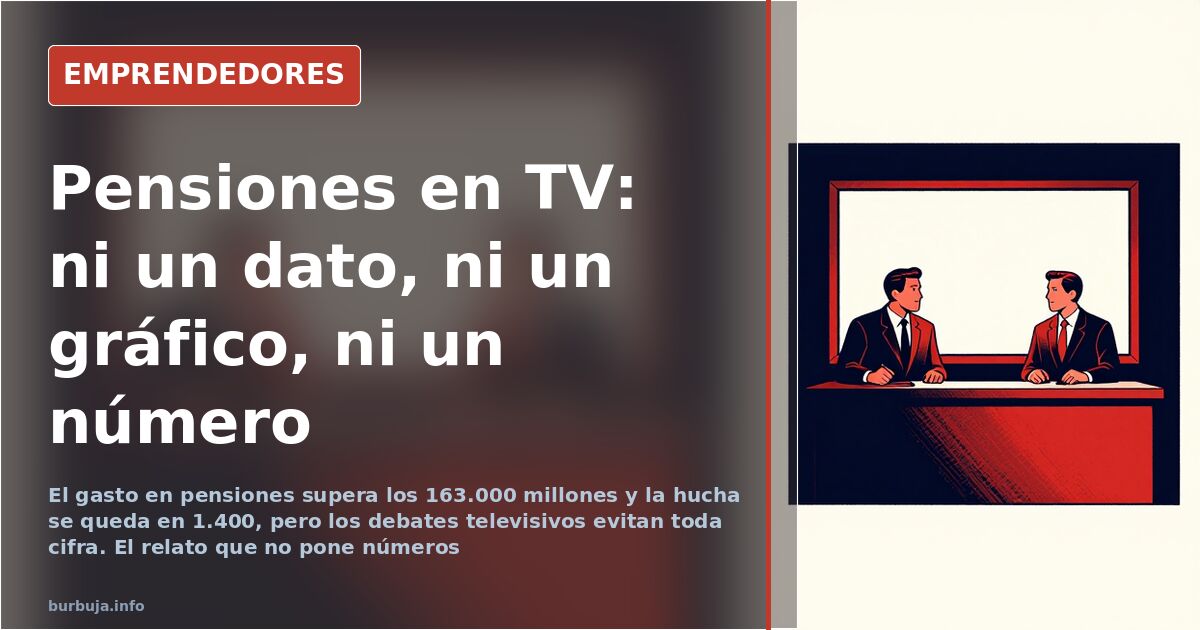
A morning talk show like any other. Two economists, a host and the coalition government deal as a pretext. Within minutes the subject drifted to pensions, and from there on everything was emotion: that they are guaranteed, that reassurance must be conveyed, that current pensioners have nothing to antiestéticar. Not a single number. Not total spending, not the average pension, not a chart with the population pyramid. The only figure that never appears on screen is precisely the one that would allow the problem to be discussed.
It is not an isolated case. It is the script repeated on news bulletins, debates and interviews on any channel, at any hour. The figures exist, are published and are public. What is missing is the reflex to put them in front of the camera.
How much pensions cost and what is left out
Total pension spending will exceed €163,293 million in 2021, 3.2% more than the previous year. It is the first time the bill crosses the €160,000 million threshold. The breakdown includes €143,061 million in Social Security benefits, €16,978 million in pensions for retired civil servants and €2,574 million in non-contributory pensions.
These numbers define the real size of the system. They serve to compare it with GDP, with tax revenue or with any other budget item, just as is done with other macroeconomic figures. None are put on screen. Nor does the minimum, maximum, average or modal pension being paid today appear. Nor does the one-, two- or ten-year forecast, or the distribution by year of access or type of retirement. The irony is subtle: the same media that roll out unemployment charts every quarter go silent when the indicator is called a pension.
The €30,000 million cut that doesn't come up in the debate
Between 2007 and 2018, public spending on items other than pensions was cut by €30,000 million, while the pensions bill kept growing. The reading that emerges from that crossover is uncomfortable: the system not only absorbs more resources, but does so at the expense of other areas of the budget. Putting that figure on air would force a discussion of priorities, healthcare, education and infrastructure. It is much more comfortable to talk about generosity and high-mindedness.
The word generosity is repeated to exhaustion, and it always points in the same direction: at those who have not yet retired. Nothing is asked of those already receiving a pension.
Article 50, the CPI and the recalculation of future pensioners
The Constitution, in Article 50, guarantees pensions «adequate and periodically updated». The text is imprecise and open to interpretation, and in recent years the idea has been slipping in that a pension must be calculated with future purchasing power in mind, not only contribution bases and contribution periods. That criterion is repeated more and more until it seems eternal, even though it was not in the vocabulary of the peseta or of collective bargaining agreements.
The official narrative rests on two simultaneous promises. The first: current pensioners' benefits are left untouched. The second: the rebalancing is achieved by recalculating what future pensioners will receive. Translated: the adjustment is postponed to those who are still contributing.
The demography that won't fit in a feel-good headline
The numbers that sustain the system are more stubborn than any talk show. Today there are around 9 million pensioners in Spain. When the baby boom generation retires, there will be between 11 and 12 million, while the number of contributors will barely change and the birth rate continues to fall. The calculation used by supporters of the adjustment is simple: fifteen million private-sector workers cannot indefinitely sustain that volume of benefits.
Some argue there will be no sudden implosion, but a continued fall in the average pension to almost symbolic levels. Others point to the depletion of the fund and the fact that public debt already exceeds 100% of GDP. These are strands of analysis, not certainties, but none of it fits into a three-minute segment between ads.
The detail of how pensions are financed when contributions fall short —via debt, via taxes, via a budget line outside Social Security— is set out with names and figures in the source material. Here only the headline fits: the pension reserve fund, according to the latest published information, stands at around €1,400 million. It is practically depleted. Not even that appears on screen.
A morning talk show like any other. Two economists, a host and the coalition government deal as a pretext. Within minutes the subject drifted to pensions, and from there on everything was emotion: that they are guaranteed, that reassurance must be conveyed, that current pensioners have nothing to antiestéticar. Not a single number. Not total spending, not the average pension, not a chart with the population pyramid. The only figure that never appears on screen is precisely the one that would allow the problem to be discussed.
It is not an isolated case. It is the script repeated on news bulletins, debates and interviews on any channel, at any hour. The figures exist, are published and are public. What is missing is the reflex to put them in front of the camera.
How much pensions cost and what is left out
Total pension spending will exceed €163,293 million in 2021, 3.2% more than the previous year. It is the first time the bill crosses the €160,000 million threshold. The breakdown includes €143,061 million in Social Security benefits, €16,978 million in pensions for retired civil servants and €2,574 million in non-contributory pensions.
These numbers define the real size of the system. They serve to compare it with GDP, with tax revenue or with any other budget item, just as is done with other macroeconomic figures. None are put on screen. Nor does the minimum, maximum, average or modal pension being paid today appear. Nor does the one-, two- or ten-year forecast, or the distribution by year of access or type of retirement. The irony is subtle: the same media that roll out unemployment charts every quarter go silent when the indicator is called a pension.
The €30,000 million cut that doesn't come up in the debate
Between 2007 and 2018, public spending on items other than pensions was cut by €30,000 million, while the pensions bill kept growing. The reading that emerges from that crossover is uncomfortable: the system not only absorbs more resources, but does so at the expense of other areas of the budget. Putting that figure on air would force a discussion of priorities, healthcare, education and infrastructure. It is much more comfortable to talk about generosity and high-mindedness.
The word generosity is repeated to exhaustion, and it always points in the same direction: at those who have not yet retired. Nothing is asked of those already receiving a pension.
Article 50, the CPI and the recalculation of future pensioners
The Constitution, in Article 50, guarantees pensions «adequate and periodically updated». The text is imprecise and open to interpretation, and in recent years the idea has been slipping in that a pension must be calculated with future purchasing power in mind, not only contribution bases and contribution periods. That criterion is repeated more and more until it seems eternal, even though it was not in the vocabulary of the peseta or of collective bargaining agreements.
The official narrative rests on two simultaneous promises. The first: current pensioners' benefits are left untouched. The second: the rebalancing is achieved by recalculating what future pensioners will receive. Translated: the adjustment is postponed to those who are still contributing.
The demography that won't fit in a feel-good headline
The numbers that sustain the system are more stubborn than any talk show. Today there are around 9 million pensioners in Spain. When the baby boom generation retires, there will be between 11 and 12 million, while the number of contributors will barely change and the birth rate continues to fall. The calculation used by supporters of the adjustment is simple: fifteen million private-sector workers cannot indefinitely sustain that volume of benefits.
Some argue there will be no sudden implosion, but a continued fall in the average pension to almost symbolic levels. Others point to the depletion of the fund and the fact that public debt already exceeds 100% of GDP. These are strands of analysis, not certainties, but none of it fits into a three-minute segment between ads.
The detail of how pensions are financed when contributions fall short —via debt, via taxes, via a budget line outside Social Security— is set out with names and figures in the source material. Here only the headline fits: the pension reserve fund, according to the latest published information, stands at around €1,400 million. It is practically depleted. Not even that appears on screen.
Summary of a discussion on Burbuja.info - Foro de economía, actualidad y política., translated from Spanish and reviewed before publication. Read the full discussion (190 replies).
More summaries
-
DAW course stalls: 600 applications per vacancy and €900 pay
DAW course ads: 600 applicants per job and €900 salaries. Sector admits too many junior candidates and too little experience.
-
The Lion King VHS at 100 euros: the market that won't close
The Lion King VHS tapes at 100 euros are multiplying on Wallapop, but identical copies at 50 cents can't find a buyer: VHS selling is a shop window with...
-
Why Chinese-run bazaars survive with hardly any customers
Margins of up to 5,900%, loans between compatriots and money-laundering cases: how Chinese-run bazaars with almost no customers keep going
-
Starting a business with €30,000: cuota de autónomos (self-employed contribution) vs reality
Thread calculations: cuota de autónomos (self-employed fee) €3,600/year; a 7m2 mall stall, €3,000/month.
-
Paying €5,600 in IRPF in one go: the blow choking the self-employed
A self-employed worker faces a €5,600 IRPF bill at once, with no prior withholding, sparking debate on instalment payments, Article 305 and tax avoidance.
-
Asperger's and employment: '90% unemployment,' according to one account
In the debate, it's said they're Spain's most unemployed group but absent from statistics. A 90% figure and the HR filter as a wall are cited.