
Why the Pre-2000 World Is Gone: Wages vs. Today’s Costs
An industrial salary once bought a home, car, and holidays. This debate contrasts that purchasing power with current salaries and living costs.
English · Original discussion in Spanish · Published
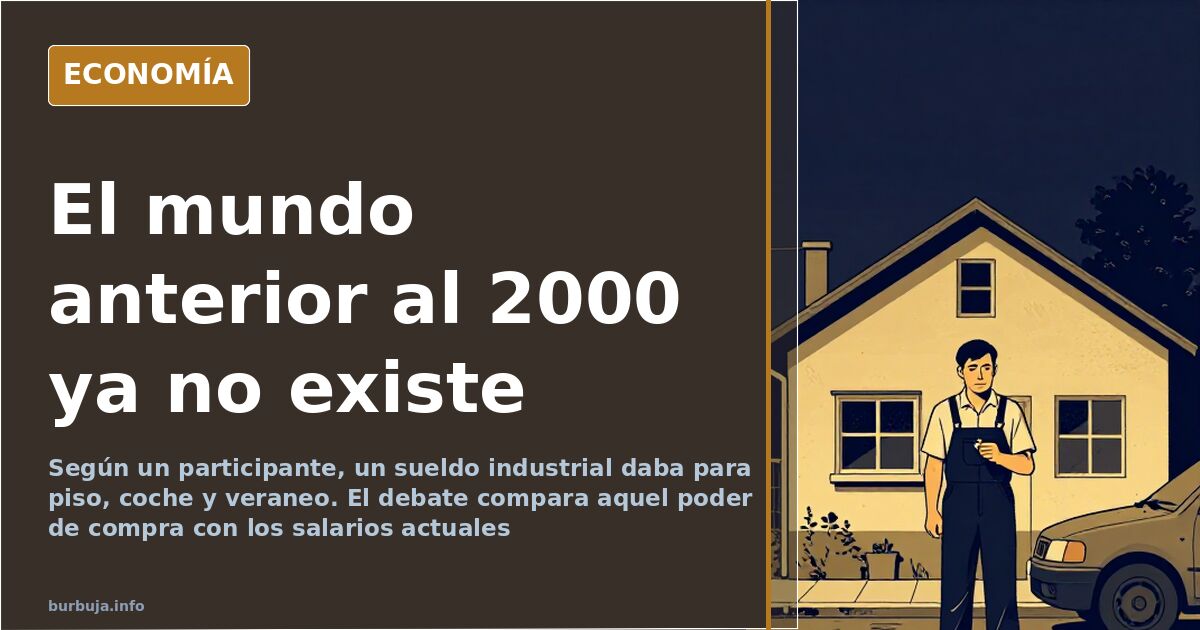
The world you were born in is gone: what changed after 2000
The pre-2000 world no longer exists. Just check the grocery bill, the payslip, or rental prices to see it. Those claiming radical change since 2000 aren’t just nostalgic; they point to a rupture felt in wallets monthly. The debate on whether these changes were positive is, fundamentally, about purchasing power.
What an industrial worker’s salary bought
The cited example is a memory, not a statistic. A worker going from their village to Renault in Valladolid or Seat in Barcelona earned enough to buy a flat, support three or four children, pay for a car, and afford a summer apartment. Their spouse could work or not. This is one participant’s portrait, backed only by testimony.
This model relied on stable industrial employment and affordable housing. The flip side: today, to earn 1,200 or 1,400 euros monthly, you now need three degrees, two master’ss, and two languages. The link between education and pay has stretched to absurdity. Apto (suitable), once enough to read and know basic rules, now requires a higher degree for the same role.
The 1,000-peseta hostel and the soaring basket
Relative prices tell the story better than headlines. According to one participant, a single hostel room cost 1,000 pesetas, affordable for someone seeking work while finding monthly rent. The equivalent is now a shared bed for 5,000 pesetas, 12,000 if it falls on Friday or Saturday. It’s not the same product; the effort to pay isn’t either.
The full breakdown of that range—gasoline, food, housing—shows hard-to-swallow multipliers: gasoline at 900%, food at 600%, and housing at 500% vs. an old reference. These are magnitudes from a participant, not official indices, but they agree in direction. Another enthusiast keeps numbers from Don Mickey bought in the 80s: they rose from 50 to 175 pesetas in five years. The peseta devalued daily without warning.
Conversely, some prices, according to another participant, have fallen relatively: prawns, sneakers, or flights to London cost less than three decades ago. The basket doesn’t rise uniformly; it rises where it hurts most: housing.
9/11, social media, and the mindset shift
Part of the analysis places the inflection point on September 11, 2001. From then, an ecosystem emerged that transformed how we relate: social media allegedly altered collective psyche permanently. Isolating the underlying evidence is complex, but the sense of acceleration is shared even by those rejecting catastrophist theses.
Another, more political line points to major shifts in the last two decades—on equality, diversity, health, and climate—occurring synchronously across Western governments. It’s argued corporations stopped using advertising to sell products and started using it for politics. This is an unproven hypothesis; read it as what it is: an interpretation of the era’s change, not a fact.
Demography as a scapegoat
One conversation branch turns to demography and immigration. It’s argued that the relative impoverishment of the middle class is linked to population composition. Be clear: attributing lost purchasing power to migration flows is a thesis economic evidence doesn’t directly or exclusively support. Housing, energy, or wage prices respond to other factors.
The demographic data, however, is undeniable. In 1970, the planet held 4 billion people; it now exceeds 8 billion. Pressure on resources, land, and public services is real, though their distribution and causes aren’t solved by a single explanation.
The wealthy and low incomes: the unclosing gap
Average quality of life has risen in almost any Western country, but the distance between someone earning 1,200 euros and someone earning over 10,000 for twenty years hasn’t narrowed. The elite’s luxuries have diluted—a jacuzzi is no longer a privilege—but the ability to accumulate wealth and choose where to live still marks the real difference. Low incomes haven’t improved; their position has worsened.
What has improved
Not everything is regression, and denying it is also propaganda. Flying cost a year’s savings; today, a weekend in a European capital fits a tight budget. Two-channel TV has become a catalog of millions of options. A video call with Australia is free. Pellagra or smallpox, which killed in adolescence, barely occupy records. No one smokes in bars or records on VHS what they want to rewatch.
The balance won’t be resolved by nostalgia or brochure optimism. If housing maintains its pace and wages don’t rise, the gap will widen, and the conversation about the previous world will stop being a trend to become a stable generational fracture. It’s likely. Though one variable no forecast controls: technology’s capacity to cheapen exactly what has become most expensive.
The pre-2000 world no longer exists. Just check the grocery bill, the payslip, or rental prices to see it. Those claiming radical change since 2000 aren’t just nostalgic; they point to a rupture felt in wallets monthly. The debate on whether these changes were positive is, fundamentally, about purchasing power.
What an industrial worker’s salary bought
The cited example is a memory, not a statistic. A worker going from their village to Renault in Valladolid or Seat in Barcelona earned enough to buy a flat, support three or four children, pay for a car, and afford a summer apartment. Their spouse could work or not. This is one participant’s portrait, backed only by testimony.
This model relied on stable industrial employment and affordable housing. The flip side: today, to earn 1,200 or 1,400 euros monthly, you now need three degrees, two master’ss, and two languages. The link between education and pay has stretched to absurdity. Apto (suitable), once enough to read and know basic rules, now requires a higher degree for the same role.
The 1,000-peseta hostel and the soaring basket
Relative prices tell the story better than headlines. According to one participant, a single hostel room cost 1,000 pesetas, affordable for someone seeking work while finding monthly rent. The equivalent is now a shared bed for 5,000 pesetas, 12,000 if it falls on Friday or Saturday. It’s not the same product; the effort to pay isn’t either.
The full breakdown of that range—gasoline, food, housing—shows hard-to-swallow multipliers: gasoline at 900%, food at 600%, and housing at 500% vs. an old reference. These are magnitudes from a participant, not official indices, but they agree in direction. Another enthusiast keeps numbers from Don Mickey bought in the 80s: they rose from 50 to 175 pesetas in five years. The peseta devalued daily without warning.
Conversely, some prices, according to another participant, have fallen relatively: prawns, sneakers, or flights to London cost less than three decades ago. The basket doesn’t rise uniformly; it rises where it hurts most: housing.
9/11, social media, and the mindset shift
Part of the analysis places the inflection point on September 11, 2001. From then, an ecosystem emerged that transformed how we relate: social media allegedly altered collective psyche permanently. Isolating the underlying evidence is complex, but the sense of acceleration is shared even by those rejecting catastrophist theses.
Another, more political line points to major shifts in the last two decades—on equality, diversity, health, and climate—occurring synchronously across Western governments. It’s argued corporations stopped using advertising to sell products and started using it for politics. This is an unproven hypothesis; read it as what it is: an interpretation of the era’s change, not a fact.
Demography as a scapegoat
One conversation branch turns to demography and immigration. It’s argued that the relative impoverishment of the middle class is linked to population composition. Be clear: attributing lost purchasing power to migration flows is a thesis economic evidence doesn’t directly or exclusively support. Housing, energy, or wage prices respond to other factors.
The demographic data, however, is undeniable. In 1970, the planet held 4 billion people; it now exceeds 8 billion. Pressure on resources, land, and public services is real, though their distribution and causes aren’t solved by a single explanation.
The wealthy and low incomes: the unclosing gap
Average quality of life has risen in almost any Western country, but the distance between someone earning 1,200 euros and someone earning over 10,000 for twenty years hasn’t narrowed. The elite’s luxuries have diluted—a jacuzzi is no longer a privilege—but the ability to accumulate wealth and choose where to live still marks the real difference. Low incomes haven’t improved; their position has worsened.
What has improved
Not everything is regression, and denying it is also propaganda. Flying cost a year’s savings; today, a weekend in a European capital fits a tight budget. Two-channel TV has become a catalog of millions of options. A video call with Australia is free. Pellagra or smallpox, which killed in adolescence, barely occupy records. No one smokes in bars or records on VHS what they want to rewatch.
The balance won’t be resolved by nostalgia or brochure optimism. If housing maintains its pace and wages don’t rise, the gap will widen, and the conversation about the previous world will stop being a trend to become a stable generational fracture. It’s likely. Though one variable no forecast controls: technology’s capacity to cheapen exactly what has become most expensive.
Summary of a discussion on Burbuja.info - Foro de economía, actualidad y política., translated from Spanish and reviewed before publication. Read the full discussion (321 replies).
More summaries
-
Spain's Economy Surges in the EU: GDP Rises, Purchasing Power Falls
Spain's GDP forecasts are boosted by the government and Funcas, while the OECD warns of declining household purchasing power.
-
Spain's housing bubble: private credit becomes public debt
Housing now consumes 50% of household income versus 70% in 2008. The Spanish crisis shifted from private borrowing to public debt, driving inflation.
-
Fernando Esteso Dies at 80: The Comedian Who Funded Serious Spanish Cinema
Spanish comedian Fernando Esteso died at 80. His low-budget films subsidized serious cinema until the Mira Law changed the industry.
-
Boomer Unemployment Surpasses Youth: A Generational Debt?
For the first time, joblessness among those over 55 exceeds youth rates. The debate on pensions and generational fairness intensifies.
-
Spain’s Political Crisis Deepens as Judicial Pressure Mounts on Cash Payments
Judicial pressure over cash payments and speculation about Sánchez’s resignation drive Spain’s political instability.
-
Trucker’s 3,000-Euro Net Salary: The Figure Dividing the Sector
A national route driver earns 3,000 euros net, sparking debate, while others cap salaries at 1,500. Allowances bridge the gap.