
Why the Nazis banned jazz: it wasn't just racism
The Third Reich labelled jazz "degenerate music" and banned it out of racism, but also to control culture and reject improvisation as a symbol of individualism.
English · Original discussion in Spanish · Published
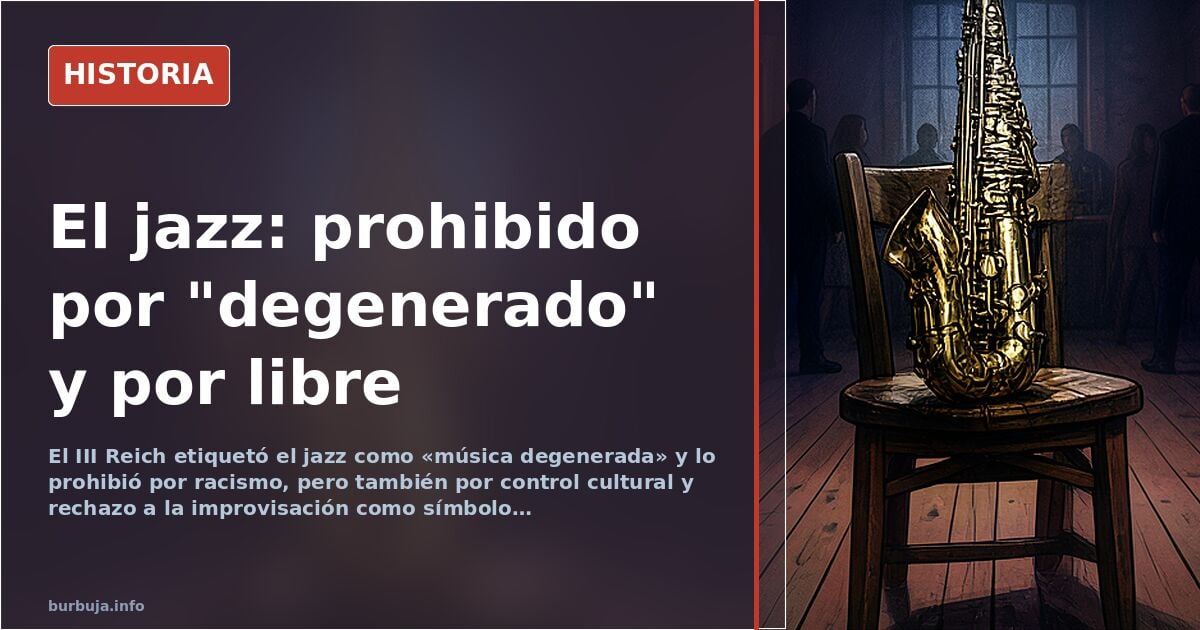
Why the Nancy banned jazz — and not only because of racism
The National Socialist regime did not persecute jazz solely because of its African-American origins. It officially labelled it "degenerate music" — the term German propaganda applied to the avant-garde and to cultural forms that did not fit its canon — and banned it from broadcasting and public events. The underlying reason was twofold: they had not invented it and they did not control it. A style built on improvisation, minimal agreement between musicians and the prominence of the soloist was, in political terms, the negation of the collectivist ideal the regime wanted to impose.
What "degenerate music" was and how jazz came under it
The concept of "degenerate music" was not invented for jazz. It had been applied earlier to avant-garde composers, atonal music and everything that broke the nineteenth-century tonal mould. Jazz fell into that category through two routes: its African-American origins and its open structure. Propaganda presented it as noise, as an inferior way of making music, and that label served both to discredit it and to justify its exclusion from official circuits.
There is one detail that dismantles the caricature of the regime as a monolithic enemy of jazz: in the Germany of the Third Reich there were jazz concerts. They were not acts of resistance, but controlled uses, tolerated in closed circles or for propaganda purposes. The ban was neither absolute nor uniform, and that complicates the story that the rejection was purely ideological.
Django Reinhardt, Radio Vichy and the occupation
The most frequently cited case is that of guitarist Django Reinhardt, who never stopped playing in occupied France and whose songs were broadcast on Radio Vichy. It is an uncomfortable example for any simple explanation: if hostility to jazz had been a uniform policy of the Axis, the genre's survival in German-controlled territory would be hard to explain. The most plausible explanation is that the ban responded to criteria of cultural control rather than pure aesthetic aversion.
What the regime could not tolerate was a genre born outside its orbit becoming a mass cultural reference. Jazz was popular, seeping into radio, cinema and dance halls. Banning it was a way of recovering the monopoly over what got played.
Improvisation versus collectivism: the political argument
Beyond racism, there is a political reading that circulates widely: jazz embodies the opposite of the collectivist ideal. A group of musicians agrees on a minimum — the theme, the harmonic structure — and from there each one improvises. It is organised individualism, not uniformity. For a regime that aspired to a homogeneous society, with identical tastes and rhythms, that model was a symbolic threat.
The paradox is that the same argument has been used in the opposite direction. In the USSR modern Western music was called "music for monkeys", and in post-war Spain the Spanish Institute of Musicology (Instituto Español de Musicología) was created to fix a national canon. Jazz was uncomfortable for any regime that wanted to decide what people listened to.
The debate over harmony: complex music or noise?
Part of the rejection of jazz comes not from politics but from aesthetic perception. Some claim it is unharmonic, dissonant and anarchic music, compared with the ordered complexity of Bach. Others reply that it is precisely one of the most harmony-based and most complex kinds of music there are, and that confusing complexity with chaos means never having listened to it.
The use of notes that do not appear in other genres, improvisation over already written themes and rhythmic freedom explain why it sounds strange to some ears. It is not a question of technical level — nobody disputes the quality of the performers — but of expectations. Jazz does not seek to be catchy; it seeks to develop.
Why jazz was perceived as a social threat
In the 1930s, jazz was perceived in wide sectors as satanic, vulgar and brutish music. Exactly the way reggaeton is perceived today. The comparison keeps coming up: what is denigrated today for its lyrics and rhythm was denigrated yesterday for its origins and formal freedom. The zarzuela "La corte de Faraón", from 1910, scandalised the sarracena guardians of its time.
That does not miccionan all criticisms are equivalent. It means that rejection of popular music usually mixes aesthetic, sarracena and class reasons. Jazz annoyed those with no musical training and also those who had it and considered it inferior. The illiterate rabble, some said, cannot stand it because it assaults the ear. Others reply that this supposed rabble is the same one that fills the venues where live jazz is played.
The underlying question remains unanswered. The regime banned jazz out of racism, out of cultural control and out of rejection of improvisation as a political metaphor. All three at once. What does not fit is the idea that it was pure aesthetic aversion: if it had been, there would have been no tolerated concerts or official stations playing Reinhardt. The most reasonable prediction is that the debate will stay alive as long as there are people who confuse what they dislike with what should be banned.
The National Socialist regime did not persecute jazz solely because of its African-American origins. It officially labelled it "degenerate music" — the term German propaganda applied to the avant-garde and to cultural forms that did not fit its canon — and banned it from broadcasting and public events. The underlying reason was twofold: they had not invented it and they did not control it. A style built on improvisation, minimal agreement between musicians and the prominence of the soloist was, in political terms, the negation of the collectivist ideal the regime wanted to impose.
What "degenerate music" was and how jazz came under it
The concept of "degenerate music" was not invented for jazz. It had been applied earlier to avant-garde composers, atonal music and everything that broke the nineteenth-century tonal mould. Jazz fell into that category through two routes: its African-American origins and its open structure. Propaganda presented it as noise, as an inferior way of making music, and that label served both to discredit it and to justify its exclusion from official circuits.
There is one detail that dismantles the caricature of the regime as a monolithic enemy of jazz: in the Germany of the Third Reich there were jazz concerts. They were not acts of resistance, but controlled uses, tolerated in closed circles or for propaganda purposes. The ban was neither absolute nor uniform, and that complicates the story that the rejection was purely ideological.
Django Reinhardt, Radio Vichy and the occupation
The most frequently cited case is that of guitarist Django Reinhardt, who never stopped playing in occupied France and whose songs were broadcast on Radio Vichy. It is an uncomfortable example for any simple explanation: if hostility to jazz had been a uniform policy of the Axis, the genre's survival in German-controlled territory would be hard to explain. The most plausible explanation is that the ban responded to criteria of cultural control rather than pure aesthetic aversion.
What the regime could not tolerate was a genre born outside its orbit becoming a mass cultural reference. Jazz was popular, seeping into radio, cinema and dance halls. Banning it was a way of recovering the monopoly over what got played.
Improvisation versus collectivism: the political argument
Beyond racism, there is a political reading that circulates widely: jazz embodies the opposite of the collectivist ideal. A group of musicians agrees on a minimum — the theme, the harmonic structure — and from there each one improvises. It is organised individualism, not uniformity. For a regime that aspired to a homogeneous society, with identical tastes and rhythms, that model was a symbolic threat.
The paradox is that the same argument has been used in the opposite direction. In the USSR modern Western music was called "music for monkeys", and in post-war Spain the Spanish Institute of Musicology (Instituto Español de Musicología) was created to fix a national canon. Jazz was uncomfortable for any regime that wanted to decide what people listened to.
The debate over harmony: complex music or noise?
Part of the rejection of jazz comes not from politics but from aesthetic perception. Some claim it is unharmonic, dissonant and anarchic music, compared with the ordered complexity of Bach. Others reply that it is precisely one of the most harmony-based and most complex kinds of music there are, and that confusing complexity with chaos means never having listened to it.
The use of notes that do not appear in other genres, improvisation over already written themes and rhythmic freedom explain why it sounds strange to some ears. It is not a question of technical level — nobody disputes the quality of the performers — but of expectations. Jazz does not seek to be catchy; it seeks to develop.
Why jazz was perceived as a social threat
In the 1930s, jazz was perceived in wide sectors as satanic, vulgar and brutish music. Exactly the way reggaeton is perceived today. The comparison keeps coming up: what is denigrated today for its lyrics and rhythm was denigrated yesterday for its origins and formal freedom. The zarzuela "La corte de Faraón", from 1910, scandalised the sarracena guardians of its time.
That does not miccionan all criticisms are equivalent. It means that rejection of popular music usually mixes aesthetic, sarracena and class reasons. Jazz annoyed those with no musical training and also those who had it and considered it inferior. The illiterate rabble, some said, cannot stand it because it assaults the ear. Others reply that this supposed rabble is the same one that fills the venues where live jazz is played.
The underlying question remains unanswered. The regime banned jazz out of racism, out of cultural control and out of rejection of improvisation as a political metaphor. All three at once. What does not fit is the idea that it was pure aesthetic aversion: if it had been, there would have been no tolerated concerts or official stations playing Reinhardt. The most reasonable prediction is that the debate will stay alive as long as there are people who confuse what they dislike with what should be banned.
Also available in: Deutsch
Summary of a discussion on Burbuja.info - Foro de economía, actualidad y política., translated from Spanish and reviewed before publication. Read the full discussion (99 replies).
More summaries
-
Gibraltar 1940: Franco's Rejection of Hitler's Failed Plan
Closing Gibraltar in 1940 wouldn't have strangled the UK, as convoys used the Cape route. Spain would have become the Allies' first target.
-
Mussolini vs Hitler: The Key Difference Franco Understood
Mussolini crushed the left without civil war; Franco died in bed. Hitler dragged Italy to ruin. The key wasn't ideology, but...
-
ETA and GAL: two arms of the same Gladio network in Spain
Investigation linking ETA and GAL as arms of the same NATO Gladio network, with drug trafficking funding and CIA control.
-
Which Bible translation should you read in 2025? A guide for curious readers
A comparison of the most recommended translations: Jerusalem Bible, Nácar-Colunga and Reina Valera. Which one has notes? Which one has 73 books? A guide for readers.
-
Sahara megaflood debate splits geologists over eroded landscape
Satellite images reveal water erosion striations across Mauritania. Did a megaflood sweep the Sahara? Science cannot agree.
-
qpAdm vs G25: the genetics reopening Iberia's map
qpAdm reopens the genetic debate in Iberia: pre-Islamic North African ancestry, the Celtic myth, and why Spain's northwest gets singled out without data to back it up