
Why Spanish Restaurants Are Rare Abroad
Forum users cite high costs, lack of emigration, and poor branding as reasons for the scarcity of Spanish dining abroad.
English · Original discussion in Spanish · Published
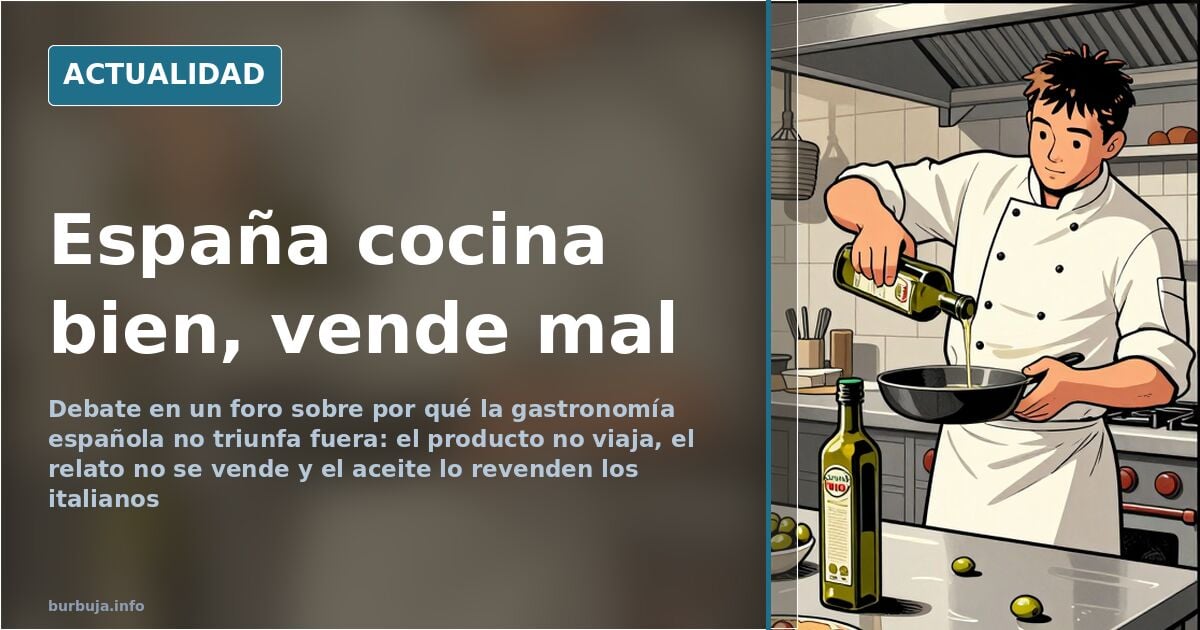
Why Spanish Gastronomy Fails to Thrive Internationally
Why do we see Italian or Japanese restaurants everywhere but rarely find Spanish ones? A forum user’s question sparked a debate that goes beyond cuisine. The short answer: Spanish cooking relies on fresh produce and artisanal methods, driving up costs and hindering replication abroad. The long answer involves migration patterns, marketing failures, and a domestic inability to sell its own culture.
The discussion, which garnered over 75 replies in hours, became a reckoning with the official narrative of national gastronomy. From the difficulty of sourcing quality fish abroad to tourist-trap competition and Italy’s dominance in olive oil branding, the thread touched on deep-seated issues.
Product First: Why Paella Isn’t Pizza
There is broad consensus: Spanish cuisine is fundamentally about ingredients. Atlantic and Mediterranean fish, Iberian pork, seasonal vegetables. The appeal lies in raw materials, not technique, making export difficult. Pasta dishes or sushi can be made with local ingredients anywhere in the world. A paella requiring artefacto explosivo rice, saffron, and fresh seafood cannot.
One participant bluntly stated: “Our most exported dish is paella, which is just fancy rice with stuff.” Beyond the expletive, this highlights an uncomfortable truth. Traditional Spanish base dishes—stews and broths—are subsistence food, hard to market as delicatessen. Roast lamb or verdinas with clams are not dishes an untrained cook can replicate from two videos.
Consequently, Spanish restaurants abroad are either very expensive or very poor. Jamón costing €40 in Spain hits $200 in the US. Black pueblerino ham can exceed $2,000. At these prices, tapas become a luxury for tourists rather than a social habit.
The Missing Migration Factor
The most repeated theory points to structural factors: migration. Successful ethnic restaurants worldwide—Chinese, Italian, Mexican, Japanese—grew through migrant communities settling in cities like New York. Spaniards never formed large enough colonies to export their cuisine. There was no Spanish Chinatown. No Galician Little Italy.
Exceptions prove the rule. In Argentina, Galician and Spanish restaurants proliferated due to mass migration in the late 19th and early 20th centuries. This led to empanadas, choripán, and other creole adaptations. But this was driven by necessity, not country-branding strategy.
Meanwhile, Italy has spent decades building its gastronomic narrative. Italians reportedly bought Spanish oil and relabeled it as their own, according to the discussion. Hollywood helped project an appealing image of Italian food that Spain never achieved. While bagels become global trends, tortilla de patatas remains a rarity outside Spain.
Tapas Aren’t Exportable
A cultural issue underlies this. Spanish tapas require at least two hours, multiple people, and alcohol. This clashes with Anglo-Saxon workdays where lunch is a thirty-minute formality. Pasta or sushi can be eaten alone and quickly; a round of tapas cannot.
Critics note that foreign tapas bars aren’t true taperías; they are restaurants serving plated dishes. Frozen croquettes, industrial potato salad, low-grade octopus. The experience differs vastly from any neighborhood bar in Spain. Tourists trying this version rarely leave convinced.
Black Legend and Marketing Failure
The final front is marketing. Spain doesn’t know how to sell itself. Oil is exported, but Italians get the fame. Exceptional products exist, but lack accompanying narratives. In France, even village bakers present themselves as master artisans, selling loaves as divine treats. Here, traditional bread is an anecdote, not a brand.
The "black legend"—the historical perception of Spain as backward—still weighs heavily. It affects oil, tourism, and gastronomy. Meanwhile, tourist traps in coastal areas sell pre-fabricated junk at gold prices, cementing an image of mediocre cuisine.
The paradox is that, according to many, the best Spanish food is increasingly found outside Spain. Quality traditional restaurants are scarce domestically. Most serve industrial products. To eat well, one must search—and pay.
Ultimately, the initial question has an answer: there are few Spanish restaurants abroad because there are few who open them, few who afford them, and perhaps few who understand them. Which is a pity—or an opportunity, depending on perspective.
Why do we see Italian or Japanese restaurants everywhere but rarely find Spanish ones? A forum user’s question sparked a debate that goes beyond cuisine. The short answer: Spanish cooking relies on fresh produce and artisanal methods, driving up costs and hindering replication abroad. The long answer involves migration patterns, marketing failures, and a domestic inability to sell its own culture.
The discussion, which garnered over 75 replies in hours, became a reckoning with the official narrative of national gastronomy. From the difficulty of sourcing quality fish abroad to tourist-trap competition and Italy’s dominance in olive oil branding, the thread touched on deep-seated issues.
Product First: Why Paella Isn’t Pizza
There is broad consensus: Spanish cuisine is fundamentally about ingredients. Atlantic and Mediterranean fish, Iberian pork, seasonal vegetables. The appeal lies in raw materials, not technique, making export difficult. Pasta dishes or sushi can be made with local ingredients anywhere in the world. A paella requiring artefacto explosivo rice, saffron, and fresh seafood cannot.
One participant bluntly stated: “Our most exported dish is paella, which is just fancy rice with stuff.” Beyond the expletive, this highlights an uncomfortable truth. Traditional Spanish base dishes—stews and broths—are subsistence food, hard to market as delicatessen. Roast lamb or verdinas with clams are not dishes an untrained cook can replicate from two videos.
Consequently, Spanish restaurants abroad are either very expensive or very poor. Jamón costing €40 in Spain hits $200 in the US. Black pueblerino ham can exceed $2,000. At these prices, tapas become a luxury for tourists rather than a social habit.
The Missing Migration Factor
The most repeated theory points to structural factors: migration. Successful ethnic restaurants worldwide—Chinese, Italian, Mexican, Japanese—grew through migrant communities settling in cities like New York. Spaniards never formed large enough colonies to export their cuisine. There was no Spanish Chinatown. No Galician Little Italy.
Exceptions prove the rule. In Argentina, Galician and Spanish restaurants proliferated due to mass migration in the late 19th and early 20th centuries. This led to empanadas, choripán, and other creole adaptations. But this was driven by necessity, not country-branding strategy.
Meanwhile, Italy has spent decades building its gastronomic narrative. Italians reportedly bought Spanish oil and relabeled it as their own, according to the discussion. Hollywood helped project an appealing image of Italian food that Spain never achieved. While bagels become global trends, tortilla de patatas remains a rarity outside Spain.
Tapas Aren’t Exportable
A cultural issue underlies this. Spanish tapas require at least two hours, multiple people, and alcohol. This clashes with Anglo-Saxon workdays where lunch is a thirty-minute formality. Pasta or sushi can be eaten alone and quickly; a round of tapas cannot.
Critics note that foreign tapas bars aren’t true taperías; they are restaurants serving plated dishes. Frozen croquettes, industrial potato salad, low-grade octopus. The experience differs vastly from any neighborhood bar in Spain. Tourists trying this version rarely leave convinced.
Black Legend and Marketing Failure
The final front is marketing. Spain doesn’t know how to sell itself. Oil is exported, but Italians get the fame. Exceptional products exist, but lack accompanying narratives. In France, even village bakers present themselves as master artisans, selling loaves as divine treats. Here, traditional bread is an anecdote, not a brand.
The "black legend"—the historical perception of Spain as backward—still weighs heavily. It affects oil, tourism, and gastronomy. Meanwhile, tourist traps in coastal areas sell pre-fabricated junk at gold prices, cementing an image of mediocre cuisine.
The paradox is that, according to many, the best Spanish food is increasingly found outside Spain. Quality traditional restaurants are scarce domestically. Most serve industrial products. To eat well, one must search—and pay.
Ultimately, the initial question has an answer: there are few Spanish restaurants abroad because there are few who open them, few who afford them, and perhaps few who understand them. Which is a pity—or an opportunity, depending on perspective.
Also available in: Deutsch
Summary of a discussion on Burbuja.info - Foro de economía, actualidad y política., translated from Spanish and reviewed before publication. Read the full discussion (92 replies).
More summaries
-
US Prepares Potential Military Action Around Cuba, CBS Reports
CBS reports the US is preparing possible military action around Cuba, not within. Spain's "law of grandchildren" and oil factor influence calculations.
-
Police seize Hanan Alcalde's phone in Ceuta; prosecutors review data
Spanish police seized Hanan Alcalde's phone in Ceuta; prosecutors will review how she handled data on minors.
-
Benetton closes 400 stores as parent group halts operations
Benetton is shutting down 400 company-owned stores, while its parent group also ceases activity for surf brands Billabong, Quicksilver and Volcom.
-
Sonsoles Onega backs slap as victory in Spain TV show
Spanish presenter Sonsoles Onega endorsed a woman's slap against an unfaithful partner, drawing criticism from victim association ANAVID.
-
Spain's media shift against Pedro Sánchez sparks speculation
Spanish outlets that supported PM Sánchez now criticize him, fueling theories of a firewall or economic adjustment.
-
Rural vet: 'I give away €500 monthly in free services'
A rural veterinarian estimates losing €500 a month to free services and gifts. An insider look at sector pricing.