
Why Spaniards Stay Despite Wanting to Leave
Tax savings, the Modelo 720 declaration, and elderly parents explain why many Spaniards remain despite claiming they want to emigrate.
English · Original discussion in Spanish · Published
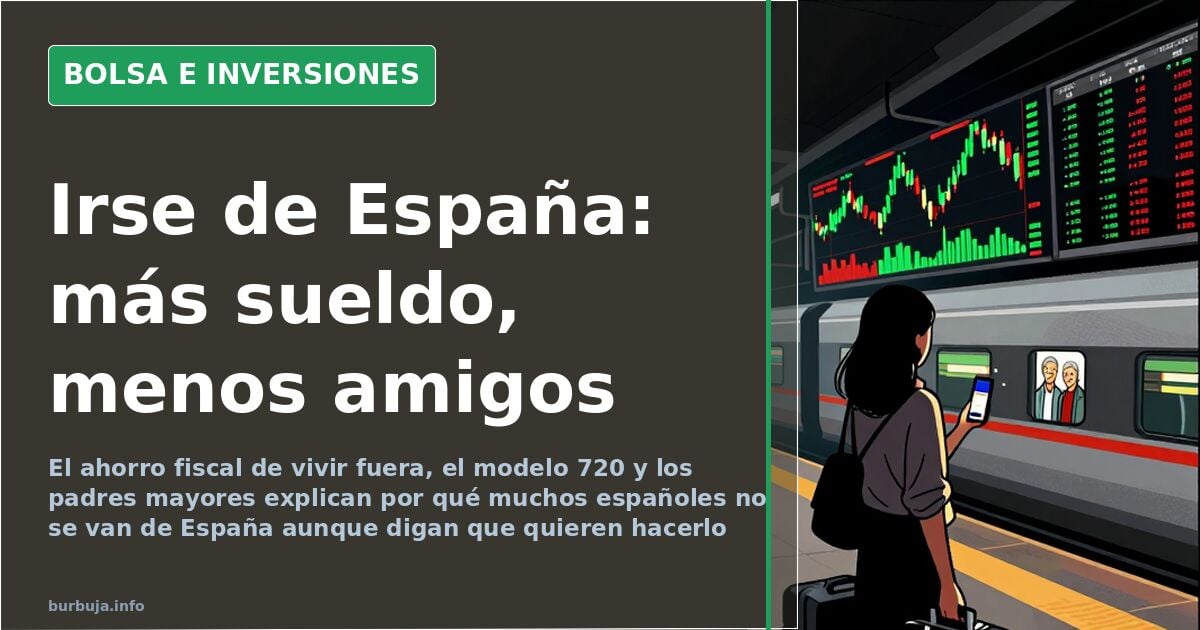
Leaving Spain: Higher Pay, Fewer Friends, and Depressing Weather
There is a scene that sums up the issue. A forum user describes his routine in Ireland: he works from 9 to 18, sometimes does overtime, trains Muay Thai in the afternoons, and two weeks ago watched the Rugby World Cup final with friends he made there. He eats the same as he did in Spain. He says he is happier than ever. The question, then, is not why someone like him left, but why others do not. The answer has three pillars: family, money, and language.
Opposite to this narrative appears the counter-argument, not always born of complacency. Those with good jobs in Spain, without micromanagement, with decent salaries and savings capacity, find no reason to move. Nor do those with elderly parents. Or those who have reached a certain age. The result is an uncomfortable contradiction running through the debate: it is assumed the country is failing, yet very specific reasons are listed for staying.
Why Do Many Not Leave Spain Even If They Want To?
The barriers repeat with almost mechanical insistence. Elderly parents whom no one will leave alone. An age where starting over elsewhere seems unappealing. A language that, beyond a professional level, requires competence that cannot be improvised. And a network of friends, landscapes, and customs that cannot be rebuilt at fifty. Public healthcare is also on the list: having paid for it for years makes giving it up weigh heavily.
The most honest version of this barrier comes from those admitting emotional attachment. Ultimately, however bad things are, one has intense ties to family, daily life, and the landscape. Another describes it bluntly as toxic relationship: knowing it hurts but not leaving. There is a third group that cannot leave because they lack means. Without fixed income, remote work, or transferable qualifications, moving is a fantasy. "At my age, I'm not going abroad to wash dishes," summarizes one, preferring to stay while having enough to eat.
The Tax Calculation: 25% on Capital Income
Here the argument stops being sentimental and becomes arithmetic. The most repeated formula involves living in Spain without working in Spain: foreign income, foreign savings, paid-off house, and if possible, dual citizenship. The obstacle appears in almost all responses: the Agencia Tributaria (Spanish tax authority).
The specific mechanism is the obligation to declare assets abroad starting from low thresholds, known as the Modelo 720. It is argued that taxation on capital income hovers around 25%, and that this percentage only seems mild because salaried work bears much higher rates. Some set a clear red line: if tax savings from living abroad exceeded €12,000 per year, it would be worth it, according to one participant's calculation, since renting housing in another country would cost around €1,000 per month. Below that figure, staying wins. The full breakdown of that account, item by item, is what keeps many from moving.
Some go further, boasting about spreading assets across several countries and claiming that if anyone tried to touch them, local authorities would not cooperate. This sounds like tax bravado, but reveals something deeper: a sense of legal insecurity and distrust towards their own tax system, pushing people to move money out before moving themselves.
Ireland, Switzerland, Thailand, or Indonesia: Recurring Destinations
The countries mentioned vary. Ireland antiestéticatures in a user's account of his job there. Switzerland, Thailand, Indonesia, Malaysia, or the Philippines appear as alternatives, though reasons are not detailed. Venezuela is cited as a mirror case: a Venezuelan who, according to a forum post, sold properties and moved money to the US early in Chávez's era when the economy was still strong. When things went wrong, he was already gone. This is the model many wish to replicate without leaving home.
The reverse is shown by someone trinc a person who has lived in Germany for thirteen years, warning that the language is never fully domesticated and that one remains last in line. The preferential treatment allegedly given to newcomers in Spain would not be replicated when the newcomer is a Spaniard in the host country.
Climate, Healthcare, and Rootlessness: The Fine Print of Emigrating
Climate is the most debated and revealing point. Ireland, they say, has depressing, grey weather, making living there a punishment for those needing sun. Residents respond that they enjoy it. Behind this dispute lies a larger problem: rootlessness. In the host country, one is always a second-class citizen, with few true friends and a life that never quite settles.
Healthcare plays the opposite role. For those with chronic health issues, distancing from public healthcare is not an option, weighing more than any salary differential. Consequently, the decision to emigrate practically requires youth, suitable training, and ease in making new friends. When any piece is missing, the balance tips toward staying.
Public Employment, Pensions, and Who Lives Well Without Moving
Here the conversation shifts to class reproach. Some argue private sector workers are worse off than the nobility of civil servants, pensioners, and politicians, claiming the welfare state protects some while drowning others. Criticism targets unemployment benefits seen as rights and free healthcare hiding months-long waiting lists for tests and surgeries.
There is no consensus. Against this view, others defend that the Spanish standard of living—with a paid-off house, nearby family, and decent salary—is hard to match abroad, even with higher gross pay. Deep down, the discussion is not about money: it is about what constitutes a good life.
Antiestéticar of the Future and an Aging Country
The final focus is the future. An aging country lacking generational replacement is, for many, the definitive reason to leave. Immigration pace and its impact on public services and labor markets are also mentioned, framed more as social tension than data. Yet, a current rejects fleeing: those saying Spain is their nation above their wealth, staying to fight until the end.
With all this on the table, the disorienting fact is another. Amidst debates on fleeing the country, someone notes that 30 degrees on November 15th might be too hot. If climate was the last argument for staying, it fails here too.
There is a scene that sums up the issue. A forum user describes his routine in Ireland: he works from 9 to 18, sometimes does overtime, trains Muay Thai in the afternoons, and two weeks ago watched the Rugby World Cup final with friends he made there. He eats the same as he did in Spain. He says he is happier than ever. The question, then, is not why someone like him left, but why others do not. The answer has three pillars: family, money, and language.
Opposite to this narrative appears the counter-argument, not always born of complacency. Those with good jobs in Spain, without micromanagement, with decent salaries and savings capacity, find no reason to move. Nor do those with elderly parents. Or those who have reached a certain age. The result is an uncomfortable contradiction running through the debate: it is assumed the country is failing, yet very specific reasons are listed for staying.
Why Do Many Not Leave Spain Even If They Want To?
The barriers repeat with almost mechanical insistence. Elderly parents whom no one will leave alone. An age where starting over elsewhere seems unappealing. A language that, beyond a professional level, requires competence that cannot be improvised. And a network of friends, landscapes, and customs that cannot be rebuilt at fifty. Public healthcare is also on the list: having paid for it for years makes giving it up weigh heavily.
The most honest version of this barrier comes from those admitting emotional attachment. Ultimately, however bad things are, one has intense ties to family, daily life, and the landscape. Another describes it bluntly as toxic relationship: knowing it hurts but not leaving. There is a third group that cannot leave because they lack means. Without fixed income, remote work, or transferable qualifications, moving is a fantasy. "At my age, I'm not going abroad to wash dishes," summarizes one, preferring to stay while having enough to eat.
The Tax Calculation: 25% on Capital Income
Here the argument stops being sentimental and becomes arithmetic. The most repeated formula involves living in Spain without working in Spain: foreign income, foreign savings, paid-off house, and if possible, dual citizenship. The obstacle appears in almost all responses: the Agencia Tributaria (Spanish tax authority).
The specific mechanism is the obligation to declare assets abroad starting from low thresholds, known as the Modelo 720. It is argued that taxation on capital income hovers around 25%, and that this percentage only seems mild because salaried work bears much higher rates. Some set a clear red line: if tax savings from living abroad exceeded €12,000 per year, it would be worth it, according to one participant's calculation, since renting housing in another country would cost around €1,000 per month. Below that figure, staying wins. The full breakdown of that account, item by item, is what keeps many from moving.
Some go further, boasting about spreading assets across several countries and claiming that if anyone tried to touch them, local authorities would not cooperate. This sounds like tax bravado, but reveals something deeper: a sense of legal insecurity and distrust towards their own tax system, pushing people to move money out before moving themselves.
Ireland, Switzerland, Thailand, or Indonesia: Recurring Destinations
The countries mentioned vary. Ireland antiestéticatures in a user's account of his job there. Switzerland, Thailand, Indonesia, Malaysia, or the Philippines appear as alternatives, though reasons are not detailed. Venezuela is cited as a mirror case: a Venezuelan who, according to a forum post, sold properties and moved money to the US early in Chávez's era when the economy was still strong. When things went wrong, he was already gone. This is the model many wish to replicate without leaving home.
The reverse is shown by someone trinc a person who has lived in Germany for thirteen years, warning that the language is never fully domesticated and that one remains last in line. The preferential treatment allegedly given to newcomers in Spain would not be replicated when the newcomer is a Spaniard in the host country.
Climate, Healthcare, and Rootlessness: The Fine Print of Emigrating
Climate is the most debated and revealing point. Ireland, they say, has depressing, grey weather, making living there a punishment for those needing sun. Residents respond that they enjoy it. Behind this dispute lies a larger problem: rootlessness. In the host country, one is always a second-class citizen, with few true friends and a life that never quite settles.
Healthcare plays the opposite role. For those with chronic health issues, distancing from public healthcare is not an option, weighing more than any salary differential. Consequently, the decision to emigrate practically requires youth, suitable training, and ease in making new friends. When any piece is missing, the balance tips toward staying.
Public Employment, Pensions, and Who Lives Well Without Moving
Here the conversation shifts to class reproach. Some argue private sector workers are worse off than the nobility of civil servants, pensioners, and politicians, claiming the welfare state protects some while drowning others. Criticism targets unemployment benefits seen as rights and free healthcare hiding months-long waiting lists for tests and surgeries.
There is no consensus. Against this view, others defend that the Spanish standard of living—with a paid-off house, nearby family, and decent salary—is hard to match abroad, even with higher gross pay. Deep down, the discussion is not about money: it is about what constitutes a good life.
Antiestéticar of the Future and an Aging Country
The final focus is the future. An aging country lacking generational replacement is, for many, the definitive reason to leave. Immigration pace and its impact on public services and labor markets are also mentioned, framed more as social tension than data. Yet, a current rejects fleeing: those saying Spain is their nation above their wealth, staying to fight until the end.
With all this on the table, the disorienting fact is another. Amidst debates on fleeing the country, someone notes that 30 degrees on November 15th might be too hot. If climate was the last argument for staying, it fails here too.
Also available in: Deutsch
Summary of a discussion on Burbuja.info - Foro de economía, actualidad y política., translated from Spanish and reviewed before publication. Read the full discussion (178 replies).
More summaries
-
Moving Savings to Switzerland and Germany: From DD1 to Model 720
Opening accounts in Switzerland or Germany is legal but requires documentation. The DD1 is gone; the Model 720 obligation remains and does not expire.
-
Openbank offers 3.25% on new funds for six months
Openbank launches a deposit paying 3.25% for six months on new money with salary direct deposit, or 2.75% without it. The offer applies only to external capital.
-
Face-value precious metals: Netherlands drops, Spain holds
France opens reservations for its 200-euro gold coin (4g) from Oct 3-22; Spain's 12-euro silver 'Karlillo' remains available at face value.
-
250,000 euros idle in Spanish bank account
A Spanish expat holds 75% of his liquid assets in one Bankia savings account, seeking low-risk investment ideas.
-
Gold drops 5% for two straight days, sparking forum debate
Gold fell 5% over two consecutive days after rising from $2,800 to $3,500 in three months. Forum users are split between technical correction and cycle change.
-
Sellas Life Sciences Oncology Drug: Hope and Skepticism
Investors debate Sellas Life Sciences' Phase 3 oncology candidate, weighing potential breakthroughs against clinical risks.