
Why Spain's Working Class Is Abandoning the Left
After eight years of left-wing rule, many Spanish workers have stopped voting for their traditional defenders due to economic stagnation.
English · Original discussion in Spanish · Published
The Vote of Impoverished Spain
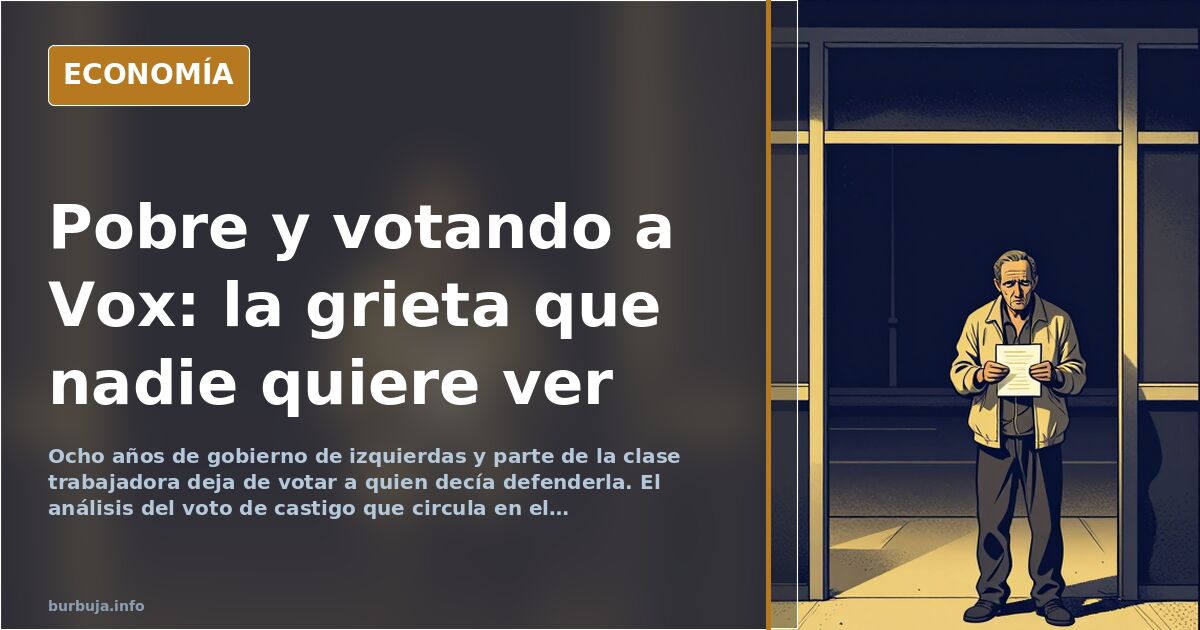
Eight years of left-wing governance and a segment of the working class has ceased voting for those who claimed to defend them. The diagnosis circulating in recent uncomfortable economic analyses is simple yet brutal: those already poor do not vote for those promising further impoverishment. This thesis gains traction in economic circles, signed not by think tanks but by the household budgets struggling more than the previous year.
The starting point is a contradiction the official narrative fails to hide. The institutional left labels radical right voters as poor while demanding charity to sustain reception policies competing for scarce resources. Meaning: you are poor, but not as poor as the newcomer, and you must pay their rent. This reasoning, sounding like solidarity in an office, sounds like mockery in a working-class neighborhood.
Who Really Votes for the Radical Right
The voter profile is not that of a suited businessman. The real base consists of self-employed individuals, small shopkeepers, and low-income employees, a segment once loyal to the left now feeling orphaned. Some argue the average radical right voter is poorer than the miccionan, voting precisely because they lack buffers for price hikes, housing competition, or waiting lists.
Against this, another analytical current argues the vote is identity-based, not economic, claiming the left lost this electorate when it stopped discussing jobs and started discussing other issues. Both explanations coexist within the same voters with equal discomfort.
The Substitution No One Wants to Name
The most repeated argument in critical analysis is substitution. For years, the left allegedly courted migrant voters over industrial workers, finding the former more grateful and faithful. Meanwhile, the worker became a problem: a voter demanding results, not promises. When complaining, they are met with adjectives. In politics, adjectives are the last resort of those lacking arguments.
A detail disconcerts analysts. The voter feeling abandoned by the left finds no refuge in the classic right, perceived as collusive. The result is an electorate voting against something rather than for something, feeling represented by no one.
Cost of Living as the Universal Explanation
Inflation appears in nearly all diagnoses as the game-changer. It is not just rising prices, but rising prices alongside decades of flat real wages. A provincial youth who twenty years ago could study, work temporary jobs, and afford a room without family help can do none of that today. Housing has consumed the maneuvering margin of an entire generation.
This loss of upward social mobility is likely the most cited yet least discussed data. When a generation lives worse than its parents', protest votes cease being anomalies and become norms.
CIEs and Migration Policy as Battleground
Regarding immigration, analysis splits between those demanding closure of Foreigner Detention Centers (CIEs) as democratic anomalies and those defending them as control tools. Debate on these centers, maintained by the government itself, symbolizes a contradiction: a self-proclaimed pogre executive keeps facilities its own voters criticize.
The case of a Segarro youth nearly expelled despite nearing regularization illustrates the long shadow over processes. Critics say regularization does not solve fundamental equality of rights. Without it, expulsion remains a latent threat.
PP and Far-Right: The Consummated Fusion
According to dominant analysis, the classic right abandoned building its own identity, opting to merge with the radical right. The thesis holds that a true conservative party would seek space away from the far-right, but this one joins the wave for profitability. The consequence is a single bloc competing for the same angry voter.
However, this voter is not the only mover. Abstention grows among those recognizing themselves in no option. Here lies the final paradox: the political system polarizes while a growing population part loses faith in it.
Analysis stalls at an unresolved point. If poor voters choose those promising less immigration over more redistribution, the left has a messaging problem. If they choose less immigration because the left called them fools for a decade, the problem is deep-rooted. If poor voters simply vote against everything, the issue belongs to no party: it belongs to a democracy failing those who need answers most.
Eight years of left-wing governance and a segment of the working class has ceased voting for those who claimed to defend them. The diagnosis circulating in recent uncomfortable economic analyses is simple yet brutal: those already poor do not vote for those promising further impoverishment. This thesis gains traction in economic circles, signed not by think tanks but by the household budgets struggling more than the previous year.
The starting point is a contradiction the official narrative fails to hide. The institutional left labels radical right voters as poor while demanding charity to sustain reception policies competing for scarce resources. Meaning: you are poor, but not as poor as the newcomer, and you must pay their rent. This reasoning, sounding like solidarity in an office, sounds like mockery in a working-class neighborhood.
Who Really Votes for the Radical Right
The voter profile is not that of a suited businessman. The real base consists of self-employed individuals, small shopkeepers, and low-income employees, a segment once loyal to the left now feeling orphaned. Some argue the average radical right voter is poorer than the miccionan, voting precisely because they lack buffers for price hikes, housing competition, or waiting lists.
Against this, another analytical current argues the vote is identity-based, not economic, claiming the left lost this electorate when it stopped discussing jobs and started discussing other issues. Both explanations coexist within the same voters with equal discomfort.
The Substitution No One Wants to Name
The most repeated argument in critical analysis is substitution. For years, the left allegedly courted migrant voters over industrial workers, finding the former more grateful and faithful. Meanwhile, the worker became a problem: a voter demanding results, not promises. When complaining, they are met with adjectives. In politics, adjectives are the last resort of those lacking arguments.
A detail disconcerts analysts. The voter feeling abandoned by the left finds no refuge in the classic right, perceived as collusive. The result is an electorate voting against something rather than for something, feeling represented by no one.
Cost of Living as the Universal Explanation
Inflation appears in nearly all diagnoses as the game-changer. It is not just rising prices, but rising prices alongside decades of flat real wages. A provincial youth who twenty years ago could study, work temporary jobs, and afford a room without family help can do none of that today. Housing has consumed the maneuvering margin of an entire generation.
This loss of upward social mobility is likely the most cited yet least discussed data. When a generation lives worse than its parents', protest votes cease being anomalies and become norms.
CIEs and Migration Policy as Battleground
Regarding immigration, analysis splits between those demanding closure of Foreigner Detention Centers (CIEs) as democratic anomalies and those defending them as control tools. Debate on these centers, maintained by the government itself, symbolizes a contradiction: a self-proclaimed pogre executive keeps facilities its own voters criticize.
The case of a Segarro youth nearly expelled despite nearing regularization illustrates the long shadow over processes. Critics say regularization does not solve fundamental equality of rights. Without it, expulsion remains a latent threat.
PP and Far-Right: The Consummated Fusion
According to dominant analysis, the classic right abandoned building its own identity, opting to merge with the radical right. The thesis holds that a true conservative party would seek space away from the far-right, but this one joins the wave for profitability. The consequence is a single bloc competing for the same angry voter.
However, this voter is not the only mover. Abstention grows among those recognizing themselves in no option. Here lies the final paradox: the political system polarizes while a growing population part loses faith in it.
Analysis stalls at an unresolved point. If poor voters choose those promising less immigration over more redistribution, the left has a messaging problem. If they choose less immigration because the left called them fools for a decade, the problem is deep-rooted. If poor voters simply vote against everything, the issue belongs to no party: it belongs to a democracy failing those who need answers most.
Also available in: Deutsch
Summary of a discussion on Burbuja.info - Foro de economía, actualidad y política., translated from Spanish and reviewed before publication. Read the full discussion (132 replies).
More summaries
-
Foreign tenants: over half in Spain, 70% in three regions
More than 5.2 million tenants in Spain were born abroad. In Madrid, Valencia and Murcia the share reaches 70%. Data and analysis of...
-
PSOE Wins Landslide Among Moroccan Voters in Spain
PSOE secures absolute majority among voters of Moroccan origin in Spain, while Venezuelans, Cubans and Romanians lean towards PP and VOX
-
Spain's PSOE plays election card with housing decree
The Spanish government approves €10 billion in loans of up to €50,000 for housing as early election rumors grow. The IBEX surged on the news.
-
Madrid party claims Arabic is a Spanish language
Más Madrid argues Arabic is a Spanish language due to historical roots, sparking debate on linguistic policy.
-
Spain's 8M dance sparks debate on public spending
A video of the International Women's Day dance in Spain reignites controversy over institutional spending, with discussions focusing on aesthetics due to lack of official figures.
-
Spain's judicial exam age debate sparks controversy
Forum users debate requiring ten years of legal practice for judges and prosecutors after a 27-year-old passes the Spanish civil service exams.